


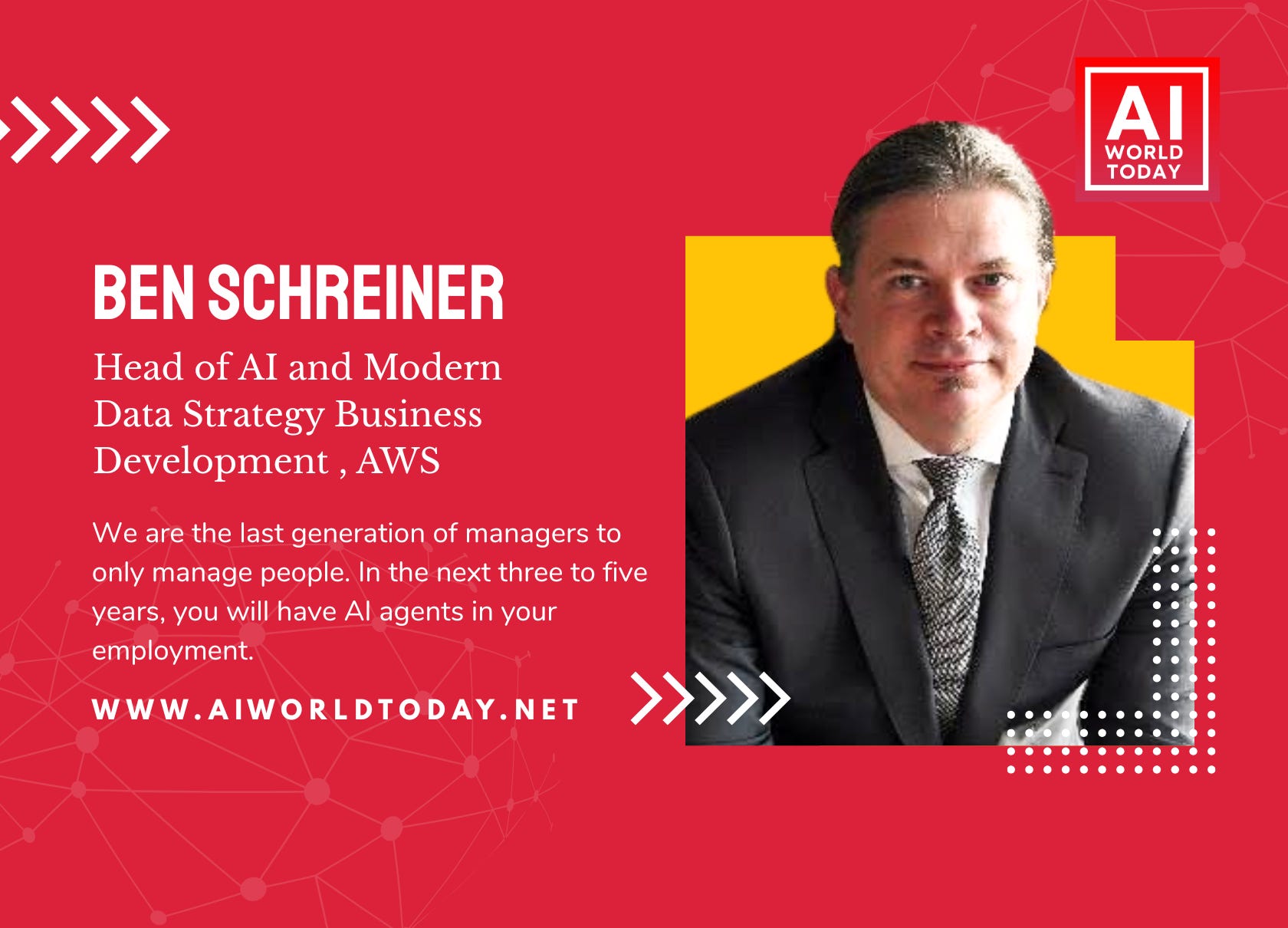
Few people understand the intersection of business strategy and emerging technology quite like Ben Schreiner. With a career spanning more than 25 years, Ben has guided some of the world’s most influential organizations through major technology transformations — from the early days of the internet revolution to today’s seismic shift driven by artificial intelligence.
Ben’s journey began in financial services, where he served as Global Head of IT Strategy and Innovation at ABN AMRO Bank in Amsterdam. After returning to the United States, he spent a decade at Dell Technologies advising organizations on digital transformation before joining Amazon Web Services (AWS), where he has been making waves for the past six and a half years. Today, Ben leads the Business Innovation team at AWS, working directly with executive teams to help them harness AI, modern data strategies, and cloud infrastructure to drive growth, efficiency, and competitive advantage.
Beyond his role at AWS, Ben is a sought-after keynote speaker on AI, cloud, big data, and security. He is also deeply committed to mentoring the next generation of CIOs and technology leaders — helping them bridge the all-important gap between business strategy and technical execution. His philosophy is simple but powerful: the leaders who can speak both languages — business and technology — will be the ones who drive the most meaningful impact in the AI era.
In an exclusive interview with AI World Today, Ben pulls back the curtain on how SMBs can move beyond the hype and build real, scalable AI strategies — sharing hard-won lessons, practical frameworks, and a glimpse into the transformative future that lies just ahead.
“We are the last generation of managers to only manage people. In the next three to five years, you will have AI agents in your employment.”— Ben Schreiner, Head of AI & Modern Data Strategy, AWS
Could you please introduce yourself to our readers – your journey, your current role at AWS, and what drives your passion for AI and emerging technologies?
I lead a team at AWS called Business Innovation, where we focus on helping executive teams leverage emerging technologies like AI and modern data strategies to transform their businesses, accelerate growth, and operate as efficiently as possible.
My journey started in financial services, where I served as the global head of IT strategy and innovation at ABN AMRO bank, living in Amsterdam for a few years. I returned to the US and spent ten years with Dell Technologies helping organizations with their digital transformations, followed by the last six and a half years at AWS, helping businesses leverage the cloud and now AI.
My passion for emerging technologies started when the internet became a thing. Many of you remember when the internet had a distinct sound that it made. When I heard that sound and saw what it could do, I was convinced it would change banking. It certainly did—it just took a little longer than my twenty-something self had the patience for. I joined a few startups along the way prior to the dot-com bubble, then returned to banking in an IT capacity, doing strategy work and trying to leverage technology to help companies grow and become more efficient.
Fast forward to a couple of years ago, when AI became a whole lot more accessible than it had ever been. Once again, I found myself convinced that a technology was going to transform pretty much all industries, and I wanted to be a part of it. I began learning, experimenting with it daily, talking to as many people as I could, and really trying to understand the numerous ways this technology could be deployed. Most importantly, I wanted to understand how leaders should be thinking about AI, their people, and how competition is going to change in the AI era.
You’ve spent over 25 years advising CIOs and business leaders. How dramatically has the conversation around AI shifted in boardrooms over the last couple of years, and what’s driving that change?
In my career, I’ve seen a number of technology transformations, from mobile to cloud, and now AI. Historically, those shifts didn’t necessarily bubble up to the boardroom or become as prevalent at the governance level as AI has.
AI landed in the boardroom first and foremost because it was consumerized. Historically, enterprise technology started in research labs or government, and only the largest organizations could afford it — sometimes for years or even decades — before it trickled down to everyone else, including small businesses. But over the last couple of years, the democratization of chatbots and having AI on your phone as a consumer application exposed everyone to what this technology could do. It completely flipped the enterprise technology paradigm on its head, because suddenly employees were bringing the technology into the organization, rather than the organization deploying it first.
This has created real challenges, security being chief among them. The threat of sensitive data or intellectual property flowing out onto the public internet through consumer chatbots was certainly a concern for boards. But I’d say the bigger concern boards are grappling with is truly how disruptive AI is going to be in their industry, and whether the board is helping the company and its leadership position itself to be competitive in the AI era.
The paramount questions are twofold: How do we govern this responsibly, making sure AI is deployed securely and safely? And how do we ensure the company doesn’t get disrupted? Those two elements have elevated the conversation to the boardroom far more than a cloud transformation or a mobile app ever did.
SMBs are increasingly stepping into the AI space. In your experience, what does the typical journey look like for an SMB moving from simply experimenting with AI to running real-world, hands-on pilots?
In my experience, there are a couple of very common patterns. First, almost all small and medium businesses rely on at least a handful of software-as-a-service products to operate. And just about every software company I talk to is incorporating AI into their products. So for most SMBs, their first real experience with AI comes through the tools they’re already using — AI is baked right into their existing software.
Couple that with the consumer products now available, and many SMBs are leveraging those as well — perhaps not always in the most secure manner, but they work as productivity tools. In the interest of time, energy, and affordability, we see a lot of SMBs gravitating toward free tools or paid consumer applications.
That said, the SMBs that truly want to be transformative in their industry are the ones looking at AI across the entirety of their business. Beyond just having it embedded in their software, they’re exploring how to layer intelligence over their entire company — improving the flow of information from one department to another, leveraging AI through all aspects of their value chain. These are the companies taking a broader view, and they’re better positioned to transform their businesses by scaling growth through efficiencies while also creating genuine competitive advantage.
It’s those SMB leaders whose goal is to transform their company to be more competitive in the AI era who are moving beyond pilots and starting to think about their industry and this technology not in an incremental way, but in a truly transformative one. I’d argue it’s still a small percentage that have reached that point, but we’ll see more and more pursue that ambition over time.
What are the most common mistakes SMBs make during the AI experimentation phase, and how can they avoid falling into those traps before scaling?
The most common mistake I see is thinking that AI is one-size-fits-all. The reality is, you are infinitely better off clearly defining the problem you want AI to solve, ensuring you have the data to solve that problem in a reliable and trusted state, and then running an experiment with clear metrics for success.
Far too often, organizations grab the latest and greatest model and try to apply it to all sorts of problems with little or no success metrics and varying degrees of results — often tied directly to the quality of the underlying data. It comes down to a lack of clearly defining the real problem and a success metric and then sticking to that discipline.
The second common pitfall is trying to solve all problems with the same model when your data is in varying degrees of quality. That leads to inconsistent outcomes, which causes executives to doubt the overall effectiveness of AI. And that perception matters enormously, because ultimately AI needs to be adopted by people. It needs to be trusted. If the results AI provides are poor or incomplete — because of the data it has access to — it leads to distrust, then a lack of adoption. And then you haven’t solved anything; you’ve just wasted time and money.
To avoid these traps, work backwards from the problem you’re trying to solve. Spend real time defining that problem and how you’re going to measure success. Validate that you have the data your system needs to achieve the desired outcome. Then run your tests, always with scale in mind.
Once an SMB has a successful AI pilot, what are the key strategies you recommend for scaling those initiatives effectively – especially when resources and budgets are limited?
The key to scaling is having it in mind from the very beginning. If you architect with scale in mind, you can save yourself a tremendous amount of time and pain. We always say: have the goal in mind, work backwards from solving a real problem with real metrics that can justify the effort — both time and money — to make sure what you’re working on is worth it.
The thing I’m most excited about for SMBs is the ability to distill a model. Think about a large model with trillions of parameters — incredibly capable, but perhaps far more than you need to solve a specific business problem. AWS gives you the ability to distill or shrink a model down to just the components you need. For example, most of these large models were trained on the entire internet, including things like Latin. If your small business problem doesn’t require Latin, why carry that overhead? By paring a model down to exactly what you need, you can shrink it to a much more affordable size to operate.
Over time, we believe businesses will tailor agents and their supporting models to precisely what those agents need to be successful, dramatically reducing the cost to operate. If you’re using an enormous model to solve everything, your return on investment on hard problems may be great — but your ROI on smaller, simpler problems suffers because you’re spending more than necessary.
The key is aligning investment to value. Make sure your resources are optimally deployed, that you have clear success metrics, and that you’re getting the benefits you anticipated.
AWS plays a significant role in helping businesses leverage cloud infrastructure for AI. How specifically can cloud services accelerate an SMB’s AI journey compared to on-premise solutions?
AWS’s approach is centered on democratizing access to AI, and we offer several unique value propositions for companies of any size.
First, from the very start, we’ve believed in model choice. We want to make as many models available to our customers as possible, because we don’t presume to know, before we’ve ever spoken with you, which model is going to best solve your particular problem. By offering a broad selection, we have far greater confidence that we can help you find the right model for whatever challenge you’re tackling.
Second, we want to make it easier to host and operate those models, so you don’t have to manage the infrastructure or worry about scaling it. We created Amazon Bedrock — the foundation of our AI democratization and managed service — which allows you to spin up any available model and operate it without deploying or managing the underlying infrastructure.
Third, knowing how people make decisions, we wanted you to be able to evaluate different models side by side. You can run your problem against multiple models, compare results, and let data drive your decisions about which model to use for which problem.
Finally, as we enter the age of AI agents — systems tasked with solving specific problems across a business’s value chain — new challenges emerge around monitoring, governance, authentication, and security. We launched Agent Core last summer to get ahead of these challenges, providing tools for memory, authentication, governance, and monitoring of agents at scale.
We’ve also made a tremendous amount of free training available through our Skill Builder website. You can search “Skill Builder AWS” to find hands-on labs and courses to get up to speed on AI, because we’re committed to helping people learn these increasingly important skills.
The AI skills gap is one of the biggest challenges businesses face today. What practical steps can SMBs take to upskill their existing workforce and build an AI-ready culture?
Let’s start with culture, because this is a defining leadership moment. Leaders need to determine where their company is going to be in the AI era and how they’re positioning the organization to get there.
Most organizations, as they grow, establish policies and procedures that enable repeatability — and that’s essential for scaling. But those same structures can make an organization harder to change or adapt. Having a culture that encourages adaptation, sets an expectation of continuous learning and continuous improvement, and embraces a growth mindset — those are going to be keys to success for any size organization.
It starts with leadership. Leading by example is critical. Every leader should be using AI as a thought partner to help them be better at what they do. They should be encouraging their people and making time for them to learn new skills. We often run innovation days, sometimes called hackathons, which can sound intimidating, but they’re really quite accessible. Think of it as a day where businesspeople get hands-on with the technology, solving real problems, and seeing the art of the possible.
It’s also important to acknowledge that many people are worried AI will take their jobs. There’s a real component of fear, around the technology itself, around change. As leaders, we need to approach this with empathy; understanding that people may feel that way and then helping your company culture get comfortable with the reality that AI is going to be part of how your business competes going forward. Creating a safe space to ask questions, build skills, and see how AI can augment their abilities builds confidence, creativity, and ultimately gives the business a workforce that is wired to adapt.
Data privacy and security remain top concerns for businesses adopting AI. What frameworks or best practices do you advise SMBs to follow to ensure their AI initiatives remain compliant and secure?
Security is absolutely top of mind, and rightfully so. There has been much written about employees putting intellectual property or customer information into public or free AI tools, creating data leakage situations. Nobody wants that.
The best way to address this is to make sure your organization is providing AI tools to employees so they can do their jobs faster and better — in a secure environment. We’re all human; we want to do a good job. If your company hasn’t made tools available and someone has a free tool on their phone, you’ll be hard-pressed to keep them from using it.
Second, you need to tell AI what it can and can’t do. I often joke that you should ask your corporate AI chatbot for a chocolate chip cookie recipe. It’s an innocent request, and unless your company is in the business of baking cookies, you shouldn’t get an answer. But many organizations rushed to deploy a chatbot, perhaps embedded in their office productivity suite, just to say they’re “doing AI,” with little regard for security or effectiveness. If you do get that cookie recipe, it suggests your IT team may not have put AI in a proper box. And if a less innocent question gets answered just as freely, that could expose the organization to real risk.
Beyond that, every question costs money, it costs tokens, and it takes time. We want AI only doing things that help employees do their jobs. On the infrastructure side, at AWS your model is yours, meaning the model provider doesn’t have access to your data. It’s hosted for you, and only you have access to it. You also want AI to respect your existing authentication and data access models, ensuring that each employee can only access the data they’re authorized to see.
As we move into the agentic era, agents become another potential attack vector. Authentication, secure environments, and robust governance are all going to be essential. We take security as job zero at AWS, and we want customers to be able to extend that confidence into their AI models and agents.
Strategic partnerships are often cited as a growth lever for SMBs in AI adoption. What should SMBs look for when choosing the right technology partners, and how does AWS support that ecosystem?
Partners are critically important. At AWS, we have more demand for our products and services than we’ll ever have people available to serve every customer directly. So, we view our partner ecosystem as a vital mechanism to help customers succeed.
Whether it’s system integrators who can help you connect various systems, or software providers who have built their products on top of AWS with AI baked in, we have hundreds of thousands of partners. Customers can find them through our partner portal, and importantly, those partners are vetted. We have various competency designations where partners demonstrate their ability to deliver, whether that’s migrating to the cloud, modernizing data, or building AI and generative AI solutions.
We even have an SMB competency for partners who focus specifically on small and medium businesses and the unique challenges prevalent in that end of the market. These partners go through an intensive vetting process from AWS to verify that their solutions are genuinely SMB-friendly. These competencies help customers choose the right partner to match their needs and their corporate culture. Given the breadth of our ecosystem, I’m confident we can find a partner that’s a good match to help accelerate the business outcomes you’re looking for.
How do you help business leaders measure the ROI of their AI investments? What metrics or benchmarks should SMBs focus on to demonstrate tangible business value from their AI pilots?
It is absolutely critical that you clearly define the problem you’re solving and how you’ll know if you’ve solved it. Let me give you a concrete example.
I’m a big fan of racing, and Formula 1 has been working with AWS for quite some time. Their technical team — the group supporting the global broadcast and all the data and technology behind putting on the show for millions of fans — had a challenge with troubleshooting issues on race weekends. Historically, their average time to resolve a technical issue was three weeks. For a live broadcast that happens between Friday and Sunday, that means you’re not solving problems during race weekend, and you won’t be back at that track for another year.
We worked with F1 to analyze their historical troubleshooting data and develop an AI agent that could help diagnose problems and recommend solutions. They cut their time to resolution from three weeks to three hours — roughly an 86 percent improvement. Now they can solve many problems during race weekend, resulting in a more stable and reliable broadcast.
That’s a great example of having a concrete problem, a clear measurement, and accessible data. Many companies of any size have a history of problems being solved. If you can analyze those for patterns and surface them to the people trying to solve today’s problem, you compress resolution time dramatically.
But I want to challenge leaders to think beyond just time savings. Most people today are measuring speed — “I did this faster with AI” — which is valid and relatively easy to grasp. But that’s only half of the ROI equation. The important piece that isn’t being measured consistently is: What do you do with the time you’ve saved? If you save three hours, are those three hours spent developing a new product, talking to more customers, or performing higher-value work? Measuring the “doing more” is where the real return lives, and I’d encourage every leader to build that into their ROI calculations.
You’ve worked with Fortune 500 companies as well as tech startups. What are the key differences in how large enterprises versus SMBs approach AI adoption, and what can each learn from the other?
The biggest difference is scale. Large organizations are compelled to develop mechanisms, processes, and policies that allow for repeatability — and that’s necessary to support their complexity. Small and medium businesses typically haven’t reached that level of need or sophistication.
When it comes to AI, that’s both an advantage and a disadvantage for large organizations. You’ll often find that larger companies isolate innovation within a dedicated team, rather than distributing it across the organization. In a smaller company, everyone can innovate, and it’s easier to manage because of the organization’s size and relative simplicity.
SMBs can typically move much faster. They don’t have the multi-layered decision-making and investment approval processes that larger organizations require — where several rounds of review and a single dissenting voice can delay a project. In an SMB, you can sometimes have a conversation and kick off a project the very next day.
On the other hand, SMBs tend to be resource constrained. They may not have the expertise or headcount to do everything themselves. Larger organizations have deeper benches of technical capability and the potential to reallocate resources to top priorities once those are agreed upon.
At Amazon, despite being a very large organization, we work hard to maintain that startup culture. You may have heard of our “two-pizza teams” — it’s one of the ways we try to keep decisions fast and teams nimble. But it’s a constant challenge. Our culture allows us to reinforce quick decision-making, learning from mistakes, and developing that adaptability muscle. Both large and small organizations can learn from that balance.
Looking at the broader AI landscape, which industries do you believe are leading the charge in AI adoption among SMBs, and which sectors still have significant untapped potential?
I’d point to two patterns among leaders. First, SMBs with technical staff, perhaps small software companies or services firms where technology is part of delivering the product, tend to be ahead. No surprise that technical teams have been early adopters, using AI to do their jobs more effectively and efficiently.
Second, and perhaps more surprising, are organizations in highly regulated industries like healthcare and financial services. Because of the laws and compliance requirements they operate under, their data is typically in a far better state to be leveraged by AI than companies in unregulated industries. Ironically, compliance becomes an asset — not just a way to avoid penalties, but a genuine head start in AI adoption. Banks, for example, have been using traditional AI for years — think fraud prevention, where every transaction flows through models looking for anomalies in your buying patterns. And intelligent document processing is another area where AI delivers tremendous value for organizations dealing with high volumes of invoices, receipts, or other manual documents.
As for untapped potential, I’d say it’s less about a specific industry and more about a universal challenge: data readiness. The most common pattern I see is that a company’s data is scattered everywhere. You can absolutely get incremental benefit from AI today regardless of your data’s state — but to achieve transformational benefit, your data needs to be reliable, trusted, and of good quality.
The opportunity for most SMBs is to get started with AI while modernizing their data in parallel — ideally centralizing it in the cloud where it’s accessible and you can apply proper governance. That way, you’re building a foundation for your company’s future while still capturing value today. Those two efforts can and should run in parallel.
As a keynote speaker on AI, cloud, big data, and security – what is the one message you always make sure your audience walks away with when it comes to AI adoption?
The one message I always come back to is responsibility.
First, it is our responsibility, for those deploying AI, to put AI in a box. Tell it what it can and can’t do on your behalf. That’s priority number one.
Priority number two is that as leaders, it’s our responsibility to paint a vision for where the company is going and bring our people along on the journey. That means having empathy for the fact that this is very disruptive technology, understanding that people need time to adjust and adapt, and providing the time and training for them to reskill. Your people have the knowledge of your processes, your customers, and your products. Give them the knowledge of this technology and let them put it to work on your behalf. Those are the two most important things any leader can do right now.
You are also passionate about mentoring future CIOs and IT professionals. What advice would you give to the next generation of tech leaders who want to build a meaningful career at the intersection of AI and business strategy?
When I mentor technical professionals, I encourage them to better understand the business they support. And when I mentor someone with a business background, I encourage them to get their hands dirty and understand the technology more deeply.
I fundamentally believe that the closer you can bridge the gap between the businesspeople who have problems that need solving and the technical people who build the solutions, the faster an organization can adapt to changing customer needs. The leaders who can speak both languages — who understand the business problem and the technology that solves it — are the ones who will drive the most impact. My advice is simple: learn the other side and make yourself a more well-rounded leader.
Finally, what does the future of AI look like for SMBs over the next 3–5 years? Are there any emerging trends or technologies on the horizon that business leaders should start preparing for right now?
I’ll say this: we are the last generation of managers to only manage people.
In the next three to five years, you will have AI agents in your employment. You’re going to need ways to monitor and manage them, ensure they’re performing the tasks you expect with the level of proficiency and quality that meets your standards. And when an agent isn’t meeting the mark, you’ll need ways to adjust, correct, retrain, or take it out of production — no different than how you’d coach and evaluate a human employee.
I don’t think agents will eliminate most jobs, by any stretch. I believe they’ll be used to remove the tasks we don’t want to do, the manual, time-consuming work, freeing up people to do more creative, value-added work. Helping the company grow in new ways. Creating new and different competitive advantages.
That is what this transformational technology has to offer us as human leaders. It’s up to us to harness the power of AI to make our people more effective and efficient, so we can ultimately grow and scale our companies in ways that simply weren’t possible before.
Final Thoughts
Ben Schreiner’s insights serve as both a roadmap and a rallying call for business leaders navigating the complex, fast-moving world of AI. From defining clear success metrics before launching a single pilot, to building empathetic cultures that embrace continuous learning, his guidance cuts through the noise with clarity and conviction. Perhaps his most memorable takeaway — that we are “the last generation of managers to only manage people” — is a powerful reminder that the future of business will be shaped not just by the tools we adopt, but by the vision and responsibility we bring to deploying them. For SMBs ready to move beyond experimentation and step boldly into the AI era, Ben’s message is clear: start with the problem, trust your data, invest in your people, and always build with scale in mind. The competitive advantage of tomorrow is being built today.