


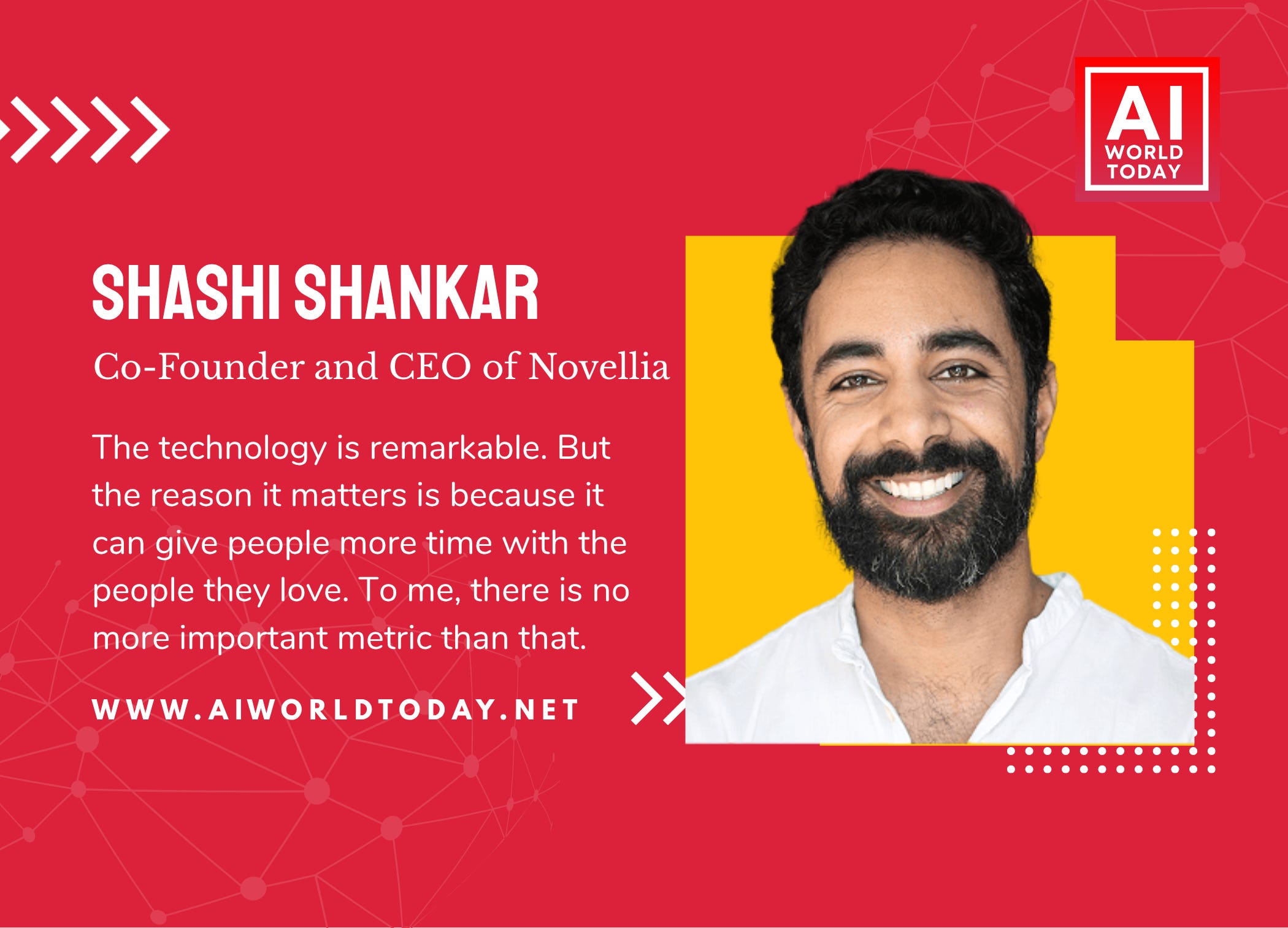
Every great health-tech company begins with a gap someone was forced to live inside. For Shashi Shankar, that gap opened the day his grandfather was diagnosed with late-stage gastroesophageal cancer—scans scattered across hospitals, lab results trapped in disconnected systems, and a family reduced to project managers of a crisis they never trained for. That experience, layered atop a decade of work at Genentech and Roche in medical affairs, health economics, and digital health innovation, became the founding thesis of Novellia: an award-winning AI health data platform now trusted by leading biopharma companies to uncover hidden insights buried in real-world patient data.
Novellia gives patients a single, unified view of their health journey by pulling together records from thousands of care sites—every physician visit, hospital stay, lab result, and specialist note—and using AI to make that fragmented history clear, navigable, and useful. On the other side of that same platform, anonymized patient journeys are transformed into research-ready datasets, helping scientists at organizations like AstraZeneca, Daiichi Sankyo, Genentech, and NCI-designated cancer centers uncover patterns—adverse event risks, care gaps, treatment realities—that traditional clinical trials and claims data simply cannot capture. Novellia’s research has already made its mark at major oncology conferences including ASCO and SABCS, signaling a genuine shift in how precision medicine is built.
In an exclusive interview with AI World Today, Shashi Shankar opens up about the personal loss that shaped Novellia’s mission, the ethical guardrails required to earn patient trust with sensitive health data, why oncology and rare disease became the company’s proving ground, and what it really takes to build an AI company inside one of the most heavily regulated industries in the world. It’s a conversation about grief, technology, and the belief that better data can mean more time with the people we love.
1. Could you start by introducing yourself and giving our readers an overview of Novellia? What it is, what it does, and the problem it was built to solve.
I’m Shashi Shankar, Co-Founder and CEO of Novellia. Novellia is a health technology company that gives folks a single place to bring their medical records together across every physician, hospital and lab they’ve visited, and then uses AI to make that information organized, understandable and useful.
One of the ways I think about Novellia is through the metaphor of a book. It’s where the name comes from. The patient should be the author, the editor, the main character and the owner of their health story. Today, the chapters are scattered all over the place, and everyone except for the patient (insurance companies, health systems, etc.) has become the author and editor of this very personal health story. Novellia changes all of this.
And there’s a second dimension. When using Novellia, patients authorize Novellia to safely transform their de-identified and anonymized health care journeys into research-ready datasets for researchers so they can develop better medicines.
These anonymized journeys can help researchers see things they’ve never been able to see before: what happens before treatment, during treatment, years after treatment, across diverse communities and real-world conditions. That’s the bridge we’re building. Individual patients get clarity about their own health today and researchers gain the understanding they need to develop better medicines for patients tomorrow.
2. Your journey to founding Novellia is deeply personal. You lost your grandfather to a late-stage cancer diagnosis due to fragmented medical data. How did that experience shape your vision for the company, and how do you carry that emotional weight into your daily work as a CEO?
My grandfather’s experience is the reason the company exists.
He was this incredibly strong, restless, self-assured person. My grandmother always described him as somebody who was constantly moving forward.
So when my mom called and told me he had gastroesophageal cancer, I really thought there must have been some mistake. He had always seemed incredibly healthy. And then suddenly our family was thrown into this world that I think millions of families will recognize.
Who is the right oncologist? Should we get a second opinion? What medications is he taking? Where are his scans? Where are his labs? What did that physician say at the last appointment?
You are trying to process some of the worst news you could possibly receive, and simultaneously you’re being asked to become a project manager for somebody’s care. That is insane to me, and it’s still the best case scenario. Imagine navigating all of this without a supoprt team.
One of the things I remember most vividly from his cancer journey was seeing other patients carrying physical binders around with them. Actual binders. Filled with scans, lab results, medication lists and handwritten notes about symptoms. And then you look at the faces of their spouses and children, and you see the exact same fear and confusion that your own family is experiencing. That was the moment when I started realizing: this isn’t just happening to us. This is happening to families across the country.
Unfortunately, he passed just a few months later.
If Novellia had existed then, the first thing I would have wanted for my grandfather was peace of mind. One place where his medical history lived. One place my mother could look to understand his medications and symptoms. One place where a new physician could understand what had already happened without us reconstructing everything from memory. And then, on top of that, intelligence. Help understanding his condition, tracking symptoms, knowing what questions to ask, and ultimately allowing his experience to contribute to research that might help another cancer patient.
I carry him into work with me constantly. There’s a memory that still gets me. When I was a kid, my grandfather picked me up from school after play rehearsal. The car always smelled like cloves because he used to chew them. A Frank Sinatra song came on, and he sang the entire thing, start to finish. Perfectly. He had a hell of a voice. I asked him what the song was.
It was “My Way.”
To this day, if I hear that song somewhere, I’m right back in that car with him, tearing up. That is what the mission means to me.
When I talk about helping patients or accelerating medicines, I think about the empty seats families live with after someone leaves too early. The company exists because I want fewer of those empty seats.
3. Real-world patient data is incredibly sensitive. How does Novellia approach the challenges of data privacy, patient consent, and ethical AI to ensure that patients feel safe contributing their data to medical research?
You’re absolutely right that patient data is incredibly intimate. Your health is probably the most personal part of who you are. So if somebody says, “Why should I trust you with this?” that is an incredibly fair question, and it’s the right question. I would ask the exact same thing.
Here’s how we approach it. First, nothing happens without the patient’s explicit authorization. That’s the foundation. A patient chooses to join Novellia. They choose to bring their records together. Every step is a conscious decision. I compare this to the way this industry has always worked, which is a murky web of legacy data brokers and companies that lease, purchase, and tokenize sensitive data without patients ever being notified.
Second, when we do share information with researchers, every personal identifier is removed. Nobody at a pharmaceutical company learns who you are. Researchers see patterns across thousands of patients in aggregate. They can understand how a disease progresses, how treatments perform, where people are falling through the cracks. But the individual identities behind those journeys remain completely protected.
Third, and this is something I feel strongly about: we are transparent about the fact that we work with biopharmaceutical companies. We are transparent about licensing anonymized data for research. We don’t treat that as something to bury in fine print. We believe medical research is part of serving patients, and we say so openly.
The reason we believe that is straightforward. There are insights sitting inside all of our collective healthcare experiences that can help researchers develop safer, smarter, more relevant medicines. What happens when a medication leaves the controlled environment of a clinical trial? What side effects do patients actually experience in daily life? Are certain communities receiving different care? Where are people falling through the cracks?
Those are questions that matter to patients. And patients can help answer them.
There’s a bigger philosophical point here, too. I believe it takes a village to solve healthcare’s hardest problems. There are answers inside my healthcare journey, your healthcare journey and the journey of the person sitting next to us. We’re doing this for patients who haven’t even been diagnosed yet. People who may become sick five, ten or twenty years from now and benefit from something researchers were able to learn from us today. The technology has to be worthy of the trust patients place in it, and we build everything with that standard in mind.
4. Novellia has made significant strides in oncology and rare disease research. Why did you choose to focus on these specific therapeutic areas first, and what unique challenges does AI face when working with data in these fields?
We started with oncology and rare disease because these conditions force folks into complex journeys throughout different systems, labs, and offices in healthcare which makes them the clearest proof of both the patient problem and the research opportunity.
Breast cancer was our first patient community. Part of that was personal. Cancer is the disease area I understand most viscerally because of what happened with my grandfather. But the structural reasons are just as important.
Think about a cancer patient for a moment. She might start with your primary care physician. Then she’s referred to an oncologist. Then perhaps an academic specialist. She may get imaging somewhere else. Her tissue samples get analyzed at a pathology lab somewhere else. Genomic testing might happen through yet another organization. Her treatment could take place in a community practice, while her second opinion comes from a major cancer center. This patient’s story is being written everywhere, and the problem is nobody necessarily gets to read all the chapters.
Rare disease can be even worse. A patient might spend years going from physician to physician before receiving the right diagnosis. Each specialist sees another piece of the puzzle, often without knowing what the others have already tried or ruled out.
That is precisely where AI becomes valuable. So much of what matters in healthcare lives inside messy, unstructured information: physician notes, pathology reports, diagnostic narratives, medication histories. These aren’t tidy rows in a spreadsheet. They’re written in clinical shorthand, buried across dozens of systems, and they accumulate over years. AI gives us the ability to start organizing and making sense of that complexity at scale.
There is a very important caveat, to call out. AI is only as useful as the data you give it. If a model sees three years of a ten-year cancer journey, it may give you a sophisticated interpretation of an incomplete story. That is why we’re so focused on having the full timeline, the whole arc from first symptom through every treatment and transition.
As Novellia has grown, we’ve expanded far beyond our original breast cancer community into prostate cancer, rare diseases, cardiovascular diseases, vaccines, immunology, neurology, and many other conditions. The underlying philosophy remains the same. Go where patients have complicated, fragmented journeys. Give those patients something meaningfully better. And then, with their participation, help researchers finally see the whole story too.
5. The concept of giving patients a “single, unified view” of their health journey is powerful. What does patient empowerment actually look like on the Novellia platform, and how are patients responding to the idea of owning and contributing their own health data?
On the Novellia platform, patient empowerment starts with two very concrete things.
The first is bringing all of a patient’s medical records together in one place. That means records from every physician, every hospital, every lab, every specialist, going back years. For someone managing a serious condition, this alone can be transformative. You no longer have to call three hospitals to find a scan from five years ago. You no longer have to reconstruct your medication history from memory during a frightening ER visit. It’s all there. You have the information to advocate for yourself without dealing with any assumptions or oversight.
The second is using AI to help patients actually understand what’s in those records. Medical information is written for clinicians. It’s full of abbreviations, clinical terminology, and references that can feel completely opaque to the person it’s actually about. Novellia has AI tools to help translate that information into language a patient can follow, so they can understand their diagnoses, summarize doctor visits, track their symptoms, and walk into an appointment knowing what questions to ask - all for free.
Now, this is an area where we take extraordinary care. There are AI chat tools out there that will ingest health information and try to explain it back to you, and many of them carry severe risks of hallucination and misinformation. In healthcare, that is dangerous. A wrong interpretation of a lab result or a medication interaction isn’t a minor error. It can lead to real harm.
We are a healthcare company, and we take care first very seriously. Novellia has built concrete guardrails to ensure that our AI helps translate health information faithfully. We are focused on helping patients understand what is actually in their records. We are not generating medical advice or speculating beyond the data. That distinction matters enormously, and it’s something we invest deeply in maintaining.
I think there is an emotional component to all of this that we don’t talk about enough, too. When somebody receives a serious diagnosis, there is this enormous loss of control. Your entire world suddenly becomes appointments and terminology and physicians and treatment decisions that you may never have thought about before. If technology can give someone even a little bit of that control back, a little sense of, Okay, I can see my information. I know what’s happening. I know what questions I need to ask, that matters.
The other side of empowerment is participation. Historically, patients have often been treated as the subject of research. Something is being studied about them. I think the future is patients becoming partners in research. You receive value from your own health information. And then, if you choose, your anonymized experience becomes part of a larger body of evidence that helps scientists better understand disease and develop medicines.
Someone living with COPD today may contribute information that helps a researcher improve treatment for a woman diagnosed ten years from now. They may never meet. They’ll never know each other’s names. But one person’s journey can still help change another person’s life. That is a very different definition of owning your health data. It isn’t only about possession. It’s about agency.
6. AI in healthcare is a rapidly evolving and sometimes controversial space. What do you see as the biggest misconceptions that clinicians, researchers, or patients have about AI-driven health data platforms, and how does Novellia work to address those concerns?
The biggest misconception is that AI is the destination. That once AI arrives in healthcare, the transformation follows automatically. I don’t believe that.
There is so much noise around AI right now. Every week there is another announcement, another model, another company promising to revolutionize healthcare. And the conversation tends to center on the same question, how will healthcare change when AI delivers on its promise?
I think that’s the wrong framing. The better question is, how can we continue to strengthen the promise of healthcare by utilizing AI? Healthcare’s mission has always been to help people. AI is a tool that can make that mission more achievable. But the mission has to come first. The technology serves the mission, and the moment you reverse that order, you lose the plot.
That’s something we talk about constantly at Novellia. AI, for us, is an enabling technology. It matters because for the first time we have tools capable of processing and making sense of incredibly large quantities of fragmented health information in seconds. Work that used to require teams of people manually reading through records, filing HIPAA release forms, waiting months for faxed documents to come back, combing through notes one by one. Those processes can increasingly be automated and scaled. Tasks that used to take six months can now happen in thirty seconds.
And we take the responsibility that comes with that speed very seriously.
The other misconception is that a massive dataset automatically equals a great dataset. It doesn’t. A billion incomplete records are still incomplete records.
The quality and completeness of the underlying information matters enormously. Pharmaceutical companies are investing significant resources into understanding patient experiences. They care deeply about this. The challenge is that traditional data sources give them fragments: a short window from a clinical trial, billing codes from an insurance claim, a snapshot from a single hospital system. What’s often missing is the full context around a patient’s journey. What happened before the diagnosis? What happened after? Why was the therapy changed? What symptoms appeared? What did the physician actually write in the note? What happened when the patient went to another health system?
Those questions matter.
7. As an entrepreneur leading an AI health tech startup, what have been your biggest operational or strategic challenges, and what advice would you give to other founders looking to build AI-driven solutions in the highly regulated healthcare industry?
The honest answer is that there have been so many moments where I felt like I had absolutely no idea what I was doing.
I think entrepreneurship gets rewritten after the fact into this beautiful linear story: founder has vision, founder raises money, founder builds company, everybody realizes founder was right. That was absolutely not my experience.
When I started Novellia, almost everybody in my life thought leaving Roche was a terrible idea. And, frankly, they had pretty good evidence. I had a great job. I had just turned thirty. I was working for global headquarters. My career was going well. My family was proud of me. And then I was proposing leaving all of that to build something nobody really understood.
But after my grandfather died, something had changed. I remember being at work between meetings thinking to myself, researchers were struggling to get a full picture of what was happening to patients. And I had just watched my own family navigate a healthcare system where patients didn’t have what they needed either. I remember thinking: I can see this. Why can’t everybody else see this?
Eventually I realized that if I believed it that strongly, I had to go try to build it.
That doesn’t mean I was suddenly good at being a founder. I was terrible at fundraising. I honestly didn’t understand that some of the coffee meetings I was taking were investor meetings. Then afterward I would get emails saying, “We’re going to bow out,” and I would think, Bow out of what?
Eventually I had hundreds of rejection emails. I remember being at a sushi dinner with friends and some founders who were laughing at the fact that they were turning down money. I had received another string of rejections that day, and I excused myself to the bathroom, I was on the verge of tears and I thought, This is ridiculous. Go back to Roche. Get your salary every two weeks. Nobody believes in this thing. And then I went back to the table, took a shot of sake, and decided, I have to keep going. For my family and others like me.
So if I’m distilling what I’ve learned into advice for other founders:
You need conviction, but conviction isn’t the same thing as certainty. You’re going to be wrong constantly. The question is whether you care about the problem enough to keep going.
Find a human problem important enough that you would still care about it if the words “artificial intelligence” disappeared tomorrow. For me, the problem was real.
Healthcare requires a strange combination of impatience and patience. Be impatient about improving things for patients. Be patient about earning trust. There are no shortcuts around trust, evidence, privacy or clinical credibility.
And hire people who actually care. The magic of our team isn’t just technical talent. We need extraordinarily capable engineers, product leaders and commercial healthcare experts, and we also need people who truly understand why the work matters. Whether somebody is building a data model or designing a patient feature, the common thread should be the same, how does this ultimately help patients and help better medicines reach them faster?
8. Looking ahead, what is your long-term vision for Novellia, and more broadly, what does the future of AI-powered precision health look like to you? Where do you see the intersection of AI, real-world data, and patient care in the next five to ten years?
The long-term vision is that Novellia becomes an integral part of every patient’s healthcare journey in America.
But the way I actually picture success is more personal than that.
I picture somebody getting diagnosed with cancer five years from now. And instead of experiencing the absolute confusion my grandfather and my family experienced, they immediately have something in their corner. Their health history is there. Their medications are there. Their physicians are there. Their records follow them. They can understand what is happening. They can track their symptoms. They can ask better questions. Their family isn’t spending nights tracking down lab reports. They feel like they have control.
The other side is what happens when millions of those patients choose to allow their anonymized experiences to contribute to medical research. Researchers stop seeing patients as tiny snapshots. They begin seeing actual journeys. They can reach populations who may have been underrepresented in clinical trials.
Whenever I think about the future, though, I come back to something much less technical.
My favorite holiday is Diwali. After my grandfather died, every Diwali had this empty space in it. There were celebrations he should have been at. New years he should have welcomed with us. Voice messages I should have received and didn’t. I think about families everywhere who have their version of that empty chair.
When you ask me what success looks like ten years from now, it isn’t that healthcare has the world’s most advanced AI model. It’s that somebody’s mother is still sitting at the Thanksgiving table. It’s that somebody’s grandfather gets another Diwali. It’s that a medicine arrives faster because researchers finally had the data they needed. It’s that a patient gets answers before it’s too late.
The technology is remarkable. But the reason it matters is because it can give people more time with the people they love. To me, there is no more important metric than that.
What emerges from this conversation isn’t just a founder’s roadmap for scaling an AI health platform—it’s a reminder of why the work matters in the first place. Shashi Shankar’s vision for Novellia is refreshingly unambiguous: technology should serve healthcare’s original mission, not redefine it. As AI continues to reshape how researchers understand disease and how patients navigate their own care, Novellia stands as a compelling example of what happens when personal loss is channeled into purposeful innovation. For Shashi, success won’t be measured in model benchmarks or funding rounds, but in empty chairs that stay filled—one more holiday, one more milestone, one more chance for a family to hold onto someone a little longer. That, ultimately, is the story Novellia is helping millions of patients finally write for themselves.