


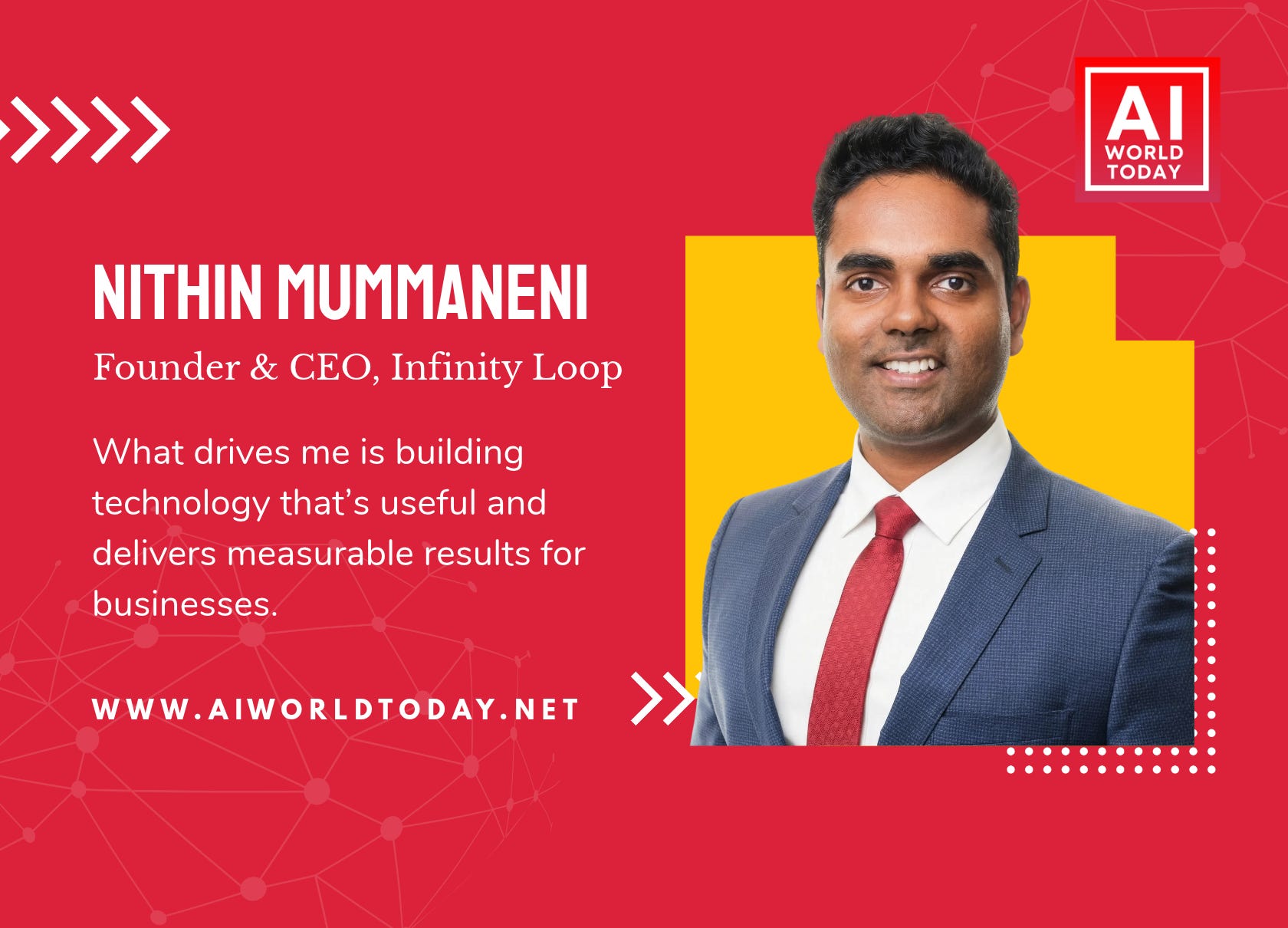
Nithin Mummaneni is the Founder and CEO of Infinity Loop, an AI-powered contract intelligence platform helping enterprises uncover hidden savings in third-party vendor agreements and negotiate from a position of strength. By combining advanced data analysis with expert negotiation strategy, Infinity Loop has helped companies achieve 10 to 15 percent cost savings, including one client who realized a staggering $19.5 million in savings in just five months. Before launching Infinity Loop, Nithin spent years in procurement and program management leadership, where he spearheaded AI initiatives that automated inefficiencies across departments. His career also includes deep experience in management consulting and M&A advisory, where he guided companies across the U.S. and Canada through complex operational and financial transformations. That blend of consulting rigor and enterprise AI expertise now shapes his sharp, often contrarian views on why most corporate AI investments fail to deliver real returns.
In an exclusive interview with AI World Today, Nithin pulls back the curtain on one of the most pressing issues in enterprise technology today: the massive gap between AI hype and AI ROI. With research showing that up to 95 percent of generative AI pilots fail to scale, Nithin argues that the problem isn’t the technology itself, but a lack of discipline, clear business outcomes, and measurable financial accountability. He explains why “AI adoption” should never be mistaken for a business outcome, how Infinity Loop was deliberately engineered from day one to be ROI-provable, and why he believes large-scale vendor negotiations should remain human-led even as automation advances.
Nithin also shares candid insights on building trust with skeptical procurement teams, competing in a crowded contract intelligence market, and why vertical, data-rich AI platforms will outperform general-purpose tools in high-stakes enterprise environments.
Following a recent $5 million seed round led by Glasswing Ventures and TIAA Ventures, Infinity Loop is emerging as a case study in what disciplined, outcomes-first AI should look like. This conversation offers a timely and practical blueprint for any enterprise leader trying to separate real AI value from the noise.
Q1. 👤 Introduction
Nithin, welcome to AI World Today! Could you start by introducing yourself - who you are, what drives you as an entrepreneur, and give our readers a brief snapshot of your journey from management consulting and M&A advisory to founding Infinity Loop?
My background spans management consulting, M&A advisory, and enterprise AI, where I’ve helped large organizations improve efficiency and reduce costs. Through those experiences, I saw an opportunity to combine consulting expertise with AI to solve a practical business problem. That’s what led me to found Infinity Loop. We built the platform to automatically identify savings opportunities and give procurement teams specific, data-driven negotiation strategies they can use to capture those savings. What drives me is building technology that’s useful and delivers measurable results for businesses.
Q2. 🚨 The ROI Crisis in Enterprise AI
You’ve been vocal about the fact that “AI adoption isn’t a business outcome.” IBM’s research shows only 25% of AI initiatives deliver expected ROI, and MIT reports 95% of generative AI pilots are failing. In your view, what is the single biggest reason enterprise AI investments are struggling to deliver measurable returns?
Executive teams face a lot of pressure to implement AI, but organizations often move forward without the necessary due diligence. Many aren’t evaluating the potential ROI upfront or identifying which solutions will actually deliver value. Enterprises need to be more deliberate about prioritization, starting with opportunities that can show clear returns through time or cost savings. Those early wins help build the case for longer-term AI investments and broader implementation.
Q3. 📉 The Pilot Trap — Why AI Gets Stuck
One of the most frustrating patterns in enterprise AI is promising pilots that never graduate to full-scale deployment. From what you’ve seen working with large organizations, what are the key organizational, technical, and cultural barriers that keep AI stuck in experimentation mode?
Ultimately, it comes down to trust. If an AI solution can’t demonstrate value during the proof of concept, organizations are unlikely to move forward with implementation. Technical challenges can also come up during deployment and prevent an otherwise promising solution from progressing. We’ve seen these challenges with other solutions in the market.
Q4. 📊 Reframing What “ROI” Even Means
You’ve argued that not every AI investment needs an immediate hard-dollar return that enterprises will ultimately carry a portfolio of AI capabilities spanning cost savings, risk reduction, and strategic advantage. How should enterprise leaders rethink and restructure their AI ROI framework to reflect this reality?
It comes down to time and money. Organizations need to understand how each solution on their AI roadmap will affect those areas and what value it could deliver. From there, you need to test those assumptions and decide whether the results justify moving forward. Not every proof of concept needs to become a full implementation. Enterprises need clear evaluation criteria and discipline about which solutions they deploy.
Q5. 🤖 Infinity Loop as a Blueprint for ROI-Positive AI
Infinity Loop is one of the few AI platforms that directly connects its technology to a specific, measurable financial outcome - 10–15% cost savings on vendor contracts. How did you deliberately design the platform to be ROI-provable from day one, and what can other AI companies learn from that approach?
From the beginning, I wanted to build something useful that could deliver measurable financial results. My background in consulting and enterprise AI showed me how much value organizations could capture through better supplier negotiations. We designed Infinity Loop to automatically identify savings opportunities and give procurement teams specific, data-driven negotiation strategies they can put into action. The goal is straightforward: help organizations negotiate more effectively and capture savings. When you’re talking about actual financial results, the impact becomes much easier to measure.
Q6. 💡 The “What Comes Next?” - A More Disciplined AI Era
You’ve stated: “We’re entering a much more disciplined phase of enterprise AI — solutions that get funded and scaled will increasingly be those that can connect their technology directly to measurable business results.” What does this new era of enterprise AI look like practically, and what types of AI solutions do you believe will thrive versus fade away?
The next phase of enterprise AI will come down to results. Companies will increasingly need to show their solutions deliver business value. Saying they use AI won’t be enough. Enterprise customers will ultimately determine which technologies succeed. Solutions that consistently demonstrate measurable outcomes will have a stronger case for broader adoption. Those that can’t prove their value will struggle to move beyond experimentation.
Q7. 🏗️ Specialized vs. General AI - The Enterprise Battleground
There’s a growing debate between broad, general-purpose AI platforms and specialized, domain-specific AI solutions. Given what you’re building at Infinity Loop, where do you stand and do you believe the future of enterprise AI lies in vertical specialization?
I believe the future of enterprise AI will largely come down to data. General-purpose large language models are useful, but specialized applications, particularly in areas like negotiations, need industry-specific information. Access to relevant, specialized data creates capabilities that general-purpose models can’t necessarily replicate. I think vertical specialization will be essential, even for companies that eventually expand into other markets. The depth and relevance of the underlying data will ultimately determine how effective those solutions can be.
Q8. 📋 The Contract Intelligence Opportunity
Infinity Loop assigns a letter-grade “report card” to vendor contracts and equips teams with expert negotiation strategies. One client realized $19.5 million in savings in just five months. Why has contract intelligence been so overlooked as an AI use case, and why is now the right moment for it?
I’d describe this opportunity as negotiations rather than contract intelligence. Historically, the technology hadn’t advanced enough to support this use case effectively. Negotiation preparation took a lot of manual work to gather and analyze the information needed to develop useful strategies. The technology now makes that process much easier, which creates a strong opportunity for AI adoption.
Q9. 🔗 AI as Middleware, Not a Disruptor
Infinity Loop is positioned as a middleware intelligence layer that sits on top of existing CLM and P2P tools like Coupa, SAP, Oracle, and DocuSign rather than replacing them. Do you think this “integrate, don’t disrupt” philosophy is the right model for enterprise AI adoption broadly, and how has it impacted Infinity Loop’s growth?
Our approach has worked because organizations generally don’t want to replace established systems. Doing that takes significant time, resources, and internal alignment. By integrating with existing platforms, we can show results faster without asking companies to overhaul their infrastructure. We also don’t directly compete with these providers, so building strong relationships with them benefits everyone involved.
Q10. 🤝 Trust, Change Management & The Human Factor
Introducing AI into sensitive, bottom-line-critical domains like procurement and contract negotiation requires enormous organizational trust. How do you navigate change management challenges - particularly with procurement teams who may initially fear AI threatens their roles?
Change management is a big part of our approach. Rather than implementing across the whole organization immediately, we might start with five or ten opportunities, expand to 30 or 40, and keep scaling as teams become more comfortable with the technology. That gradual approach lets us build trust through demonstrated results. Our platform is designed to support existing procurement teams, not replace them. A phased rollout, combined with measurable outcomes, helps teams build confidence in the technology over time.
Q11. 💰 The $5M Seed Round & What It Signals
Infinity Loop recently raised a $5M seed round led by Glasswing Ventures and TIAA Ventures. Beyond funding growth, what does investor interest in ROI-driven, domain-specific AI signal about where the broader enterprise AI market is heading?
I think investors are increasingly focusing on AI solutions that deliver business value, beyond the excitement around the technology. From our perspective, the interest we’re seeing reinforces the importance of building AI around practical applications and measurable outcomes. Ultimately, the technology needs to solve a real business problem.
Q12. ⚔️ Competing in a Crowded Landscape
The contract intelligence space includes players like Ironclad, Pactum, and ThoughtRiver and larger incumbents are building AI features too. How does Infinity Loop differentiate itself, and how do you maintain a competitive edge as the market matures?
Our differentiation comes down to the data we use and our approach to negotiations. We believe large, high-value negotiations shouldn’t be fully automated because of their complexity and financial significance. Autonomous solutions have a place in the market, particularly for smaller transactions, but that’s not our primary focus. Infinity Loop gives procurement teams specialized intelligence and negotiation strategies to support better decisions in high-value negotiations, while keeping people involved in the process.
Q13. 🔮 The Road to Autonomous Negotiation
You’ve spoken about Infinity Loop’s long-term vision of fully autonomous vendor negotiations. Given that enterprise AI ROI is already hard to prove, how do you build the business case and the trust for AI that doesn’t just recommend negotiation strategies but eventually executes them?
I don’t think AI is ready to independently negotiate million-dollar contracts. Those decisions have significant implications for a company’s bottom line, so people still need to be involved.
Autonomous negotiations are more likely to gain traction in smaller transactions, potentially below $100,000. That could evolve as organizations become more comfortable with AI, but we’re not there yet. Ultimately, it will depend on the depth and quality of the data available to support those decisions.
Q14. 📣 Practical Advice for Enterprise Leaders
For a Chief Procurement Officer or CFO who is skeptical about AI after seeing pilots fail to deliver ROI, what is your concrete, practical advice on how to evaluate, deploy, and measure AI in a way that actually moves the needle financially?
Start by defining the business outcome you want. Will the solution save your organization time, reduce costs, or both? From there, prioritize opportunities based on their potential impact and how quickly they can demonstrate results. Some initiatives may deliver significant long-term value, but early wins can help build confidence and support broader implementation. The key is to evaluate AI investments against measurable outcomes rather than the technology itself.
Q15. 🌟 The Bigger Picture — A Message to the AI Industry
Finally, stepping back from Infinity Loop - what is the message you most want to send to the broader AI industry and to enterprise technology buyers right now? What needs to fundamentally change in how we build, sell, and measure AI for the next chapter of this technology to truly deliver on its promise?
Don’t implement AI simply for the sake of implementing it. Organizations need to be clear about how these investments support business outcomes and how they’ll measure the impact. It’s not enough to say a solution can deliver value. You need to demonstrate the results, measure them, and report on them.
As enterprise AI enters what Nithin calls a “more disciplined phase,” his perspective serves as a timely reality check for an industry often driven more by momentum than measurable outcomes. Rather than chasing automation for its own sake, Nithin champions a model where technology is built to solve specific, provable business problems, and where human judgment remains central to high-stakes decisions. With Infinity Loop, he is demonstrating that AI’s greatest value may not lie in replacing people, but in empowering them with sharper data, smarter strategy, and measurable financial impact.
As more enterprises demand proof over promises, leaders like Nithin are helping redefine what responsible, results-driven AI adoption truly looks like. We thank Nithin Mummaneni for sharing his insights with AI World Today and look forward to following Infinity Loop’s continued growth in the enterprise AI space.