


Your brain operates as a sophisticated multi-layered memory system where information updates at wildly different speeds. New phone numbers vanish within seconds unless you rehearse them. Yesterday’s conversations fade over hours. Childhood memories persist for decades. This isn’t a design flaw—it’s precisely how human cognition achieves its remarkable flexibility and efficiency. Now researchers at Google have developed a sophisticated artificial intelligence framework that actually works this way.
The research team has unveiled Nested Learning, a paradigm-shifting approach that could fundamentally transform how we build and train AI systems. Unlike traditional deep learning models that stack layers like a tower of blocks, Nested Learning represents neural networks as interconnected systems of optimization problems, each operating at its own pace and managing its own “context flow.” Think of it as the difference between a single highway and a complex network of roads where traffic moves at different speeds depending on urgency and importance.
Why should you care? Because current AI systems, including powerful language models like ChatGPT, suffer from a critical limitation: they experience what researchers describe as “digital amnesia.” These models excel at processing information within their immediate context window but struggle to continuously learn and adapt without expensive retraining. It’s similar to a person with anterograde amnesia who can remember their distant past and engage in conversations but cannot form new long-term memories. This limitation has prevented AI from achieving true continual learning—the ability to seamlessly acquire new knowledge and skills over time without forgetting previous information.
The Google Research team’s solution draws inspiration from neuroscience, specifically how the human brain consolidates memories through multiple time-scale processes. Their framework reveals something surprising: well-known optimization algorithms like Adam and SGD with Momentum aren’t just mathematical tools—they’re actually memory systems that compress and store information. This revelation opens entirely new possibilities for designing AI that learns more like humans do, with different components updating at different frequencies to balance rapid adaptation with long-term knowledge retention.
Breaking Down the Memory Barrier in Modern AI
Current artificial intelligence architectures face a paradox that limits their potential. Large language models demonstrate remarkable capabilities in understanding and generating text, yet they remain fundamentally static after deployment. They can process whatever fits within their context window—typically a few thousand words—but everything beyond that boundary might as well not exist.
The research team identified this as more than just a technical limitation. It represents a fundamental design flaw in how we conceptualize machine learning systems. Traditional deep learning stacks layers vertically, creating networks that grow deeper and wider. More layers mean more parameters, which translates to greater capacity for learning patterns from training data. However, this approach hits diminishing returns when it comes to continual learning and adaptation.
Nested Learning proposes something radically different. Instead of viewing neural networks as static architectures with fixed update schedules, the framework represents them as dynamic systems where different components learn at different rates. Some parts might update with every new piece of information, while others change more gradually, consolidating patterns over longer timescales. This multi-rate learning mirrors biological systems, where synaptic consolidation happens rapidly while systems consolidation unfolds over days or weeks.
The implications extend beyond theoretical elegance. By decomposing machine learning models into nested optimization problems, researchers gain unprecedented transparency into how different components contribute to learning. A gradient descent optimizer with momentum, for instance, isn’t just adjusting weights—it’s solving a two-level optimization problem where the momentum term acts as a memory system compressing past gradients. This insight emerged directly from the Nested Learning framework and suggests entirely new ways to design more powerful optimization algorithms.
The Neuroscience Connection: Learning from Brain Architecture
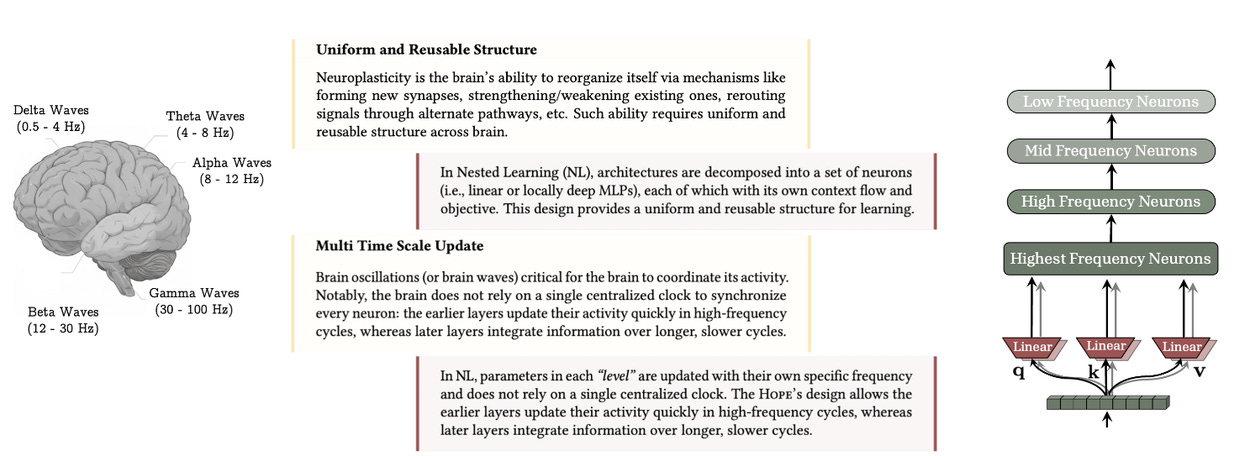
Human memory formation involves remarkably sophisticated processes that machine learning has struggled to replicate. Neuroscientists have identified at least two distinct consolidation mechanisms working in concert. Synaptic consolidation occurs rapidly, sometimes within minutes or hours of learning, stabilizing new memory traces. Systems consolidation happens more gradually, reorganizing memories and transferring them from temporary hippocampal storage to more permanent cortical regions during sleep.
These biological processes operate at vastly different timescales, yet they work together seamlessly. The research team recognized this multi-timescale architecture as a potential blueprint for more capable AI systems. Current models lack this temporal hierarchy—every parameter typically updates at the same frequency during training, creating a rigid learning schedule that doesn’t match biological flexibility.
The brain’s uniform yet reusable structure provides another crucial insight. Different regions handle different cognitive tasks, but they share common architectural principles and operate at characteristic frequencies. Brain waves reveal this hierarchy: high-frequency gamma waves correlate with immediate sensory processing, while slower theta and delta waves coordinate memory consolidation and long-term storage. Nested Learning incorporates this concept through its frequency-based organization of model components.
What makes this approach particularly compelling is its neurobiological plausibility combined with mathematical rigor. Unlike many AI techniques inspired by neuroscience that remain metaphorical, Nested Learning provides formal mathematical foundations while maintaining clear connections to brain function. This dual nature—scientifically grounded yet practically applicable—positions it as more than just another machine learning technique.
Introducing HOPE: A Self-Modifying Architecture
The research team developed HOPE (Hierarchical Optimization with Persistent Experience), a novel neural architecture that implements Nested Learning principles. HOPE represents a significant departure from standard Transformer models that dominate current AI applications. While Transformers use attention mechanisms to process sequences, they treat all parameters as updating at identical frequencies during training.
HOPE introduces what researchers call a “Continuum Memory System.” Instead of the traditional binary division between short-term working memory and long-term knowledge storage, HOPE implements multiple memory levels operating at different update frequencies. Think of it as having not just short and long-term memory, but also medium-term, quarterly-term, and various gradations in between.
Each memory level in HOPE corresponds to a specific update frequency. High-frequency components adapt rapidly to immediate context, similar to working memory handling current conversation. Lower-frequency components change more gradually, consolidating patterns across longer timescales like episodic or semantic memory. This hierarchy allows HOPE to balance rapid adaptation with stable long-term knowledge retention—something current models struggle to achieve simultaneously.
The architecture also incorporates self-modification capabilities. HOPE doesn’t just learn from data; it learns how to modify its own learning process. By treating optimization algorithms as learnable components rather than fixed procedures, HOPE can adapt its learning strategy based on experience. This meta-learning ability represents a step toward more autonomous AI systems that improve not just their knowledge but their learning efficiency itself.
Deep Optimizers: Rethinking How Neural Networks Learn
One of Nested Learning’s most profound insights concerns optimization algorithms—the mathematical procedures that adjust neural network parameters during training. The research reveals that popular optimizers like Adam and SGD with Momentum aren’t merely computational tools; they’re actually associative memory modules solving their own optimization problems.
Consider gradient descent with momentum. Traditionally viewed as an algorithm that smooths optimization by incorporating past gradients, Nested Learning shows it’s actually solving a two-level nested optimization problem. The momentum term functions as a memory system that compresses historical gradient information into its parameters. This compression process itself involves optimization—specifically, learning how to map input gradients to stored values.
This revelation opens new possibilities for optimizer design. If momentum acts as a simple linear memory, why not replace it with more sophisticated memory architectures? The researchers propose “Deep Momentum,” which uses multi-layer neural networks instead of simple matrices to store gradient history. This deeper memory structure can capture more complex patterns in optimization dynamics, potentially leading to faster convergence and better solutions.
Another extension involves changing the objective that optimizers minimize internally. Standard momentum uses dot-product similarity to measure gradient mapping quality. The research team experimented with squared-error regression loss instead, resulting in delta-rule based updates that manage memory capacity more effectively. These variations demonstrate how Nested Learning provides a principled framework for designing novel optimizers rather than relying on trial-and-error experimentation.
Experimental Validation: Testing Theory Against Reality
The research team conducted extensive experiments to validate Nested Learning’s practical benefits. They compared HOPE against established architectures including standard Transformers, RetNet, DeltaNet, and other modern recurrent networks across multiple scales and tasks. The benchmark suite included language modeling, commonsense reasoning, continual learning, and long-context understanding.
Results showed HOPE achieving competitive or superior performance across different model sizes. At 1.3 billion parameters trained on 100 billion tokens, HOPE achieved perplexity scores of 15.11 on WikiText and 11.63 on Language Model Benchmarks, outperforming comparably-sized Transformers and other baselines. On commonsense reasoning tasks, HOPE scored 57.23% average accuracy across multiple benchmarks, demonstrating strong general intelligence.
Perhaps more impressive than raw performance numbers, HOPE exhibited capabilities that standard architectures lack. In continual learning experiments, HOPE maintained stable performance when learning new tasks sequentially, showing significantly less catastrophic forgetting than baselines. This ability to accumulate knowledge without destroying previous learning directly validates Nested Learning’s core premise about multi-timescale updates enabling better continual adaptation.
Long-context reasoning tasks revealed another strength. While Transformer attention mechanisms struggle with sequences exceeding their training length, HOPE’s hierarchical memory structure handled extended contexts more gracefully. By consolidating information across different timescales, HOPE could maintain relevant context even when immediate working memory became saturated—much like human memory systems juggling information across different temporal horizons.
Implications for AI Development and Future Systems
Nested Learning’s impact extends beyond incremental improvements in benchmark scores. It suggests fundamental shifts in how we conceptualize and construct intelligent systems. If neural networks are better understood as integrated systems of nested optimization problems rather than static computational graphs, entirely new architectural possibilities emerge.
The framework provides a principled way to design models with different learning dynamics for different components. Imagine language models where vocabulary embeddings update rapidly to incorporate new terms while syntactic knowledge changes more slowly and semantic relationships evolve even more gradually. This matches intuitive notions about learning—some knowledge should be flexible and adaptive while other aspects require stability and consistency.
For continual learning applications, Nested Learning offers a path forward without expensive retraining or complex rehearsal mechanisms. By naturally incorporating different update frequencies, systems can balance plasticity and stability inherently rather than through external mechanisms. This could enable AI assistants that genuinely improve through interaction, industrial systems that adapt to changing conditions, and scientific tools that accumulate knowledge across experiments.
The self-modification capabilities suggested by HOPE point toward more autonomous learning systems. Rather than requiring human experts to hand-design optimization algorithms and learning schedules, future AI might develop its own learning strategies through meta-learning. This doesn’t mean human oversight becomes unnecessary, but it shifts the role from micromanaging every algorithmic detail to setting high-level objectives and constraints.
Understanding the Mathematical Foundation
At its core, Nested Learning formalizes a simple but powerful idea: represent machine learning as hierarchical optimization. Each component in a neural network—whether a layer, an optimizer, or a memory module—solves its own optimization problem with its own objective and update frequency. These problems nest within each other, creating a hierarchy ordered by update rate.
The framework defines update frequency precisely as the number of parameter updates per unit time, where one unit equals processing a single data point. Components that update every iteration have high frequency while those changing less often have low frequency. This creates a natural ordering: faster components reside in inner optimization loops while slower components occupy outer loops.
Consider training a linear attention model with gradient-based optimization. Traditional deep learning views this as one process: adjusting all parameters to minimize a loss function. Nested Learning decomposes it into multiple nested problems: the attention memory optimizes its key-value mappings with gradient descent, while projection matrices optimize their parameters with a different optimizer at a different rate. Each level has its own context flow—the sequence of information it processes and learns from.
This mathematical structure reveals connections between seemingly disparate techniques. Fast Weight Programs, meta-learning, and continual learning all involve nested optimization at different scales. Nested Learning provides a unified language to describe, analyze, and design such systems systematically rather than treating each as an isolated approach.
Challenges and Open Questions
Despite its promise, Nested Learning faces important challenges and unanswered questions. The framework’s complexity increases with additional nesting levels, potentially making implementation and debugging more difficult than standard architectures. Practitioners need new tools and methodologies to effectively work with multi-level optimization systems.
Theoretical understanding remains incomplete in several areas. While the paper demonstrates that Nested Learning can improve performance, the precise conditions under which different nesting structures excel remain unclear. What determines optimal update frequency ratios? How many levels provide meaningful benefits before diminishing returns set in? These questions require both theoretical analysis and empirical investigation.
Computational efficiency presents practical concerns. Although Nested Learning can improve sample efficiency—learning more from less data—it may increase computational costs per sample through additional optimization steps at different levels. Understanding this tradeoff and developing efficient implementations will be crucial for large-scale deployment.
The relationship between nesting depth and emergent capabilities needs deeper exploration. The research shows that in-context learning emerges naturally from the Nested Learning perspective, but what other capabilities might emerge from deeper nesting? Could higher-order reasoning, better generalization, or enhanced robustness follow from adding more levels? Answering these questions could guide future architectural innovations.
From Theory to Practice: Implementation Considerations
Translating Nested Learning from theoretical framework to practical systems requires careful consideration of implementation details. The research team provides concrete examples through HOPE, but many design choices remain open for exploration. Practitioners must decide how many nesting levels to include, what update frequencies to assign, and which objectives each level should optimize.
Hyperparameter selection becomes more nuanced with nested structures. Each optimization level requires its own learning rates, momentum coefficients, and regularization strengths. While this flexibility allows fine-tuned control over learning dynamics, it also expands the hyperparameter search space considerably. Automated hyperparameter optimization and principled initialization strategies will be essential for practical adoption.
Debugging and interpretability pose unique challenges. When multiple optimization processes run concurrently at different timescales, identifying performance bottlenecks or failure modes becomes more complex than with standard architectures. Visualization tools and diagnostic metrics specifically designed for nested systems could help practitioners understand and improve their models.
Integration with existing machine learning infrastructure requires attention. Most deep learning frameworks assume synchronous parameter updates across all model components. Implementing asynchronous, frequency-based updates may require modifications to standard training loops and distributed computing strategies. Creating Nested Learning-compatible libraries and tools would lower barriers to experimentation and adoption.
Broader Context in AI Research
Nested Learning emerges amid growing recognition that current AI systems face fundamental limitations. Despite impressive capabilities in specific domains, even the most advanced language models struggle with continual learning, long-term memory, and genuine adaptation beyond their training distribution. These limitations have motivated diverse research directions, from neuroscience-inspired architectures to meta-learning frameworks.
The framework connects with several active research areas. Meta-learning studies how systems can learn to learn, often through nested optimization where an outer loop optimizes learning algorithms while an inner loop solves specific tasks. Nested Learning generalizes this idea beyond the standard two-level meta-learning setup to arbitrary nesting depths and diverse components.
Continual learning research seeks methods for accumulating knowledge without catastrophic forgetting. Nested Learning’s multi-timescale updates provide a natural mechanism for balancing plasticity and stability—rapid adaptation in high-frequency components while preserving stable knowledge in low-frequency parameters. This offers a principled alternative to rehearsal methods or architectural compartmentalization.
Neuroscience-inspired AI has produced valuable architectures like attention mechanisms and convolutional networks, but often lacks rigorous mathematical foundations connecting biological inspiration to computational implementation. Nested Learning maintains both biological plausibility through its multi-timescale structure and mathematical rigor through formal optimization theory, bridging this gap more completely than many previous approaches.
Looking Ahead: The Future of Nested Learning
As research continues, Nested Learning could influence AI development in several directions. Near-term applications might focus on improving existing architectures by incorporating multi-timescale updates selectively. Even partially adopting Nested Learning principles could yield performance gains in specific domains like continual learning or long-context processing.
Longer-term possibilities include fundamentally new architectures designed from the ground up around nested optimization. Rather than retrofitting existing models, future systems might organize all components—from low-level features to high-level reasoning—into coherent hierarchies of nested learning processes. This could produce qualitatively different AI capabilities, potentially including better generalization, more efficient learning, and genuine continual adaptation.
The framework might also inform biological research by providing computational models of multi-timescale neural processes. If Nested Learning successfully captures essential aspects of how brains consolidate memories and learn continuously, it could generate testable predictions about neural dynamics and inform neuroscience experiments. This bidirectional flow between AI and neuroscience could accelerate progress in both fields.
Practical deployment will require developing best practices, design patterns, and tool support specifically for nested systems. As the community gains experience with Nested Learning, standard architectures and training recipes will likely emerge, similar to how ResNets and Transformers evolved into well-understood templates. This maturation process will be essential for widespread adoption beyond research laboratories.
The journey from theoretical framework to transformative technology often takes years or decades. Nested Learning provides a new lens for understanding and designing learning systems, but realizing its full potential will require sustained research effort, practical experimentation, and community collaboration. The early results with HOPE suggest the promise is real, but much work remains to fully explore this new dimension of deep learning.
FAQs
Q1: What is Nested Learning in artificial intelligence?
Nested Learning is a new AI framework developed by Google researchers that represents machine learning models as interconnected systems of optimization problems, each operating at different timescales. Unlike traditional deep learning that stacks layers uniformly, Nested Learning organizes model components into hierarchical levels that update at different frequencies, similar to how human brains consolidate memories through multiple timescale processes.
Q2: How does Nested Learning differ from traditional deep learning?
Traditional deep learning stacks layers vertically with all parameters updating at the same frequency during training. Nested Learning decomposes models into nested optimization problems where different components learn at different rates—some updating rapidly with every input while others change more gradually. This multi-timescale approach enables better continual learning and memory consolidation compared to standard architectures.
Q3: What is HOPE and how does it implement Nested Learning?
HOPE (Hierarchical Optimization with Persistent Experience) is a novel neural architecture that demonstrates Nested Learning principles in practice. It features a Continuum Memory System with multiple memory levels operating at different update frequencies, allowing the model to balance rapid adaptation with stable long-term knowledge retention. HOPE also includes self-modification capabilities, enabling it to learn and adapt its own learning process.
Q4: Why do current AI systems struggle with continual learning?
Current AI systems, including large language models, suffer from what researchers call “digital amnesia.” They excel at processing information within their immediate context window but cannot continuously acquire new knowledge without expensive retraining. They experience a condition similar to anterograde amnesia—unable to form new long-term memories beyond their training phase while maintaining existing knowledge.
Q5: How does Nested Learning relate to neuroscience?
Nested Learning draws direct inspiration from how human brains consolidate memories through multi-timescale processes. The brain uses rapid synaptic consolidation for immediate learning and slower systems consolidation for long-term memory storage. Nested Learning mimics this by organizing AI components into frequency-based hierarchies that update at different rates, similar to brain waves operating at characteristic frequencies for different cognitive functions.
Q6: What are the practical applications of Nested Learning?
Nested Learning enables several important capabilities including improved continual learning without catastrophic forgetting, better long-context reasoning, more efficient optimization through deeper memory structures, and self-modifying systems that adapt their learning strategies. These advances could benefit AI assistants, industrial adaptive systems, scientific research tools, and any application requiring ongoing learning and adaptation.
Q7: What challenges does Nested Learning face for widespread adoption?
Key challenges include increased implementation complexity compared to standard architectures, expanded hyperparameter search spaces requiring careful tuning, computational overhead from multiple optimization levels, and the need for new debugging and visualization tools. Additionally, theoretical understanding of optimal nesting structures and integration with existing machine learning infrastructure require further development before widespread practical deployment.