


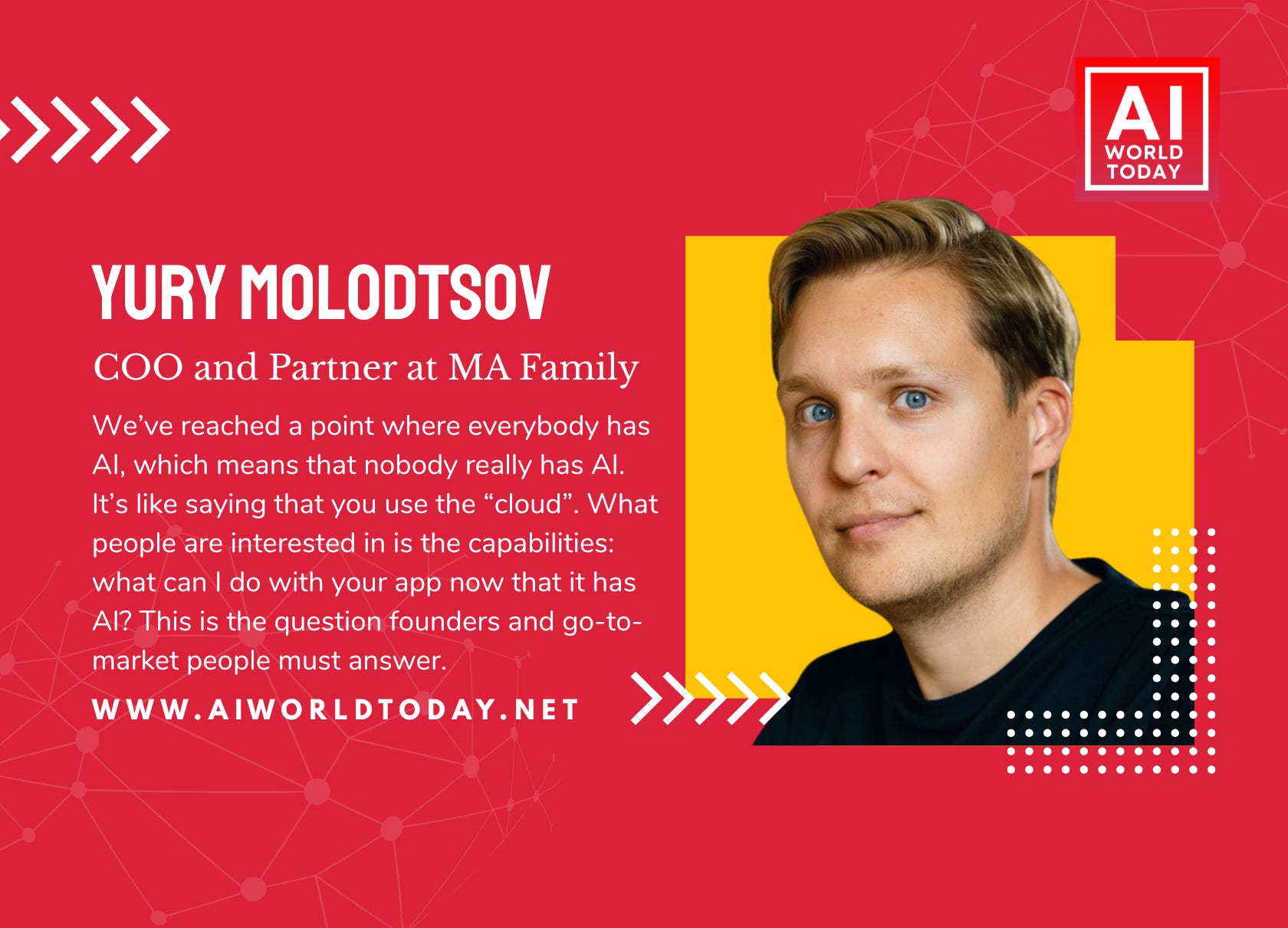
Yury Molodtsov, the visionary COO and Partner at MA Family, stands at the forefront of the rapidly evolving tech communications landscape. With a unique background that spans both venture capital and strategic PR, Molodtsov has become a driving force in shaping the narrative for innovative tech startups. His impressive track record includes spearheading PR efforts for industry giants like JetBrains, Flipper Zero, Miro, and Gett, demonstrating his prowess in navigating the complex world of technology marketing.
In an exclusive interview with AI World Today, Molodtsov shares his journey from venture capital to communications, offering valuable insights into the changing dynamics of AI marketing and PR. His experience as an investor at Day One Ventures, a San Francisco-based VC firm that backed successful startups like Superhuman, Truebill, and Remote, has given him a unique perspective on both sides of the tech ecosystem. This blend of investment acumen and communications expertise positions Molodtsov as a thought leader in the ever-changing field of AI startup marketing.
Q: Can you tell us about your background and what led you to work in venture capital and communications?
My career began in communications and got back there, but in the interim, I had a meaningful stint in venture capital.
This taught me a great deal about the inner workings of the technology ecosystem and what founders are going through. I know how much venture capitalists are driven by FOMO and what things founders can do to create it.
Q: You moved from venture capital into PR and communications. Why did you make that change, and what did your VC experience teach you about PR?
Most people working in comms come from the media but aren’t too technical. I believe that understanding the products you’re marketing is a necessity. Otherwise, all you can do is parrot talking points.
Ultimately, venture capital was not too different from communications. You help founders figure out positioning, you think about people to connect them with. What you’re trying to do is to convince the other side that you have the best company. Pitching a company to a reporter is fairly similar to finding co-investors for your deal.
Ultimately, most non-technical jobs lead to sales. Even as an engineering manager, you have to sell. You sell to candidates to join your team, and you sell to leadership to secure resources.
Q: Is there anything that’s different about marketing AI products and startups?
At first, AI made technology exciting again for both users and journalists. Even industries that previously would stay in the shadows got their moment under the spotlight. Integrating AI chats or agents was already a news event.
Now we’ve reached a point where everybody has AI, which means that nobody really has AI. It’s like saying that you use the “cloud”. What people are interested in is the capabilities: what can I do with your app now that it has AI? This is the question founders and go-to-market people must answer.
Q: Is there a place for AI in communications and marketing? Have you changed your own approach in any way?
Certainly not in writing! But I encourage everyone to use AI for what comes before and after writing. You can use LLMs to do basic research and you can ask it to be your editor and find weak logic in your writing. It’s hard for people to judge the results of their work objectively, so having a 24/7 editor is extremely valuable. My favorite AI for this is Claude. Their latest models tend to write the best and can actually object to you. I argue with them every day defending what I wrote!
But what really changes is how people search for information. More and more of our clients report getting up to 40% of their new leads directly from ChatGPT. This is a drastic shift. Instead of “ten blue links,” people are getting customized research reports on tools and products they actually need. Ensuring that your product appears in such searches is now a part of the job.
Q: Which sources tend to appear in ChatGPT’s responses?
You achieve this by creating your own content, such as landing and comparison pages, and through mentions in top-tier media sources, which is the job of PR. It’s quite similar to regular SEO, but there’s often a strict cut-off. Ask for the best business neobank in Europe and you will get just 3-5 options. Often, tiny adjustments decide which ones. If you aren’t one of them, it’s not great.
We have even built Horus, an in-house AI search analytics tool, that we and some of our partners use to track positions of specific brands and products within ChatGPT and Perplexity. You can’t change what you don’t measure, so we started measuring this ourselves. We monitor which products are mentioned in relevant queries, identify the sources that lead to these mentions, and try to secure a mention in them, whether it’s a listicle on Business Insider or a story on TechRadar.
Q: What does this change for the media publications in the age of AI?
Hard to predict for sure. On one hand, it gives them a lot more power. Previously, a lot of attention and eyeballs went first to social media and then to the new media platforms, newsletters and podcasts. But conventional news media tend to rank much better in both search and AI responses, so they can potentially use it.
On the other hand, while businesses care primarily about leads and paid users, media publications need eyeballs. So if AI gathers information and provides responses do detailed users don’t have to read the actual news sources, they will end up in a tough place.
Q: We’ve seen media orgs doing licensing deals with OpenAI and Perplexity, is this the way forward?
It could be, although none of them is bringing as much money as subscriptions or ads would to these outlets.
AI does two things: it makes generating content infinitely easier, and it makes creating applications much easier. What becomes valuable is unique data that you can’t just get out of ChatGPT. A great example is the recent partnership that Manus did with SimilarWeb. You can play with Claude Code all you want, but you will not get the deep viewership stats that SimilarWeb gathered from its users and partners and the algorithms they built on top for websites that don’t participate.
Media publications are building the moats. Most have a paid subscription tier and hide a significant share of content behind it, and many are building out data operations for their respective industries.
Yury Molodtsov’s insights into the intersection of AI, communications, and venture capital underscore the rapid transformation of the tech industry’s marketing landscape. His approach, combining deep technical understanding with strategic communication skills, sets a new benchmark for PR in the AI era. As artificial intelligence continues to reshape how information is disseminated and consumed, professionals like Molodtsov are leading the charge, guiding startups through the intricacies of AI-driven marketing and media relations. His emphasis on creating value through unique data and insights, coupled with an understanding of AI’s role in content discovery, provides a roadmap for tech companies aiming to stand out in an increasingly AI-dominated world. As the industry evolves, Molodtsov’s strategies and MA Family’s innovative approach to tech communications will undoubtedly play a pivotal role in shaping the future of AI startup marketing and PR.