


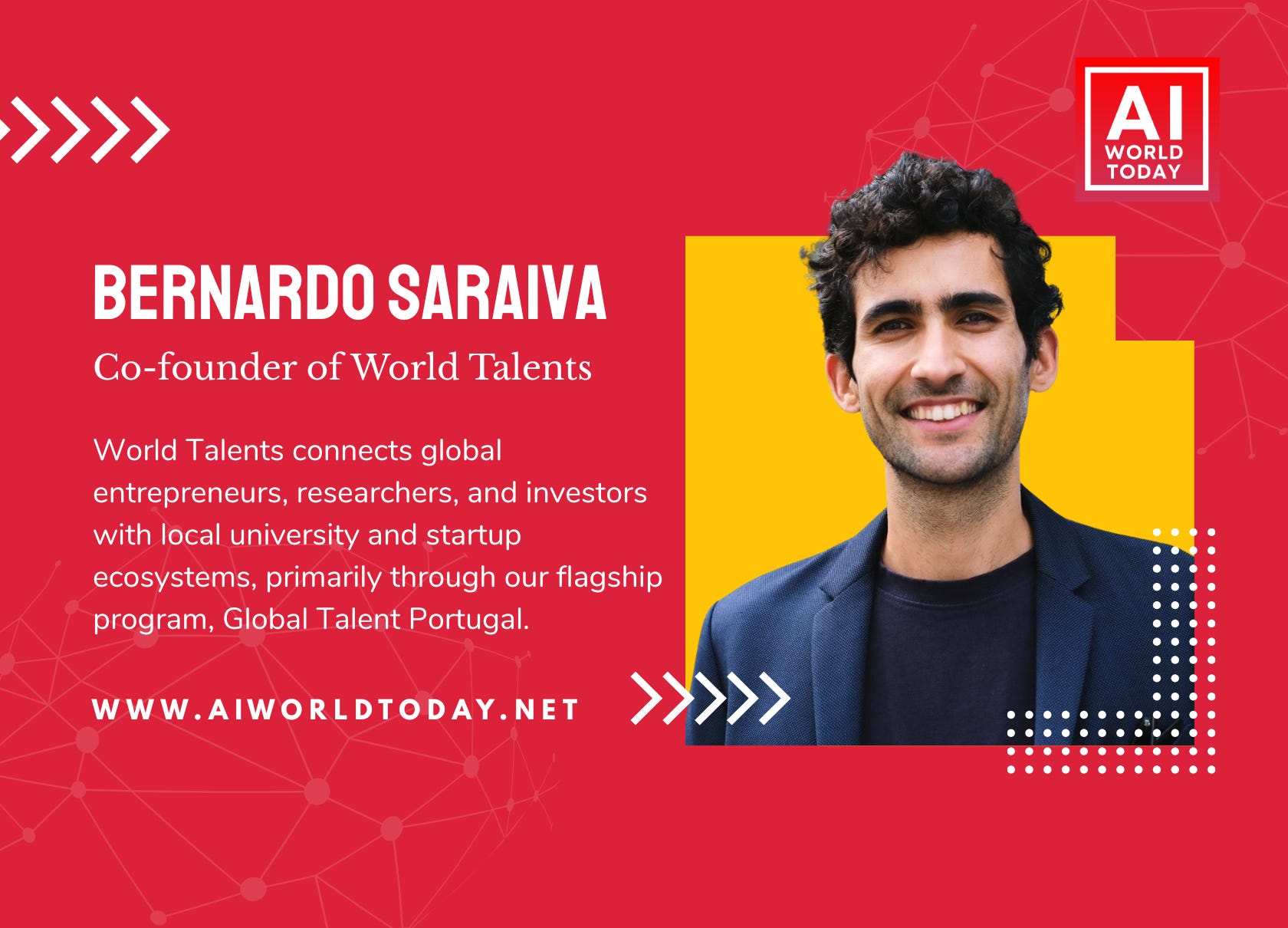
When the conversation turns to the global AI race, the spotlight almost always falls on the same cast of characters: Silicon Valley giants, Chinese tech conglomerates, and the billion-dollar funding rounds that fuel them. But Bernardo Saraiva has spent years watching a different story unfold — one that rarely makes the front page, yet may matter just as much.
Bernardo is the Co-founder and Director at World Talents, a global talent mobility platform that connects high-caliber entrepreneurs, investors, and researchers with startup ecosystems across Europe. His path to this role is anything but conventional. A former professional tennis player on the ATP Tour and a graduate of the University of San Francisco, Bernardo built his career at the intersection of international business, Silicon Valley, and Portugal — giving him a front-row seat to the friction that brilliant people face when they try to cross borders with purpose.
That experience became the blueprint for World Talents. Today, the company’s flagship program, Global Talent Portugal, is quietly placing seasoned CEOs, billion-dollar fund managers, and C-suite veterans from the world’s largest tech companies into the heart of Portugal’s growing innovation ecosystem. The clients aren’t early-career dreamers — they’re operators with exits, track records, and the capital to build anywhere on earth. And increasingly, they’re choosing Europe.
In an exclusive interview with AI World Today, Bernardo pulls back the curtain on this accelerating migration — who’s moving, what’s driving them, and whether Europe’s institutional environment can move fast enough to turn a moment into a lasting structural advantage.
1. While most of the conversation around AI talent focuses on the U.S. and Asia, you’ve been tracking a quieter movement into Europe. What’s actually happening beneath the surface?
The current AI narrative is heavily focused on infrastructure, the large investment rounds, compute capacity, and data center buildouts. I believe we’re missing a critical layer, which is the human talent actually building, implementing, and using these systems. We’re seeing senior AI founders, researchers, and operators choose Europe because of stability, predictability, and access to strong research ecosystems. People still want to build at the highest level, but also within an environment that allows for longer-term thinking and personal stability.
2. You’ve built a career around supporting talent across borders. How did you get into this field, and what was the moment you realized there was a real gap in the market?
I lived firsthand how disorienting it can be to navigate new jurisdictions, and how much opportunity that friction was hiding. I’ve graduated from the University of San Francisco as a student-athlete and spent years competing as a professional tennis player on the ATP Tour across the globe. I then made use of my International Business degree between Portugal and Silicon Valley startups. The gap became obvious when I started meeting entrepreneurs who had the ambition and the capital to move, but no real infrastructure to connect them meaningfully to the places they were moving to.
Most programs were processing visas, and nobody was deeply integrating talent into ecosystems.
That’s what led me to partner with Tim, World Talents’ founder, whose background in investment migration gave us the strategic foundation. We saw a chance to build a global talent mobility program that created real, lasting connections between global entrepreneurs and the local universities, startups, and institutions that needed them.
3. Can you walk us through what World Talents is and what it does? Who is your typical client?
World Talents connects global entrepreneurs, researchers, and investors with local university and startup ecosystems, primarily through our flagship program, Global Talent Portugal. Rather than focusing on passive investment or visa processing alone, we build structured relationships between our clients and Portugal’s leading universities, where they can mentor startups, invest in R&D, and develop new ventures from within the ecosystem or even take board-level roles in emerging companies.
Our typical client is a high-achieving and experienced entrepreneur or senior executive, someone with a track record, a network, and a genuine desire to build something meaningful in a new market. We’ve worked with everyone from NASDAQ-listed companies’ CEOs to C-suite leaders from the Mag 7 to investors with billion-dollar AUM.
4. You’re describing a quiet but real migration of AI talent into Europe. How long has this been happening, and at what point did it shift from a trickle to something you’d call a trend?
The movement has been building for several years, but I believe 2024 was the inflection point. The policy uncertainty in the U.S., particularly around visa access for skilled professionals, pushed the conversation among many founders and operators, who began to assess their futures with greater urgency. What had been a slow drip of digitally nomadic talent became a more deliberate and strategic migration trend of entrepreneurs and senior talent.
The other accelerant has been Europe’s own maturation. Ecosystems in Lisbon, Porto, Berlin, and Tallinn have become quite credible, and the selling point is no longer just the fact that they’re cheaper. When senior AI talent starts seeing peers they respect making the move and thriving, it also becomes a competitive decision.
5. Is this movement being driven more by people wanting to leave the U.S. and Asia, or by what Europe is actively offering? What are the top two or three factors pulling senior AI talent westward?
It’s genuinely both, and they’re reinforcing each other in ways that make the shift harder to ignore.
Three factors stand out. First, visa unpredictability and geopolitical tension are pushing talent to reconsider long-term stability, something we’ve seen affect hiring and expansion decisions directly. Second, cost efficiency is a major driver. Teams in Lisbon or Porto can often operate at 40–50% lower cost than in cities like San Francisco or even London. Third, Europe offers access to both deep technical talent and a 450-million-person market. Combined with a stable environment, this allows founders to build and scale with more predictability.
6. Portugal keeps coming up as an emerging hub in Europe. What specifically makes it attractive to an AI founder or operator who could theoretically set up anywhere in the world?
I often say that Portugal offers something rare: the combination of a growing innovation ecosystem with quality of life and cost structures that larger hubs simply can’t match. A developer who costs €80,000 in London or Berlin might cost €45,000 in Lisbon or Porto, and the talent is genuinely strong, especially in engineering and applied research. Add in access to the EU market, cultural and linguistic bridges to Brazil and Africa. I still believe people underestimate the university ecosystem. Portugal’s research institutions, such as Coimbra University, are genuinely engaged with the startup community through joint R&D, early-stage investment, and talent pipelines. For an AI founder, that proximity to applied research is a structural advantage that’s hard to replicate elsewhere in Europe at this cost.
7. Who exactly is moving? Are these early-career professionals, or are we genuinely talking about founders, fund managers, and C-suite operators with track records?
From what we see at World Talents, it’s firmly the latter. The people coming through our program are seasoned CEOs who have built and exited companies, fund managers looking to deploy capital into European ecosystems, and senior executives with specific sector expertise. We’re seeing several founders who have already had successful exits choosing to build their second or third ventures in Europe. The early-career talent flow is a separate and older phenomenon. What’s newer and more significant is the senior cohort making deliberate decisions to establish themselves here.
8. Critics would argue Europe is still constrained by regulatory complexity, smaller venture markets, and a fragmented ecosystem. How do you respond to that?
Europe has historically struggled with over-regulation, bureaucracy, and fragmentation. But we’re starting to see clear signals of a more innovation-friendly approach to talent, company formation, and cross-border scaling. Initiatives like EU Inc are particularly important because they aim to address one of Europe’s biggest structural challenges: fragmentation. If executed well, they can significantly simplify how startups are built and scaled across the continent.
On the venture side, yes, Europe is still smaller than the U.S., but that doesn’t make it less attractive. In fact, we’re seeing increasing interest from non-European investors and funds who are actively diversifying their exposure beyond the U.S. Critics will always focus on the downside, but right now, the upside in Europe is arguably greater.
9. Are we seeing meaningful company formation or investment activity follow the talent?
Yes, and Portugal is a useful case study. The ecosystem now has 5,091 active startups with nearly 70% founded in the last five years alone. They’ve generated €2.856 billion in total turnover and support around 28,000 jobs, with average salaries 81% above the national average. What’s also notable is that we start to see a distribution of the ecosystem, with serious startup activity happening in regions like Braga and Coimbra, for example, not just Lisbon and Porto. Another great example is Start Campus, which is investing €8.5 billion in a data center hub in Sines.
10. How much of this shift is being shaped by immigration policy versus organic ecosystem growth? And are European governments doing enough to capitalize on the moment?
Policy changes, especially in the U.S., have clearly been an accelerant, but the talent is genuinely drawn to what Europe is building: strong research institutions, improving startup infrastructure, and a high quality of life that supports long-term decisions. This makes their move more sustainable rather than reactive.
That said, Europe is still not moving fast enough to fully capitalize on this moment. The opportunity is exceptional, but these windows don’t stay open indefinitely. The regions that act decisively now by investing in compute capacity, strengthening talent pipelines, and deepening university–industry collaboration will build lasting structural advantages. Where Europe still falls short is in execution at scale. Fragmentation continues to slow down capital flows and talent mobility across borders. Policymakers must streamline these, making it as easy to build and scale across Europe as within a single market.
11. If this migration continues at its current pace, what does the European AI landscape look like in five years? And what’s the single biggest thing that could accelerate or derail it?
Europe has a genuine chance to host a very relevant network of AI clusters, distinct centers of gravity with their own advantages in specific industry applications, foundational research, and enterprise AI. The biggest accelerant would be a coordinated European approach to compute access and AI infrastructure investment, turning national programs into something that truly operates at the EU scale. The biggest risk is regulatory overreach that creates so much compliance overhead that it offsets everything else that makes Europe attractive. The talent is here and arriving. The question is whether the institutional environment can move fast enough to keep it.
Bernardo Saraiva’s perspective offers something rare in the AI conversation: a ground-level view of where the talent is actually going, not just where the money is flowing. His work at World Talents sits at a critical intersection — one where immigration policy, ecosystem maturity, research infrastructure, and human ambition all collide. Whether Europe can fully seize this moment remains an open question, but if the people Bernardo is moving are any indication, the continent’s AI future is being quietly assembled right now, one deliberate one move at a time. For anyone tracking where AI’s next wave of innovation will emerge, the migration he’s describing isn’t a footnote. It may well be the headline.