


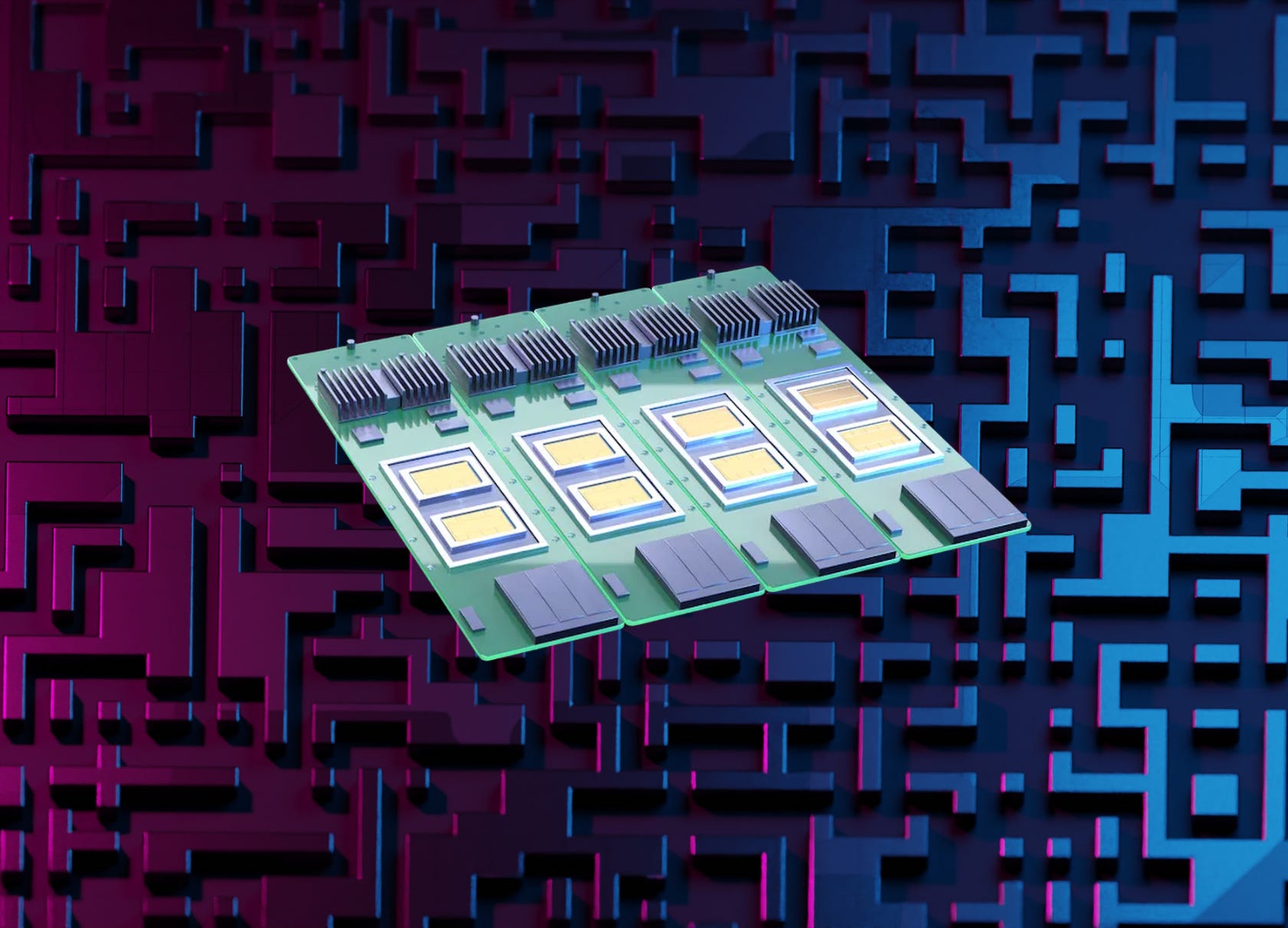
Google introduced two more eighth-generation TPU systems on Nov. 9, bringing its total to four TPU systems in a single year, a first for the company. The timing matters. Hyperscalers and AI labs are pouring money into custom AI chips, and the numbers now show where that spending is landing and where it is not.
Custom AI chips are processors that cloud giants and AI labs design for their own workloads instead of buying general-purpose GPUs. They are gaining ground fast in unit shipments, but Nvidia still captures most AI accelerator revenue, because its chips sell at higher prices and remain the default for training frontier models.
This research piece draws on earnings releases, product announcements, customer agreements and independent forecasts from TrendForce and Silicon Analysts. Every performance figure below comes from the company that makes the chip unless stated otherwise.
What Are Custom AI Chips, and Why Are Companies Building Them?
Custom AI chips are application-specific integrated circuits, or ASICs, built for a narrow set of machine learning jobs. Google’s Tensor Processing Units (TPUs), Amazon’s Trainium, Microsoft’s Maia and Meta’s MTIA are the best-known examples. A GPU can run almost any parallel workload. An ASIC gives up some of that range in exchange for lower cost and power per task.
Inference, the work of serving a trained model to users, now drives much of the demand. Those jobs repeat the same operations millions of times, which suits a fixed design. Power has also become a hard limit on data center growth, so performance per watt counts as much as raw speed. Owning a chip design also gives a cloud provider a second source of supply when GPUs are scarce.
What Is Nvidia’s Market Share in AI Accelerators?
Nvidia’s market share is roughly three-quarters or more of AI accelerator revenue, depending on who is counting. Its lead in dollars has barely moved even as rivals ship more chips.
The scale gap is wide. Nvidia’s data center revenue reached $89.0 billion in its fiscal second quarter ended July 26, up 117% from a year earlier. The company guided total revenue for the following quarter to about $108 billion.
Market share estimates diverge because trackers measure different things. Silicon Analysts projects Nvidia’s revenue share at about 75% for 2026, down from a peak near 87% in 2024. Axis Intelligence Research put Nvidia’s market share at 87.4% for the first quarter of 2026, but it counts only Nvidia, AMD and Intel and leaves out in-house hyperscaler silicon.
Shipment data on custom AI chips tells a different story. TrendForce forecast that cloud providers’ in-house ASICs would grow 44.6% in 2026 versus 16.1% for GPUs, based on AI server shipments. The firm expects ASIC-based systems to reach 27.8% of AI server shipments this year, their highest share since 2023.
Both sets of numbers can be true at once. A custom AI chip generally carries a lower price per unit than a top-end Nvidia part, so a large shift in units produces a much smaller shift in revenue share. When one headline says ASICs are winning and another says Nvidia’s share is stable, the first is usually counting units and the second is counting dollars.
The Google TPU Business Moves Beyond Google
Google built its first TPU more than a decade ago for internal jobs such as voice recognition and translation. It now sells TPU capacity through Google Cloud and lets some customers install TPUs in their own data centers. The company says the business has nearly 100 customers, including frontier AI labs, trading firms, retailers and universities.
Both new systems target specific bottlenecks:
TPU 8tx pairs the silicon of TPU 8t with fifth-generation AMD EPYC CPU hosts. It keeps data and model weights protected while in use, a design aimed at governments and regulated industries. Google claims up to 2x lower latency than TPU 8t.
TPU 8i Max places two TPU 8i chips on one package. This doubles compute, on-chip SRAM and memory bandwidth for agents working across very long context windows.
The largest disclosed outside Google TPU buyer is Anthropic. In October 2025, Anthropic said it would expand its use to as many as 1 million TPUs in a deal worth tens of billions of dollars, expected to bring well over a gigawatt of capacity online in 2026.
The most consequential part of the Nov. 9 announcement may be software rather than silicon. Google said it had open-sourced TorchTPU, which lets PyTorch code and Hugging Face models run natively on TPUs without rewrites. Nvidia’s CUDA platform has long been one of the main reasons developers stay with its GPUs. A lower switching cost matters more to outside customers than any single spec sheet. Google did not disclose pricing or a full rollout schedule for the new systems.
Broadcom Shows Where Custom Chip Spending Goes
Most hyperscalers do not build custom AI chips alone. Broadcom co-designs custom accelerators for several of the largest buyers, which makes its results one of the clearest public readouts on the trend. Its AI semiconductor revenue hit $16.7 billion in the fiscal third quarter ended Aug. 2, up 221% year over year. The company guided to $21.7 billion for the next quarter, a 236% increase.
That growth rate is far faster than Nvidia’s. In absolute terms, Broadcom’s AI business is still less than a fifth the size of Nvidia’s data center segment. Its AI figure also includes networking chips, not only accelerators.
OpenAI is one of the newer customers. The two companies plan 10 gigawatts of OpenAI-designed accelerators, with rack deployments targeted to begin in the second half of 2026 and finish by the end of 2029. OpenAI has signed separate capacity deals with Nvidia and AMD, so the custom program adds to its GPU fleet rather than replacing it.
Are Custom AI Chips Cheaper Than Nvidia GPUs?
For the right workload, the makers say yes, but the public evidence comes almost entirely from the makers. Amazon says customers including Anthropic, Karakuri and Ricoh have cut training costs by up to 50% on Trainium compared with alternatives. Google says TPU 8i delivers 80% better inference price-performance than its previous generation.
That second claim needs a careful read, because Google is comparing TPU 8i with its own older chip, not with an Nvidia GPU. Google also points to InferenceX and AgentX benchmark results from SemiAnalysis that it says show leading price-performance for its TPU software stack. No independent test of TPU 8tx or 8i Max had been published as of Nov. 10.
The table below compares three of the largest custom AI chip programs on the makers’ own claims.
ProgramStatus, Nov. 2026Maker’s main claimNotable external userGoogle TPU, eighth generationFour systems announced in 2026; 8tx and 8i Max pricing not disclosed8t: up to 2.7x training performance; 8i: 80% better inference price-performance, both versus prior TPUsAnthropic, up to 1 million TPUsAWS Trainium3Available through AWSUp to 50% lower training cost versus alternativesAnthropic, Karakuri, RicohOpenAI and Broadcom acceleratorsRack deployments targeted from the second half of 202610 gigawatts planned by the end of 2029OpenAI, internal use
The Case That Nvidia’s Lead Is Safe
The strongest counterargument to the rise of custom AI chips comes from the companies designing them: they keep buying GPUs. Alongside Nvidia’s latest results, AWS and Nvidia announced plans to deploy 2 million additional Nvidia GPUs across AWS infrastructure in 2027 and 2028. Anthropic, one of the largest TPU and Trainium customers, describes its approach as spreading work across Google TPUs, Amazon Trainium and Nvidia GPUs.
Training frontier models also remains mostly a GPU job. Methods shift as research advances, and a GPU’s flexibility protects buyers from betting on a design that may not suit next year’s models. Custom AI chips have found their footing mainly in inference, where the workload is stable and cost per query drives the economics.
When Custom Silicon Is the Wrong Bet
Google’s own announcement describes chip design as a multi-year process bound by manufacturing timelines. That lag means custom AI chips pay off only when the buyer can predict its workload years ahead and run it at enormous volume. Most enterprises meet neither test. A company running a few hundred accelerators, or one without engineers to tune software for a new architecture, will usually do better renting GPUs or a cloud provider’s existing ASIC capacity than commissioning its own design.
Methodology and Limits of This Analysis
Revenue figures come from Nvidia’s and Broadcom’s quarterly earnings releases.
Shipment growth comes from TrendForce forecasts based on AI server shipments, and revenue share comes from Silicon Analysts estimates. Both are projections, not audited counts.
Chip performance and cost claims come from Google and Amazon. They have not been independently verified for the newest systems.
Market share figures for custom AI chips carry extra uncertainty, because Google, Amazon and others do not report chip revenue separately. Outside estimates rely on supply chain data and assumptions about pricing.
What to Watch Next for Custom AI Chips
Custom AI chips are taking a growing share of AI server shipments, while Nvidia keeps the bulk of the revenue and most of the training market. The distance between those two measures is the number to track.
Several dated events will test it:
Nov. 17: Nvidia reports fiscal third-quarter results, against its own guidance of about $108 billion.
Broadcom’s next report: its fiscal fourth quarter closed on Nov. 1, and the report will show whether AI revenue reached the guided $21.7 billion.
Before the end of 2026: OpenAI and Broadcom racks are due to begin deploying.
Still pending: Google has yet to publish pricing and availability for TPU 8tx and 8i Max.
If custom chip revenue keeps compounding at triple-digit rates while Nvidia’s growth slows, revenue share estimates will start to move the way shipment data already has.
Frequently Asked Questions
What are custom AI chips?
Custom AI chips are application-specific integrated circuits that companies design for their own machine learning workloads instead of buying general-purpose GPUs. Google’s TPUs, Amazon’s Trainium, Microsoft’s Maia and Meta’s MTIA are leading examples. They trade some flexibility for lower cost and power use on repeated tasks such as serving models.
Is Nvidia losing market share to custom AI chips?
Slowly in dollars, faster in units. Silicon Analysts projects Nvidia’s share of AI accelerator revenue at about 75% for 2026, down from roughly 87% in 2024. TrendForce expects custom ASIC shipments to grow 44.6% this year, nearly triple the 16.1% growth it forecasts for GPUs.
What is the difference between a TPU and a GPU?
A TPU is a chip Google designed specifically for the matrix math behind neural networks. A GPU is a more general parallel processor that runs graphics, scientific computing and AI. TPUs can be cheaper and more efficient for stable AI workloads, while GPUs offer broader software support and flexibility.
Can companies outside Google use TPUs?
Yes. Google rents TPU capacity through Google Cloud and now lets some customers install TPUs in their own data centers. The company says the business has nearly 100 customers, including frontier AI labs, trading firms, retailers and universities. Anthropic has agreed to use as many as 1 million TPUs.
Are custom AI chips cheaper than Nvidia GPUs?
For predictable workloads at very large scale, the chipmakers say yes. Amazon says some Trainium customers cut training costs by up to 50% compared with alternatives. Most of these figures come from the companies selling the chips, and independent benchmarks for the newest systems were not yet published as of November 2026.
Who designs custom AI chips for tech companies?
Hyperscalers set the specifications, and design partners turn them into manufacturable chips. Broadcom co-designs accelerators for several of the largest buyers, including Google and OpenAI, while Marvell and MediaTek also run custom programs. Taiwan Semiconductor Manufacturing Co. fabricates most of these advanced chips.