


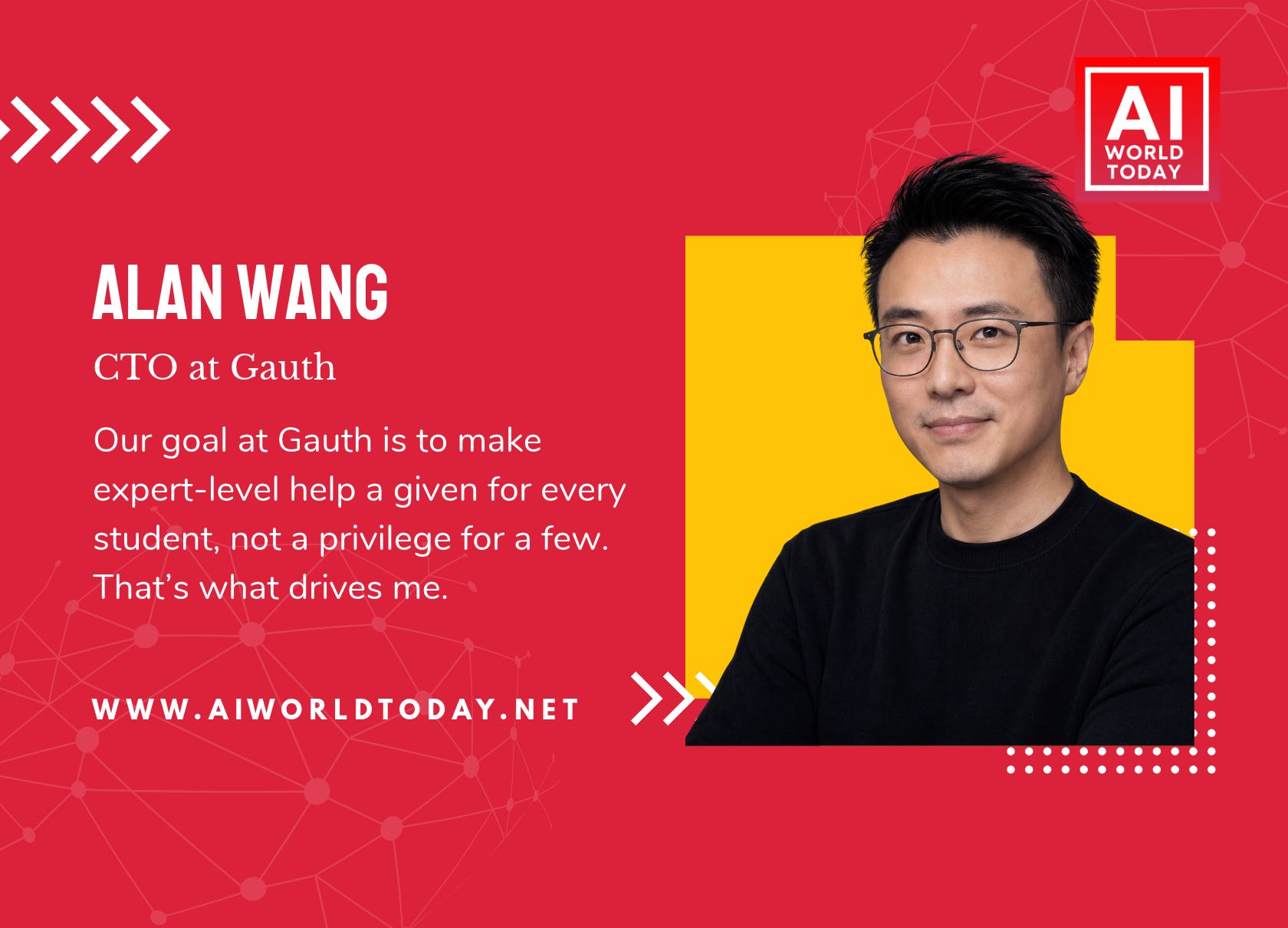
Alan Wang has spent over a decade at the forefront of consumer technology, building products that millions of people rely on every day. His journey began at iFLYTEK, where he worked on AI and speech technology, before moving to Baidu, where he contributed to Baidu Healthcare and Mobile Baidu, a platform that grew to serve more than 100 million daily active users during his time there. Since 2017, Alan has been at ByteDance, where he has led product development across industries as varied as automotive, with Dongchedi, and AI-powered education. Today, as Chief Technology Officer of Gauth, he is channeling that experience into building one of the most widely used AI study platforms in the world, which has surpassed 200 million downloads and continues to expand its reach among students and lifelong learners globally. A graduate of the University of Science and Technology of China (USTC) with a degree in Computer Science, Alan brings both deep technical expertise and a genuine passion for making quality education accessible to everyone, not just those with access to tutors or extra resources.
In an exclusive interview with AI World Today, Alan Wang opens up about the philosophy driving Gauth’s explosive growth, the thinking behind bold new features like AI Course and user-generated lessons, and why he believes the future of AI in education lies not in giving faster answers, but in building deeper understanding. From the architecture that powers Gauth’s step-by-step problem solving to his vision for an AI study partner that remembers a student’s journey over time, Alan offers a rare look into what it takes to build AI products that genuinely change how people learn. He also shares candid advice for the next generation of AI builders on staying grounded in real human frustration rather than chasing technical novelty for its own sake.
INTRODUCTION
You’ve spent over a decade shaping some of the most impactful consumer tech products in the world — from iFLYTEK to Baidu to ByteDance. Could you start by introducing yourself to our readers and sharing a bit about what drives your passion for technology and education?
I’m Alan Wang, CTO at Gauth. I’ve spent more than a decade building consumer technology. I started in AI and speech at iFLYTEK, then worked at Baidu, and now I’m at Gauth. What’s stayed the same is that I like building things a lot of people use every day, and education is where that matters most to me.
Every student gets stuck in their learning journey. Some students have a parent who can sit down with them or a regular tutor for extra help, but many don’t. They have a textbook, a deadline and few extra resources. Our goal at Gauth is to make expert-level help a given for every student, not a privilege for a few. That’s what drives me.
GAUTH’S GROWTH
Gauth has reached 200 million downloads and significant global growth. What do you believe is the single most important reason students around the world keep choosing Gauth over competing study tools?
If I had to pick one thing, it’s that we show the thinking, not just the result. When a student snaps a photo of a problem, the solution is laid out in the same order they’re taught in class, broken into small steps they can check line by line. Then they can then ask a follow-up question or try a similar problem.
Under the hood, we don’t rely on one general-purpose model. We pair a curated bank of more than 500 million academic problems with a model built for education, because the questions students face are messy. They’re handwritten, multimodal and tied to a specific curriculum. But students don’t see the architecture. What they feel is that Gauth meets them where they are, at the moment they’re stuck.
PRODUCT INNOVATION
Gauth recently launched its “AI Course” feature, turning complex topics into cinematic, story-driven learning experiences. You described it as making learning feel “less like studying and more like being pulled into a story.” Can you walk us through the vision behind AI Course and how it was built?
For years, Gauth has helped students one problem at a time, walking through the thinking behind a concept step by step. But the more we dug into how students actually learn, we recognized that most educational content isn’t designed around the individual student and the way they prefer to learn. That’s what led us to build AI Course.
Education is still one-size-fits-all in most cases but with AI Course, instead of asking students to fit into a course, it builds a course around the student. Type any topic and get a full course including visual lessons, mindmaps, and built-in quizzes, designed specifically for you, in seconds.
The story part came from the same thinking. When a lesson is a story, students follow their curiosity and stay with it. Our first courses, built in collaboration with Seedance 2.5, turned history into AI-narrated visual stories. From there we added more than 200 math courses, from Algebra I through AP Calculus, plus an AI Tutor students can pause and ask mid-lesson. Overall, we want students to find learning experiences that can be customized to their preferences.
LEARNING PHILOSOPHY
One of Gauth’s strongest design principles seems to be: don’t just give answers, build understanding. With AI making it dangerously easy to get instant answers, how does Gauth ensure it’s a tool for genuine learning rather than just academic shortcuts?
This is the question we think about most. An answer on its own doesn’t teach anyone anything. The method does, so every part of Gauth is built around the method behind the answer.
Solutions are broken into small steps in the order students learn in class, so they can follow the reasoning and see exactly where they went wrong. After a solve, they can ask why a step works or practice a similar problem on their own. In AI Course, quizzes sit inside the lesson, so students are recalling, not just watching. On the infinite canvas, when a student pauses to ask a question, the AI Tutor acts like a human tutor, explaining steps and concepts in real-time and explains everything right under the step they’re stuck on, so the reasoning stays next to the confusion. We design every feature to keep the thinking front and center.
USER-GENERATED CONTENT
You recently launched a user-generated course feature, letting students build and share their own lessons. That’s a bold shift from passive consumption to active creation. What inspired this move, and what early signals are you seeing from students who’ve used it?
When we looked at how students learn, one thing kept coming up. Most educational content isn’t designed around the individual student: their gaps, their pace, the way they like to learn.
Instead of asking millions of learners to fit into the same course, AI Course lets each student generate one designed for them. Type a topic, pick a level, and in seconds you get a full course with visual lessons, mindmaps and quizzes. You can also turn your own notes or an uploaded document into a lesson.
The part I’m most excited about is sharing. When a student builds a course to explain the Krebs cycle to their study group, they engage with it differently than someone who just watched a lecture. It’s a new model for learning that shifts students from consuming education to creating a learning experience that matches your own curiosity, skill level, and goals.
COMPETITIVE LANDSCAPE
The global EdTech market is becoming increasingly crowded with AI-powered tools. How does Gauth differentiate itself not just on features, but on its fundamental philosophy of what learning with AI should look like?
A lot of AI tools are built around a chat box. You ask, it answers, and the conversation scrolls away. That’s useful, but it’s not how people work through a hard idea. Learning isn’t linear. You jump back to an earlier step, zoom into one detail, then pull back to see how it all connects.
Our view is that AI in education should act less like a search engine and more like someone sitting next to you, working through the problem with you. That’s why we built Gauth for education instead of wrapping a general-purpose model, and why we keep moving away from linear formats. The Infinite Canvas shows this most clearly. The student and the AI Tutor work on the same board, and the tutor can see where the student’s thinking is and step in at that exact point.
FUTURE VISION
Looking ahead, what does the next chapter of Gauth look like? Are there new subjects, geographies, or entirely new learning modalities that you’re most excited about bringing to students worldwide?
The biggest shift I’m excited about is going from helping a student in a single moment to understanding them over time. Right now, most study help starts from zero every time. A student gets stuck, gets help, and the interaction ends. The next time they open the app, it doesn’t know what they struggled with last week, where their gaps are, or how they like things explained.
We’re working on changing that with our next launch this month. Imagine a study partner that remembers where you’ve been, notices the concept underneath the one you’re stuck on, and helps you plan what to work on next, whether you’re building a daily habit or getting ready for a big exam. It’s about guiding students through the reasoning instead of handing them an answer.
Alongside that, we’ll keep pushing what the canvas can do, like bringing 3D and simulations to more subjects and to the courses students create themselves. The principle stays the same. Build around the student, not the other way around..
ADVICE & INSPIRATION
Finally, for the AI enthusiasts, students, and aspiring tech leaders in our AI World Today community — what is the one piece of advice you’d give to someone who wants to build meaningful AI products that truly make a difference in people’s lives?
Start with a real person and a real moment of frustration, not with the technology. For us, it’s a student at 11pm with a problem they can’t solve and nobody to ask. Every decision we make traces back to that moment.
Be honest about the difference between what your users need and what’s impressive to build. A model that gives a perfect answer instantly is impressive. But if the student doesn’t understand that answer, we haven’t helped them. Sometimes the right product is the one that slows down and shows its work.
And decide early who it’s for. If your goal is to make something a given for everyone rather than a privilege for a few, that has to shape your choices from day one, not after you’ve grown.
As AI continues to reshape how students learn, Alan Wang’s approach at Gauth offers a refreshing counterpoint to the industry’s obsession with speed and convenience. Rather than racing toward instant answers, Gauth is betting on a slower, more deliberate path, one where understanding, curiosity, and personalization take center stage. With new features like AI Course, user-generated lessons, and an upcoming memory-driven study partner on the horizon, Alan and his team are signaling a broader shift in EdTech: from tools that simply respond to students, to platforms that truly know them. For the millions of students who open Gauth at their most frustrated moment, that distinction may be the difference between giving up and finally understanding. As Alan puts it, the goal isn’t to impress. It’s to make expert-level support a given for every learner, not a privilege for a few.