


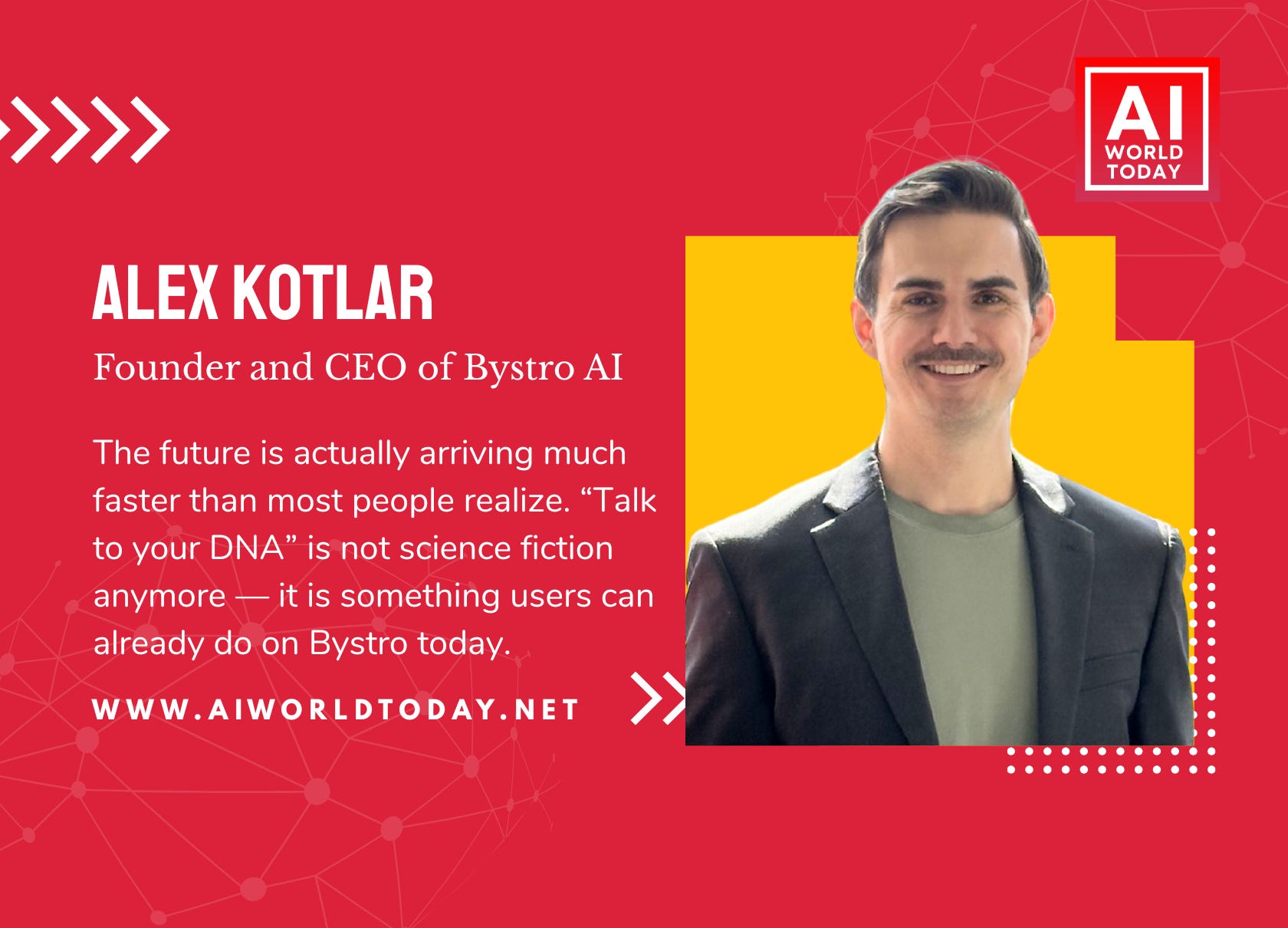
What happens when a childhood shaped by nuclear fallout, immigration, and family tragedy collides with world-class scientific training? For Alex Kotlar, PhD, the answer is Bystro AI — a Boston-based artificial intelligence company quietly rewriting the rules of modern genomics.
Born near Chernobyl, Ukraine, Kotlar immigrated to the United States as a child after his family was exposed to radioactive fallout. Watching loved ones battle cancer didn’t just leave a mark — it ignited a lifelong obsession with understanding disease at its biological roots. That personal fire eventually led him to pursue a PhD in genetics at Emory University, followed by postdoctoral research within the Harvard University and Broad Institute ecosystem, where he sharpened his expertise in large-scale genomic analysis and machine learning. Today, as founder and CEO, Kotlar leads a multidisciplinary team building what many are calling the “ChatGPT for genetic data” — a platform powerful enough to interrogate genome-scale datasets, yet intuitive enough for anyone to use without writing a single line of code.
In an exclusive interview with AI World Today, Kotlar pulls back the curtain on the deeply personal journey that fueled Bystro AI’s creation, breaks down how the platform actually works, and shares his bold vision for a future where genetic insight becomes a foundational layer of medicine — accessible not just to elite researchers, but to billions of people worldwide. From AI ethics and data privacy to the next frontier of predictive healthcare, this conversation is one you won’t want to miss.
Q1. Please introduce yourself to our readers — who is Alex Kotlar, what is Bystro, and what is the core mission driving your work?
I’m Alex Kotlar, the co-founder and CEO of Bystro AI. At its core, Bystro exists to make personalized medicine accessible, understandable, and actionable for everyone — not just elite researchers or major institutions. We believe genetic information should empower individuals, clinicians, and scientists to better understand disease risk, treatment response, and long-term health outcomes. Our mission is to dramatically accelerate discovery while making the power of genomics available to billions of people worldwide.
Q2. Your origin story is remarkably personal — growing up near Chernobyl, immigrating to the U.S., and watching your family battle cancer. How did those early life experiences directly shape your decision to pursue genetics and eventually build Bystro AI?
Those experiences shaped me in two profound ways. First, when you watch people you love suffer from illness up close, healthcare stops being theoretical. It becomes deeply personal and urgent. I lost family members to cancer, and that naturally pushed me toward understanding the biological roots of disease and how we might prevent it earlier.
Second, growing up as a refugee gave me a unique perspective on talent and opportunity. I learned early that brilliance is not confined to elite institutions or privileged backgrounds. There are incredible minds everywhere, but the tools needed to work with genetic data have historically been inaccessible to most people. Part of Bystro’s mission is democratization — giving researchers, clinicians, and even individuals the ability to ask meaningful questions of genetic data without needing an army of engineers or massive institutional resources.
Q3. Bystro AI has been described as a “Google” or “ChatGPT” for genetic data. In simple terms that any of our readers — whether beginners or experts — can understand, how does the platform actually work?
Bystro AI is essentially an agentic AI platform built specifically for genomics and biomedical research. In practical terms, it allows someone to interact with highly complex genetic information using natural language instead of advanced programming.
For example, a user can upload their genomic data and ask questions like:
“Am I genetically predisposed to Alzheimer’s disease?”
“What does my DNA suggest about athletic recovery?”
“Are there genetic markers tied to drug response or metabolism?”
Behind the scenes, Bystro translates those plain-English questions into sophisticated computational analyses that would traditionally require deep expertise in bioinformatics, statistics, and distributed computing. The goal is to make genomic analysis feel conversational, intuitive, and accessible — while still maintaining scientific rigor.
Q4. During your PhD at Emory University, you identified a major bottleneck in genomics — the inaccessibility of analytical tools for most researchers. Can you walk us through that “aha moment” and how it translated into the founding of Bystro AI?
At Emory, my formal training focused heavily on molecular biology and understanding the mechanics of genetics. But once you actually begin doing large-scale genomic research, you realize the real bottleneck isn’t biology alone — it’s computation.
Modern genomics requires an incredibly rare combination of skills: biology, software engineering, machine learning, distributed systems, and advanced statistics. Very few people possess all of those capabilities simultaneously. As a result, research often becomes dependent on massive, expensive teams and slow-moving collaborations.
The “aha moment” for me was realizing that much of this complexity could potentially be automated. If AI systems could handle the computational and algorithmic heavy lifting, then a single scientist with a great idea — or even an individual with curiosity about their own health — could uncover insights thousands of times faster than traditional models allow today. That realization became the foundation of Bystro AI.
Q5. The phrase “talk to your DNA” is both exciting and futuristic. What does that practically look like today on the Bystro AI platform, and how far are we from making this a mainstream reality for everyday people?
The future is actually arriving much faster than most people realize. “Talk to your DNA” is not science fiction anymore — it is something users can already do on Bystro today.
We’ve intentionally been cautious about public rollout because accuracy matters tremendously in healthcare. Before opening the platform broadly, we wanted to ensure the system minimized hallucinations, grounded its outputs in structured genomic data, and consistently produced reliable insights.
Today, users can upload genetic data and interact with it conversationally. Over time, as AI systems improve and genomic sequencing becomes cheaper and more commonplace, I believe this type of interaction will become a foundational layer of medicine much like electronic medical records eventually became standard in healthcare.
Q6. Traditional genomic analysis requires deep programming expertise. How has Bystro AI’s natural-language interface changed the day-to-day experience for scientists and clinicians who are now using the platform?
Traditionally, genomic analysis has required extensive coding knowledge and familiarity with highly specialized software pipelines. That creates enormous friction for clinicians and researchers whose expertise may lie in biology or medicine rather than computer science.
Bystro changes that workflow entirely. Instead of wrestling with code, users can ask direct questions in natural language and receive meaningful, interpretable answers. That dramatically reduces the time between hypothesis and insight.
More importantly, it allows researchers to focus on asking better scientific questions rather than spending the majority of their time managing technical infrastructure.
Q7. You’ve had the privilege of conducting postdoctoral research at institutions affiliated with Harvard University and the Broad Institute. How did those experiences influence the scientific rigor and architecture behind Bystro AI?
I was fortunate to train alongside exceptional scientists and engineers. At Emory, researchers like David Cutler and Michael Zwick helped shape my understanding of statistical genetics and scientific rigor. Later, at the Broad Institute ecosystem, I was exposed to large-scale genomic infrastructure projects and sophisticated distributed computing systems.
Those experiences fundamentally shaped how we built Bystro. We designed the platform with the understanding that biomedical AI requires more than flashy interfaces, it requires deep scientific grounding, scalable infrastructure, and reproducible methods. Seeing how major collaborative genomic projects operate also taught me what it takes to build interdisciplinary teams capable of solving incredibly difficult problems.
Q8. AI in healthcare often faces a trust problem — clinicians and researchers worry about accuracy, bias, and interpretability. How does Bystro AI address those concerns, particularly when the stakes involve disease risk and drug response insights?
That concern is absolutely valid. Every system, AI-powered or otherwise, can make mistakes, especially in medicine. That’s why we view Bystro as a tool to accelerate understanding and decision-making, not as a replacement for physicians or expert clinical judgment.
We approach reliability in several ways:
We built a highly controlled agentic architecture designed specifically for consistency and accuracy, even if it means slower runtimes.
We offload complex computational tasks to deterministic algorithms whenever possible rather than relying entirely on generative AI.
We deeply annotate and structure genomic information so the models operate from grounded, validated data rather than vague abstractions.
We run outputs through multiple layers of automated verification and review to catch inconsistencies or potential errors.
Healthcare AI must earn trust through rigor, transparency, and validation. Not just hype.
Q9. Bystro AI is already being used by leading academic institutions and research consortia. Can you share any specific use cases or outcomes that you are particularly proud of — where the platform made a real, tangible difference?
What excites me most is seeing researchers dramatically accelerate work that previously would have taken enormous teams and long timelines. We’ve seen scientists use Bystro to interrogate massive genomic datasets far more efficiently and surface insights that may have otherwise remained buried behind technical bottlenecks.
More broadly, I’m proud that we are helping lower the barrier to entry in genomics research itself. When people who previously lacked the computational resources or expertise can suddenly engage meaningfully with genetic data, that creates opportunities for entirely new discoveries.
Q10. The AI tools space is evolving at a breathtaking pace. How do you see Bystro AI differentiating itself in an increasingly crowded landscape of AI-powered biotech and health platforms?
Right now, there’s a tendency in the AI space to prioritize breadth over depth, to bolt together large collections of open-source tools without ensuring scientific quality or reliability.
Our philosophy is very different. We care deeply about precision, usability, and scientific rigor. Instead of trying to do everything, we are focused on building the best possible platform for genomics specifically.
I often describe the goal as building an “Apple-like” experience for genomic AI: highly polished, intuitive, and reliable. We want users to trust that the system is not only powerful, but thoughtfully engineered and scientifically defensible.
Q11. You have worn many hats — computational biologist, human geneticist, software engineer, machine learning expert, and now CEO. How do you balance the deeply technical nature of your work with the demands of building and leading a company?
The truth is that building a company at the frontier of AI and genomics requires constant translation between disciplines. You have to understand the science deeply enough to guide technical decisions, but you also need to communicate vision clearly to investors, partners, researchers, and the broader public.
I try to stay rooted in the mission itself. If the mission is meaningful enough, it creates alignment between the technical work and the business decisions. Ultimately, both are in service of the same goal: accelerating personalized medicine and improving human health.
Q12. Genomic data is among the most sensitive personal data in existence. How does Bystro AI approach data privacy, security, and ethics — especially as the platform scales and reaches more individual users?
We take privacy extremely seriously because genetic data is uniquely personal and permanent. One important design choice is that we do not permanently retain users’ uploaded genomic files. For example, when someone uploads a VCF file, it is processed and then deleted immediately afterward. Users maintain control over their derived data and can remove it whenever they choose.
Philosophically, we also believe many past mistakes in tech and healthcare stem from companies collecting far more personal data than they truly need. We intentionally want to avoid that model. Coming from a background shaped by authoritarian systems and personal experiences with institutional overreach, I’m very aware of how dangerous centralized control over sensitive data can become over time.
If individuals participate in research initiatives through Bystro, it should always happen transparently and through clear opt-in consent mechanisms.
Q13. You believe the future of healthcare lies in predicting and preventing disease, not just treating it. How close are we to a world where AI-powered genomics becomes a standard, foundational layer of everyday medicine?
The potential already exists today. The real question is whether society is willing to invest the focus, infrastructure, and effort needed to realize it fully.
I genuinely believe genomics, combined with AI, can help unlock entirely new understandings of disease, aging, longevity, and personalized treatment. The resolution we now have through DNA, RNA, proteins, and metabolomics is extraordinary.
If progress continues at the current pace … and if companies like Bystro are given the opportunity to scale responsibly … I think we could see major breakthroughs within five to ten years. But none of it is inevitable. The future depends on sustained scientific and societal commitment.
Q14. For AI enthusiasts, students, and researchers in our audience who are fascinated by the intersection of AI and genomics — what advice would you give them to break into this space and make a meaningful contribution?
My advice is simple: pursue problems that genuinely matter to you, not just trends that happen to be popular at the moment.
The most meaningful breakthroughs often come from people who become deeply obsessed with difficult problems long before the broader market pays attention. When I first started working on natural-language systems for genetics, almost nobody cared about the concept. There was very little support or funding around it.
But if you commit yourself fully to an important problem and work relentlessly at it, you eventually develop an edge that trends alone cannot replicate. Excellence compounds over time.
Q15. Finally, what is the big vision for Bystro AI over the next five years? Where do you see the company heading, and what does success ultimately look like for you — both professionally and personally?
Our vision is to dramatically accelerate scientific discovery while making personalized medicine genuinely useful and widely accessible for everyday people.
Success for Bystro would mean helping transform healthcare from a reactive system into a predictive and preventive one — where people can identify risks earlier, make better-informed decisions, and live healthier lives because of it.
Personally, success would simply mean building something that creates lasting value for humanity. If we can help even a small part of the world move toward earlier detection, better prevention, and more intelligent healthcare, then I think we’ve accomplished something meaningful.
Alex Kotlar’s story is a powerful reminder that the most transformative innovations are often born not from boardrooms, but from deeply personal battles and an unrelenting refusal to accept the status quo. With Bystro AI, he is not simply building another health tech product — he is working to democratize one of the most powerful datasets in human history: our own DNA. As artificial intelligence continues to accelerate the pace of scientific discovery, platforms like Bystro represent a glimpse into a future where precision medicine is no longer a privilege of the few, but a tool available to everyone. For researchers, clinicians, and curious individuals alike, that future may be closer than we think — and Alex Kotlar intends to be at the forefront of it.