Inside the Philippine data annotation ecosystem that the world’s most technically demanding AI labs, autonomous vehicle programs, and robotics companies depend on — and how PITON-Global’s 25 years of market intelligence connects enterprises directly to the top 1% of providers, free of charge.
Executive Summary
Five foundational facts every AI, robotics, and AV decision-maker needs before choosing an annotation partner:
The world’s most technically demanding AI programs — from large language model alignment to autonomous vehicle perception systems — require annotation quality that only a small fraction of global providers can deliver. The Philippines’ top 1% of BPO providers meets that bar, consistently, at a scale no comparable English-speaking market can match.
Autonomous vehicle annotation demands a unique combination of spatial reasoning, engineering literacy, and extreme precision — LiDAR point-cloud labeling, 3D bounding box annotation, and lane segmentation at pixel level. The Philippines has built specialist AV annotation capabilities that are now embedded in the supply chains of leading mobility technology companies worldwide.
For healthcare AI, the Philippines possesses a structural advantage no other outsourcing destination can replicate: it is the world’s third-largest exporter of nurses and holds one of the largest medical and allied health graduate pools in Asia. This translates directly into a deep reservoir of domain-expert annotators for radiology AI, clinical NLP, and pathology imaging programs.
The quality gap between the median Philippine BPO and the top 1% is wider than most buyers assume. Inter-annotator agreement rates vary from 65% at the low end to above 92% at the top — a differential that determines whether a training dataset produces a production-ready model or a dataset that must be rebuilt from scratch.
PITON-Global is the Philippines’ leading outsourcing advisory firm with 25+ years of on-the-ground market presence, partnering with the nation’s top 14 specialist annotation providers across AI/ML, robotics, autonomous vehicles, and healthcare. Advisory and supplier sourcing are provided 100% free of charge to client organizations.
The Annotation Imperative: Why the World’s Most Advanced AI Runs Through the Philippines
There is a supply chain behind every AI breakthrough that rarely makes headlines. The autonomous vehicle that navigates a rain-slicked intersection at night does so because millions of camera frames were labeled with centimeter-level precision by human annotators who tagged every pedestrian, every lane marking, every traffic cone. The large language model that passes the bar exam was shaped by thousands of human raters who evaluated hundreds of thousands of model responses against nuanced rubrics of accuracy, helpfulness, and reasoning quality. The surgical AI that flags an anomalous cell in a pathology slide learned to do so from annotated training images reviewed by domain-expert labelers with medical backgrounds.
This invisible workforce — the human layer beneath artificial intelligence — is increasingly concentrated in one country. The Philippines has become the annotation engine of the global AI industry, not by accident, but because it uniquely combines the attributes that technically demanding AI programs require: native-level English comprehension, a 30-year BPO infrastructure built to serve the most demanding US and UK clients, a demographic pipeline producing 750,000 university graduates annually, and a government-backed AI strategy that explicitly positions data services as a national priority sector.
The question for AI, robotics, and autonomous vehicle companies is no longer whether to outsource annotation to the Philippines. For most, the answer to that question is already settled. The real question — the one that determines whether an annotation program succeeds or struggles — is which Philippine providers to work with, and how to reach them.
Philippine Annotation Excellence Across the Four Most Demanding AI Verticals
Autonomous Vehicles: Where Precision Is Measured in Centimeters
Autonomous vehicle perception systems are trained on data where annotation error is not merely a quality issue — it is a safety issue. A mislabeled pedestrian in a training frame, a bounding box that clips the edge of a cyclist, an incorrectly segmented road boundary — these errors propagate into neural network weights and can degrade perception performance in edge cases where the cost of failure is catastrophic. The annotation requirements for AV programs are among the most technically rigorous in the AI industry: LiDAR point-cloud labeling, 3D cuboid annotation, semantic and panoptic image segmentation, lane topology mapping, and multi-sensor fusion data alignment.
The Philippines has developed genuine depth in AV annotation. Engineering and information technology graduates, who represent a disproportionately high share of the BPO workforce’s upper talent tier, bring the spatial reasoning and technical literacy that AV annotation demands. Several of the top Philippine annotation providers — accessible through PITON-Global’s curated partner network — have been operating dedicated AV annotation centers for years, with purpose-built quality control pipelines, proprietary 3D annotation tooling, and track records of delivery to mobility technology companies operating in the US, EU, and Japan.
“Autonomous vehicle programs have zero tolerance for annotation error at the edges — and that’s precisely where most annotation providers fall apart. What we’ve built at PITON-Global is a clear view of which Philippine providers have the engineering talent, the tooling maturity, and the QA discipline to hold the precision standards that AV clients demand. We don’t recommend everyone. We recommend the right ones.”
— John Maczynski, CEO, PITON-Global
Robotics: Annotating the Physical World for Machine Intelligence
The next generation of industrial and service robots — systems that pick and pack, perform surgical assistance, navigate warehouses, and collaborate with human workers — require training data that is fundamentally different from the image classification datasets of early computer vision. Robotic AI training data demands grasp-point annotation that specifies precisely where and how a robotic arm should make contact with an object; manipulation trajectory labeling that encodes the physics of object interaction; environment mapping data that enables spatial awareness in unstructured settings; and sensor fusion annotation that aligns inputs from cameras, depth sensors, and force-torque arrays into coherent training examples.
The Philippine annotation workforce brings a combination of technical literacy and meticulous attention to detail that makes it well-suited to these tasks. The country’s engineering graduate pipeline — producing tens of thousands of mechanical, industrial, and electronics engineers annually — supplies annotators who understand the physical and mechanical concepts underlying robotic training data, not merely the visual patterns. This domain comprehension is what separates annotation that produces a generalizable robot from annotation that produces a brittle one.
Healthcare AI: The Structural Advantage No Other Country Can Replicate
Medical AI annotation occupies a unique position in the data services landscape. The consequences of annotation error in a diagnostic AI system — a missed tumor, a misclassified arrhythmia, an incorrectly extracted medication dosage — make domain expertise not a preference but a requirement. Radiology image annotation requires annotators who understand anatomical structures. Clinical NLP requires annotators who can parse medical terminology with accuracy. Pathology slide labeling requires annotators who know what a malignant cell looks like.
Here, the Philippines holds an advantage that no other major outsourcing destination can replicate on structural grounds. The country is the world’s third-largest exporter of nurses, with a nursing and allied health graduate base numbering in the hundreds of thousands. It also produces large cohorts of medical technologists, pharmacists, physical therapists, and other clinical professionals annually. For healthcare AI companies building diagnostic, imaging, or clinical decision support tools, this means that the Philippine annotation market can supply annotators with genuine clinical domain knowledge — not general-purpose crowd workers trained on a three-hour medical labeling tutorial.
“When a healthcare AI company tells us they need annotators for radiology imaging or clinical NLP, we’re not searching for people who can be taught enough medical vocabulary to get by. We’re connecting them with Philippine providers who have dedicated medical annotation teams staffed by nurses, medical technologists, and clinical graduates — people who understand what they’re looking at. That’s a structural advantage the Philippines has that no amount of training can replicate in other markets.”
— John Maczynski, CEO, PITON-Global
Large Language Models and RLHF: The Cognitive Frontier
The emergence of large language model development as a dominant AI investment category has created a new and rapidly growing demand signal for a specific type of annotation: Reinforcement Learning from Human Feedback. RLHF — the process by which human preference raters evaluate model outputs for quality, accuracy, helpfulness, and safety — is cognitively demanding work that requires annotators who can reason analytically about nuanced text at high volume and maintain consistency across complex multi-dimensional rubrics.
The Philippines is the world’s most capable market for RLHF at scale. The combination of near-native English fluency, high analytical reasoning ability in the upper talent tier, and a BPO workforce culturally conditioned by decades of quality-focused, US-client-facing work produces RLHF annotators who can hold the cognitive standards that leading AI labs require. Several of PITON-Global’s 14 specialist partners run dedicated RLHF programs serving AI labs and technology companies building foundation models and generative AI applications.
Philippine Annotation Capability by Industry Vertical: A Technical Assessment
The table below maps the mission-critical annotation tasks for each major AI industry vertical, explains why Philippine talent is specifically well-suited to each, and provides benchmark accuracy standards that enterprise programs should use as evaluation criteria when selecting annotation partners.
Table 1: Philippine Data Annotation Capability — Industry Vertical Deep-Dive
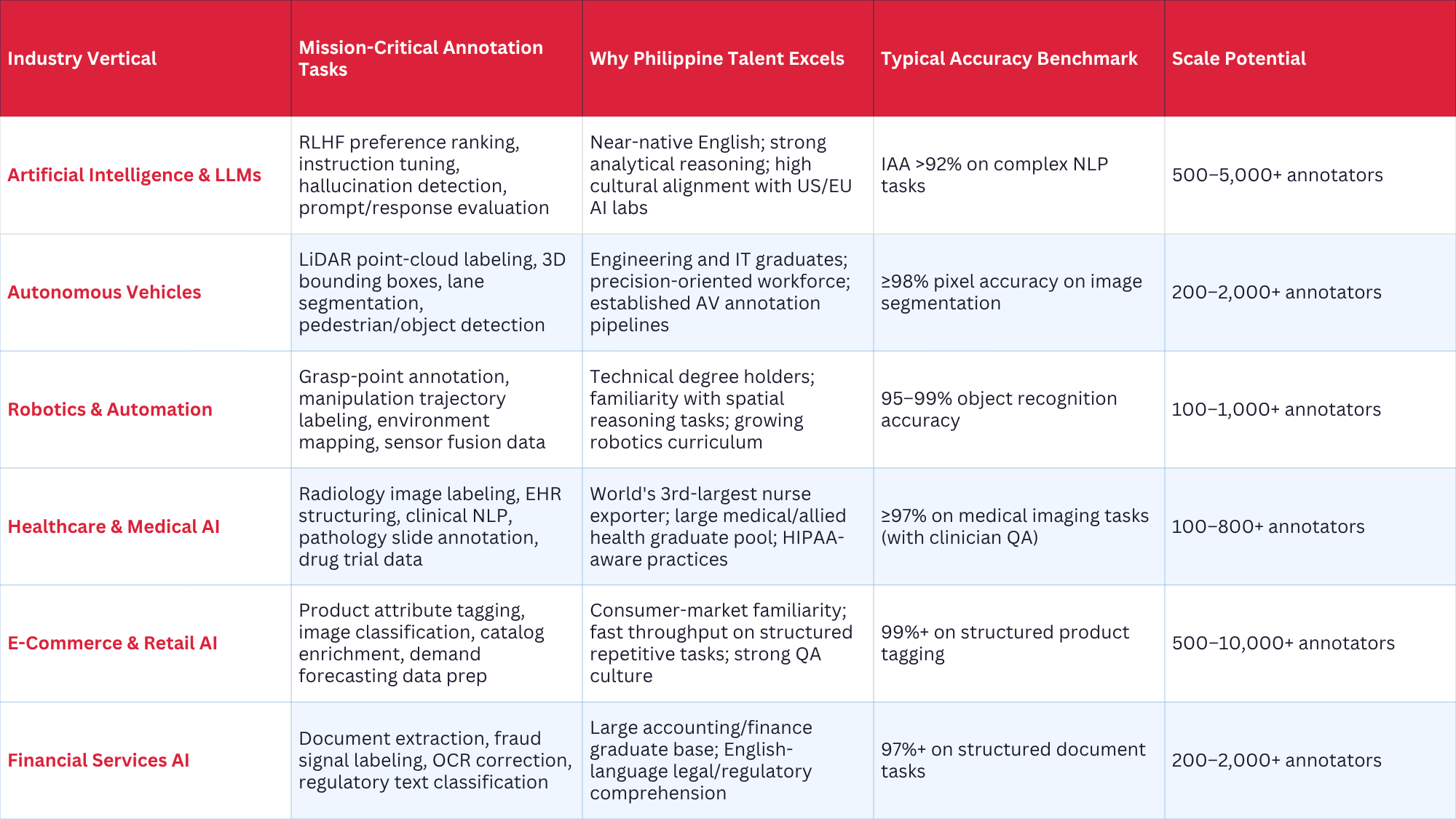
Note: ✔✔ indicates deep specialist capability within PITON-Global’s partner network. IAA and accuracy benchmarks reflect top-1% provider performance standards. Sources: PITON-Global 25-year market assessment
The Quality Gap: Why Provider Selection Is the Most Important Decision You Will Make
The Philippine BPO market contains hundreds of providers who describe themselves as AI data annotation specialists. A small fraction of them genuinely are. The distance between the median provider and the top 1% is not a matter of marginal difference — it is the difference between a training dataset that produces a production-ready model and one that must be rebuilt from the ground up.
The most quantifiable expression of this gap is inter-annotator agreement — the statistical measure of how consistently different annotators label the same data. At the median end of the Philippine annotation market, IAA rates for complex tasks hover between 65% and 75%. This means that roughly one in three to four annotations is inconsistent with other annotators working on the same task — a noise level that corrupts training signals and forces downstream rework. At the top 1%, IAA rates for comparable tasks exceed 90% consistently, sustained across high-volume programs over months and years.
The table below makes explicit the business consequences of this gap across five dimensions that enterprise AI programs encounter directly.
Table 2: The Real Cost of Getting Annotation Wrong — Quality Tier Comparison

“The most expensive decision an AI company can make in the annotation space is choosing the wrong provider and finding out three months into a program. By then you’ve built your training pipeline around their data format, your team is dependent on their delivery schedule, and the quality issues are embedded in datasets you’ve already used for a model run. The cost of switching — in time, in rework, in delayed product launches — is enormous. Our entire advisory model exists to prevent that outcome by getting the provider match right before a single annotation task is assigned.”
— John Maczynski, CEO, PITON-Global
PITON-Global: The Market Intelligence Layer Between Enterprises and the Philippines’ Best Annotation Providers
The Philippine annotation market’s greatest strength — its scale and diversity of providers — is also its greatest navigation challenge for international buyers. Without deep, current, on-the-ground market intelligence, the probability of landing in the top 1% on a first engagement is low. The probability of making a costly mistake is high. This is the market failure that PITON-Global has been solving for over 25 years.
PITON-Global is a leading outsourcing advisory firm with more than a quarter-century of market presence in the Philippines. The firm’s function is not to provide annotation services itself, but to act as the intelligence and matchmaking layer between enterprises with demanding annotation requirements and the Philippine providers with the documented capability to meet them. PITON-Global’s sourcing and advisory services are provided entirely free of charge to client organizations — the firm operates on a supplier-partnership model that aligns its incentives completely with client success.
The firm currently maintains active partnerships with 14 of the Philippines’ top specialist data annotation providers — firms that have been evaluated, over years of engagement, against PITON-Global’s proprietary assessment framework covering quality management systems, security architecture, domain expertise depth, tooling maturity, attrition rates, scalability evidence, and client retention track records. These 14 partners represent coverage across every major annotation vertical: artificial intelligence and large language models, robotics and automation, autonomous vehicles, healthcare and medical AI, financial services, and e-commerce.
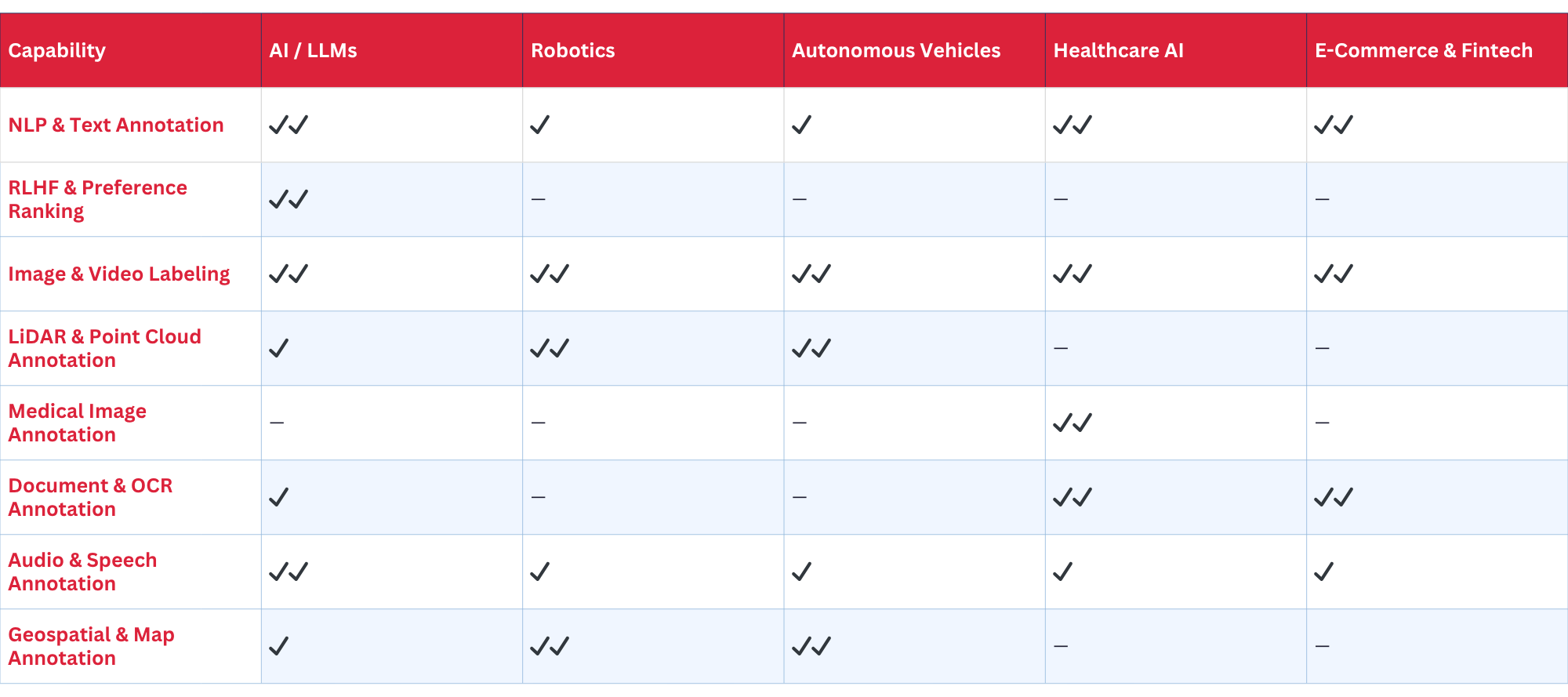
PITON-Global Partner Network: Annotation Capability Coverage Matrix
The following matrix maps the annotation capabilities available across PITON-Global’s 14 specialist Philippine partners by industry vertical. ✔✔ indicates deep specialist capability with demonstrated high-volume track record. ✔ indicates solid capability available within the network. — indicates the partner network does not focus on this combination.
Table 3: PITON-Global Partner Network — Annotation Capability Coverage by Vertical