


Ramayana: Part 1 opened in cinemas worldwide on 5 November 2026, in Hindi and in an English version. That English version relies on a less familiar name: Brahma AI, the Prime Focus AI venture that helped an Indian epic speak a new language.
Brahma AI is an enterprise AI content platform that brings together technology from Prime Focus Technologies, DNEG and Metaphysic. It helps studios and large companies search, create and localise video. Ramayana was shot only in Hindi. For the English version, voice artists recorded the dialogue, and Brahma AI reshaped the actors’ on-screen mouth movements to match it.
How AI lip-sync technology made Ramayana speak English
Nobody went back on set to film the epic a second time. The English cut came together after the shoot, when the team changed the actors’ lip movements to match English. Producer Namit Malhotra has described the pipeline. Voice actors whose faces resemble the cast performed the lines. A human “driver” supplied the mouth movement for each voice. Then a tool Prime Focus built with AI stitched that performance onto the actor’s face.
The first public test came three months before release. The English trailer, released on 5 August 2026, used lip-synced performances made with Brahma AI. Many fans online said the lip-sync looked so natural that the cast might have performed in English, and some even preferred it to the Hindi trailer.
The voices are human. Director Nitesh Tiwari said at the Los Angeles premiere on 27 October 2026 that no AI was used for dubbing, only for lip-sync. Ranbir Kapoor voices Lord Rama himself in the Ramayana English version.
Dubbing and AI lip-sync technology solve two halves of one problem. Here is how a single line of dialogue moves through the process:
A voice artist records the English line, following the emotion of the original Hindi scene.
A performer speaks the English line on camera, so the system has a real mouth movement to copy.
The software maps that movement onto the original actor’s face and leaves the rest of the Hindi performance alone.
Skip step three and you get the old problem of dubbed films. The lips keep moving after the words stop. Subtitles avoid that, but they ask a family audience abroad to read for more than three hours. A face that matches the English words is a far easier way into a story many overseas viewers have never heard.
What is Brahma AI, and where did it come from?
Brahma AI grew out of CLEAR AI, the media asset management system from Prime Focus. It took its current shape when Prime Focus Technologies and Metaphysic came together under one name. Founder and CEO Prabhu Narasimhan leads it. Jo Plaete runs technology as chief technology officer.
Calling it an Indian AI unicorn is fair. Its parent group, Prime Focus, is Indian and listed on the National Stock Exchange.
The products in one table
Under the hood, the enterprise AI content platform has two layers and two named engines:
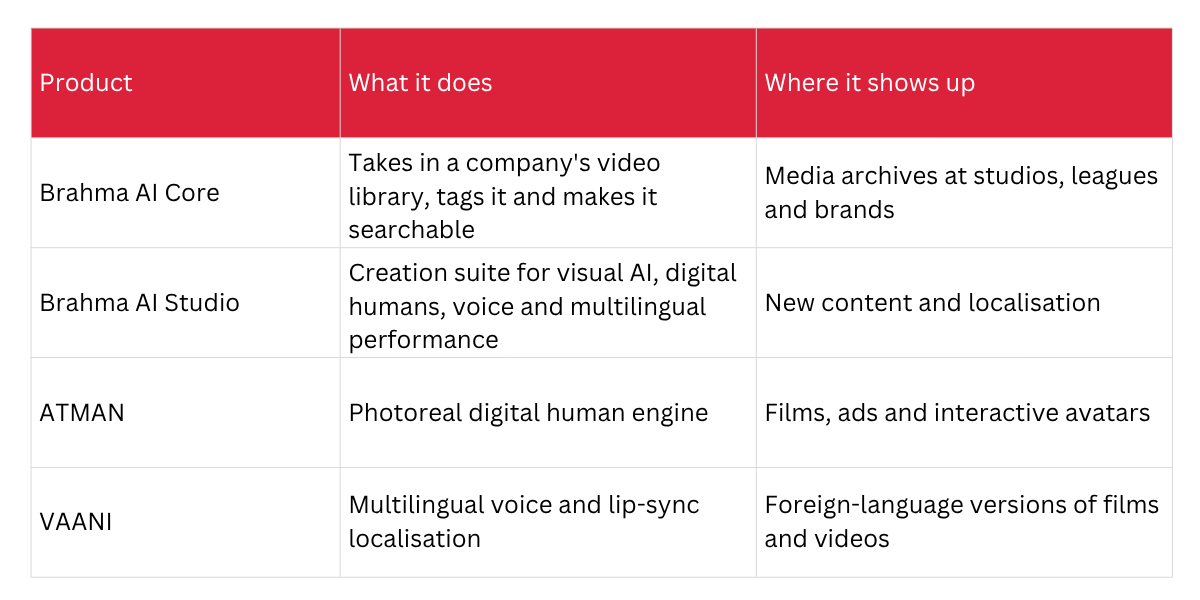
The strength is the combination. Narasimhan argues the edge comes from pairing visual AI tools with an AI-native asset library. A company can find old footage and turn it into something new in one place. He gives a simple test: a fashion brand should be able to pull up every past campaign that shows a woman running with a handbag.
Brahma AI also does not build its own foundation model. It picks whichever model suits the job, so it can adopt better models as they arrive. Narasimhan says the company holds more than 18 patents. He also says no single rival covers the whole chain from archive to finished video, and he places companies such as Synthesia in narrower categories.
Why did Brahma AI win an Emmy?
Brahma AI won a 2026 Technology and Engineering Emmy for AI-based face replacement that keeps an actor’s performance intact. The award recognises its Neural Performance technology. Disney Research, Rising Sun Pictures and Digital Domain were honoured in the same category. Brahma AI was the only AI-native company of the four. The ceremony was scheduled for 14 October 2026 at the Television Academy’s Saban Media Center in North Hollywood, three weeks before Ramayana reached cinemas.
The technology first proved itself on Robert Zemeckis’s Here, the Tom Hanks drama that took its lead from his teens to old age on screen. A US patent on latent space editing and neural animation protects the core method. The same research now powers ATMAN. Since then, the company says, it has been used across feature films, television, live performance and multilingual content. So the tool behind Rama’s English lip-sync has a Hollywood track record.
Who owns Brahma AI after the $150 million round?
Prime Focus will keep most of the economics, but it is giving up control of the company. In September 2026, Brahma AI raised $150 million at a $2 billion valuation. Multiples Alternate Asset Management led the round and committed $100 million through preferred shares. The company also reported another $100 million of investor interest that could enlarge the round. When the round was announced, the lead investment was reported to be awaiting approvals.
Once the deal closes, Prime Focus will keep roughly 66% of the economic ownership through DNEG. Its voting rights will fall to 24.99%. That split is smart design. Prime Focus shareholders keep most of the upside from any future listing. Brahma AI gets the independence that outside investors and enterprise buyers expect from a technology vendor.
The valuation has climbed quickly. When Brahma acquired Metaphysic in February 2025, the combined business was valued at $1.43 billion. One explainer about the film put the company’s worth at $2 million, an error worth correcting. The real figure is a thousand times larger. That is also a 40% rise for the Prime Focus AI venture in about 19 months.
Beyond cinema: interactive digital humans for business
Ramayana is the showpiece, but the business runs on large enterprise accounts. Sales grew from about $45 million in 2024 to $74 million in 2025, with more than $130 million tracked for 2026. The company counts more than 90 customers, and 24 of them bring in over 80% of revenue. It names Warner Bros, the NBA and Mayo Clinic among its anchor accounts.
Four industries, one platform
Brahma AI focuses on four industries: media and entertainment, sports, healthcare and advertising. Multiples founder Renuka Ramnath has framed the bet simply. In her view, every enterprise is becoming a content enterprise. Each one will need a way to manage and reuse what it films, and that is the gap Brahma AI wants to fill.
In March 2026, the company signed a multi-year partnership with Google Cloud. The goal is interactive digital humans that can talk with audiences in many languages. Its Studio platform runs natively on Google Cloud. VAANI uses Google’s text-to-speech and Gemini for speech that stays consistent with a person’s identity. Ramayana chose human voices; for business avatars, synthetic speech is part of the product. A separate deal with Hakuhodo Technologies takes the same digital humans to Japan and the wider Asia-Pacific market.
Think of a sports league with one interview from a star player. With the player’s approval, it could publish versions for fans in Japan, Brazil and India without booking another studio day. That is the business case in one example.
Consent built into the product
Digital humans are created only with the agreement of the person they represent. The company says that person keeps control and ownership of their data. Provenance tools record where content came from, what was created and who created it. For a brand putting its CEO’s face on a multilingual video, that record matters as much as the picture quality.
What comes next for Brahma AI
Narasimhan has said the new money will go mainly into research on interactive digital humans, with a bigger push into the US market. Ramayana has already given the company something a press release cannot: audiences around the world watching its work on cinema screens in the same week. Few Indian AI unicorn stories get that kind of public proof. If the next Indian blockbuster opens in English, Japanese and Portuguese with matching lips, AI lip-sync technology will have moved from novelty to normal.
The company is also raising its profile with the people who buy enterprise software. It demonstrated its platform at NAB Show in Las Vegas in April 2026 and at IBC2026. In October 2026 it was headline partner of World Summit AI in Amsterdam. Expect more launches around interactive avatars, and more Indian films testing the same English route.
If you watched Ramayana in Hindi, see the English version too and judge the lip-sync for yourself.
Frequently Asked Questions
Was Ramayana dubbed using AI?
No. Human voice artists recorded the English dialogue, and Ranbir Kapoor voices Lord Rama himself. AI was used only to adjust the actors’ lip movements so they match the English words. The film’s director and producer both said this publicly before the film’s worldwide release on 5 November 2026.
How is AI lip-sync different from dubbing?
Dubbing replaces the sound: an artist records new dialogue in another language. AI lip-sync changes the picture: software reshapes the actor’s mouth so it matches the new dialogue. Used together, they let a film keep its original performances while viewers hear and see their own language on screen.
Who founded Brahma AI?
Prabhu Narasimhan founded Brahma AI and leads it as chief executive. He built it by combining technology and teams from Prime Focus Technologies, DNEG and Metaphysic. Jo Plaete, an expert in visual AI and digital humans, leads technology and research as chief technology officer.
Is Brahma AI an Indian company?
It has strong Indian roots. Its largest economic shareholder is Prime Focus, an Indian group listed on the National Stock Exchange, and it grew out of Prime Focus technology. The company publishes its announcements from London and serves customers worldwide, so it works as a global business with Indian origins.
How much is Brahma AI worth?
Brahma AI was valued at $2 billion after raising $150 million in September 2026, in a round led by Multiples Alternate Asset Management. Any figure of $2 million is an error. The valuation rose from $1.43 billion in February 2025, when the business acquired Metaphysic.
Which companies use Brahma AI?
The company names Warner Bros, the NBA and Mayo Clinic as anchor customers, and it works across media, sports, healthcare and advertising. It has more than 90 customers in total. Google Cloud and Hakuhodo Technologies are partners that help it reach enterprises in new markets.