


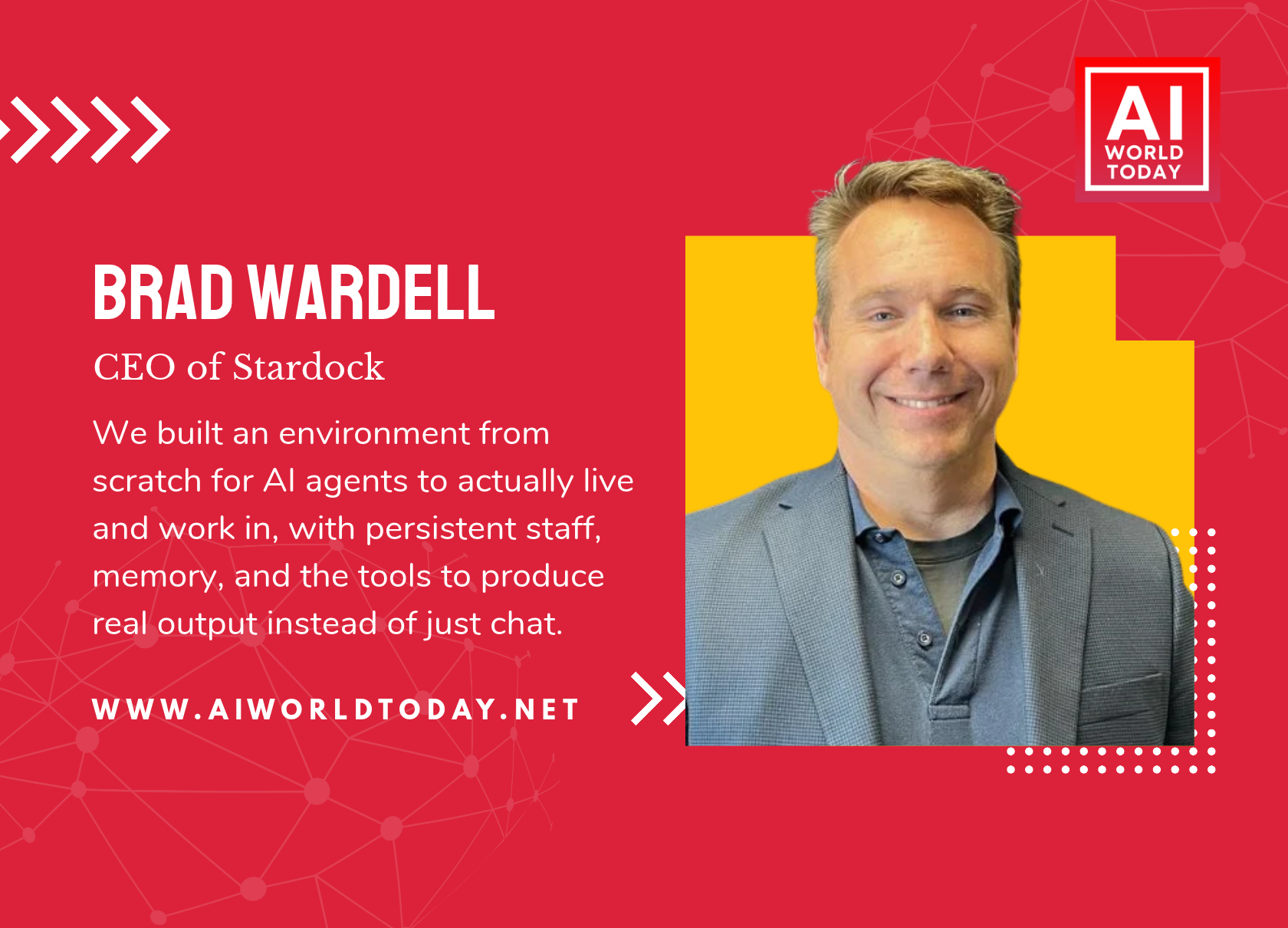
Brad Wardell has spent more than three decades turning frustrating technical problems into software millions of people now take for granted. He founded Stardock out of a college dorm room in 1991, and over the years his company has quietly shaped how we all use computers from the zip-file “compressed folder” standard born out of a 1990s hard-drive shortage, to Ctrl+Alt+Del bringing up a task manager instead of rebooting a PC, to desktop customization staples like Fences, Start11, and WindowBlinds.
Along the way, Stardock also built Impulse, one of the earliest digital distribution platforms for PC games proof that Wardell has always been drawn to solving his own company’s problems first, then sharing the fix with the world.
That same instinct is now driving his newest venture, Clairvoyance AI, incubated at Stardock. Born from an internal tool used to ship the game Ara: History Untold on deadline, Clairvoyance has grown into a free, cross-platform application that lets AI agents work directly on a user’s own machine opening real files, compiling real code, and handing back finished work, rather than living inside a disconnected browser chat window.
In an exclusive interview with AI World Today, Wardell opens up about the origin story behind Clairvoyance, the “AI staff” model that gives agents names, memory, and persistence, why he believes the only real AI trust boundary is a physical one, and how partnerships like the one with Qualcomm’s Snapdragon chips are pushing local, on-device AI into the mainstream. He also shares a bold prediction: within 18 months, he expects 90–95% of everyday AI work to run locally, not in the cloud and explains why he built Clairvoyance, in part, to save the jobs AI might otherwise take.
Q1. Intro
You’ve spent over 30 years building software and games, from a one-person operation to a global developer and publisher. For our readers at AI World Today who may be meeting you for the first time, could you introduce yourself, walk us through the journey of building Stardock, and tell us what excites you most about the work you’re doing right now with Clairvoyance AI?
I’m Brad Wardell, CEO of Stardock. We’ve been making software and games for about 30 years, going back to when I started the company out of my dorm room in college.
I started writing software because of my interest in AI where I wrote the first commercial game to make use of multithreaded computer opponents in the OS/2 game, Galactic Civilizations.
Being located in Michigan, it’s always been a challenge staying competitive, especially in a global market. So we’ve always been excited about the potential technology has in helping people get more done with less.
Over the years, we’ve made a lot of software to solve our problems that later became widely adopted such as ZIP files as folders with Object Desktop or using Ctrl+Alt+Del (which used to reboot the PC) with Process Commander to bring up a task manager or GUI customization with programs like WindowBlinds or put widgets/gadgets on the desktop with DesktopX.
Today our software such as Fences, Start11, DirectSkin, and Multiplicity are used by millions of people worldwide to help users get more done with less effort.
Embracing AI early was a natural fit for our company’s technology culture. We were using a proto-version of Clairvoyance internally in 2023 for document management and search and our Spring 2023 release of Galactic Civilizations IV included a feature called AlienGPT where users could describe the alien civilization they wanted in their game and it would generate the text and images in game.
I started Stardock back in college, in 1991, and incorporated it in ‘93. We were doing OS/2 software early on, and I got obsessed with one problem: OS/2 was incredibly powerful but brutal to use. That’s where Object Desktop came from. A lot of things people take for granted today came out of that era. Compressed folders on Windows are zip files because when we built Object Desktop for OS/2 in the mid-90s, zip was the only compression library we had, so we made zip act like a folder, years before Windows did the same.
What excites me about Clairvoyance is that we’re not bolting AI onto something we already built. We built an environment from scratch for AI agents to actually live and work in, with persistent staff, memory, and the tools to produce real output instead of just chat. We did this for our own team first, so every feature survived contact with real deadlines before anyone outside Stardock ever saw it.
Q2. The Origin Story
Clairvoyance started as an internal tool. What specific Stardock problems were you trying to solve, and what was the “aha moment” that turned it into a public product?
By 2024, what would become known as Clairvoyance was pretty well established at Stardock. We used it heavily to help Microsoft and Oxide Games finish Ara: History Untold.
In that game, a great deal of time was spent bringing creative assets into the game itself. Writing was sent at .DOCX files and would then have to be painstakingly brought into XML or CSV files. 3D assets had to be carefully brought over into the game’s custom engine. Making a balance change involved changing many different files. Localization meant taking the localization studio’s translated files and meticulously matching it up with the right string keys in the right files. Clairvoyance made those tasks painless and enabled the game to ship on time.
By late 2025 there was a lot of internal debate on whether Stardock should make Clairvoyance available to the public. On the one hand it was a tremendous internal advantage. Imagine having a superset of something like OpenClaw a year early. But on the other hand, we were seeing troubling reports of people losing their jobs to AI.
What most people don’t understand about AI is that 99% of its use isn’t for creative endeavors. It’s just that the 1%, art and creative writing generation, gets the most attention because it’s more in your face. In reality, 99% of it is doing things like fixing CMAKE files or writing routine code in C++, Python, Typescript, etc.
I have written A* (pathfinding) algorithms for 30 years. I don’t feel robbed of not having to implement that again. Or type up the XML code for a game save screen UI. Or figure out why some header file suddenly won’t compile. That is where AI makes the biggest difference.
Unfortunately, before Clairvoyance, the general lack of usability surrounding AI tools meant only the most technically proficient users were getting the most out of AI. More specifically, technically proficient people who are following the AI space closely. So we were seeing lots of friends and colleagues losing their jobs to AI automation that could have been saved if they had had Clairvoyance.
In short, Clairvoyance was built to save human jobs (starting with our own).
Q3. “AI Staff” Paradigm
Instead of a standard chatbot, Clairvoyance uses persistent “AI staff.” How do you explain this shift, and why is it a better model for human-AI collaboration?
For our own users, we found that people really struggled with interfaces like ChatGPT because the chats and their outputs were simply lost or hard tro find later They responded much better to not just having the AI sessions stick around permanently but also being able to be given names and give them their own workspaces.
So in Clairvoyance, I come in Monday morning, turn on my PC and my entire staff of developers, producers, Devops, marketers, tech writers, etc. are all back up and ready to go from where we left off complete with names like Bob, Sally, Haalee, etc.
And setting them up this way lets people naturally put them in a hierarchy. For instance, I don’t want to keep track of 20 “agents.” I have a Project Manager (Haalee) and she has 5 or 6 of her staff who have their own staff. And at this point, after months of working with her, I can basically say “Do the magic” and she knows what I mean and who to assign it to.
Q4. Local AI & Privacy
You argue the only real AI trust boundary is a physical one. Why isn’t cloud security enough, and how does local, on-device AI change the privacy equation?
We’re hearing directly from enterprise customers that they’re frustrated with uploading entire confidential workflows to Anthropic or OpenAI. Cloud security is about keeping other people out. It doesn’t answer the question of whether the model provider itself should have your company’s secrets in the first place.
Clairvoyance is local-first by design. This means your notes, projects, and staff memory live on your own machine, and what goes to a cloud model is your call, per staff member. Run a local model and none of it has to leave your hardware at all.
Q5. The Qualcomm Partnership
Clairvoyance was featured at Snapdragon Summit 2026. How did this partnership start, and what does running on the Hexagon NPU mean for the future of on-device AI?
It grew out of us just moving fast. Qualcomm sent us a prototype laptop with their next Snapdragon chip, and we had it running within a weekend. That turned into an official integration and we built Qualcomm’s on-device AI runtime, GeniX, directly into Clairvoyance. On a Snapdragon X Series PC, Clairvoyance runs models on the Hexagon NPU out of the box, you install the app and it’s ready, no separate setup step.
Running natively on the Hexagon NPU means the hardware people already paid for when they bought a Snapdragon PC actually gets used. Agents run locally on the NPU, in the cloud, or a mix of both, all from one app, so your files stay on your machine and your day-to-day tasks come off a metered cloud bill. We built the integration with Qualcomm’s team around one goal, make local AI easy enough that going from unboxing a Snapdragon PC to running a local AI task takes under five minutes.
Q6. Multiplayer AI
Clairvoyance 0.85 introduced real-time Multiplayer AI. What was the core engineering challenge, and how do you secure the host’s machine while others collaborate?
The idea sprang from realizing that it was a lot quicker to just jump into a colleague’s AI session than having to do a Team’s call with them. The average user does not know the difference between an Opus GPT or a Grok Pilot.
The Multiplayer AI lets users ask others to join them live within an existing workspace. It would be like using ChatGPT and being able to have other people contribute to the session including their own files.
Remember, in Clairvoyance, the AI agents are working on the user’s actual computer and not in the cloud which means they don’t have to drag and drop some file to the chat. The AI can go into any location on your computer you’ve given it permission to visit. So Multiplayer AI lets more experienced users quickly help out others on their team.
Q7. Hivemind & Shared Compute
The upcoming Hivemind feature lets agents outsource tasks to more powerful local machines. How does this differ from cloud AI, and what is the enterprise advantage?
In many respects, Hivemind doesn’t differ from Cloud AI at all except in one very important way: You control that cloud yourself. If one of our users accidentally pastes their credentials into chat (you know who you are) it’s not leaving the building.
Like other features, Hivemind started out as an internal problem. Stardock has a game studio which means we have a lot of powerful GPUs all over the place just sitting there. Our first attempts to see if there was a good third-party solution to this involved setting up endpoints and trying to figure out how to control when and how a given GPU would be available.
With Hivemind, the user sharing their GPU just has to say what hours it’s available and to who and they’re done. And a user using it doesn’t have to do anything other than choose Hivemind as their AI provider and it takes care of the rest.
For enterprises, the advantage is straightforward. GPUs are expensive, and most of them sit idle most of the time. A company doesn’t need to buy a $20,000 card for data classification work when it already owns a room full of underused ones. Install it, flip on the feature, and that’s it, there’s no third step.
Q8. AI as a Routing Problem
You’ve said AI is a routing problem, not a model-size problem. How do you decide what runs locally versus in the cloud, and how much work can realistically run on-device today?
We are working on a feature called Concierge that treats this as exactly a routing problem. I think you will see a lot of solutions like it arrive soon now that local AI is viable.
For example, your readers looking at this, admit it, you’ve used Fable or Astra at one time or other to do a Git commit. We’ve all done this because it’s inconvenient to switch to a different model or ask your PM staff agent to orchestrate it to GPT Luna or Sonnet or Composer. With Concierge, you don’t have to do anything. All your staff always know when to route it out to the right model.
I think within 18 months, 90 to 95% of AI work will be local, with only around 5% needing the cloud for frontier work. That’s mostly because almost nothing is being done by AI today. I don’t need Claude Code to look through 400 resumes to see if they’re located in Michigan or to find out if the shipment of ball bearings is going to be here on Monday or Tuesday. Today, that work is still being done by humans even though, obviously, OpenAI would love for you to send that work to them. But even a 4B parameter model can run that and you can run that on a laptop.
The challenge is that the average person doesn’t know what a 4B parameter model is. Or what an Opus is. They just want to say “Please look through this month’s expense reports and make a presentation.” and for it to automagically happen with the right model for the right job. That’s what Concierge does.
Q9. The Nine-Person Studio
You predict tiny teams using AI will soon rival massive studios. What are the limits of this vision, and where is human creativity irreplaceable?
AI can’t make a good game. People make good games. But a 300 person game studio is mostly not making a game at all. They are having to spend their time writing CMAKE files. Handling build servers. Fixing a UI bug where text gets clipped when it’s in German or trying to get that Maya file to look right in the game engine with the same lighting. And meetings. So many meetings.
Before AI, the dream of unleashing one’s creative potential was always blocked by the reality of the job being drawing bubbles 40 hours a week for the Little Mermaid direct to streaming special.
With Clairvoyance, designers, writers, artists and engineers.get to focus on the actual game making part because they’ll have swaths of agentic AI staff doing the grunt work. Including making bubbles.
Q10. Stardock’s Pioneer Legacy
Stardock pioneered digital distribution with Impulse. Does Clairvoyance follow that same DNA of building your own infrastructure, and how does it give you an edge?
It’s the same DNA.
When you use some of these AI programs, even ones from the major providers, it’s often pretty obvious that the people who made them aren’t really using them.
Our advantage is that we are the first customer. We make this for ourselves. Why did “compressed” folders standardize on .ZIP and not one of the more popular formats? Because a Stardock developer in 1993 only had unzip.exe available and we couldn’t afford bigger than 50MB hard drives so we needed zip files to act like folders.
Same for digital distribution. In the late 1990s we never were able to get paid on time by our retail distributors. We needed to develop a way for people to pay and download our software directly. That meant having to figure out how to let people type in credit cards and manage downloads. That ultimately led to Impulse.
And now, we need to get usable AI into the hands of our own employees to do real work. And we want other companies and individuals to be able to do the same thing.
For instance, Clairvoyance isn’t just an AI orchestrator, even more work has gone into document management. The AI makes things. I need easy ways to organize those things, share those things, and quickly find that thing a month later from anywhere at any moment.
Of course, first-mover advantage doesn’t always, or even usually translate into market dominance. We use Windows, not OS/2. It’s Steam. Not Impulse. But it does allow us, we hope, to help nudge the overall trajectory a little bit. And in the case of Clairvoyance, if that helps make AI more usable to more people that will be a real win.
Q11. Coexisting with Giants
Clairvoyance works with tools like Claude, Copilot, and Grok. What is your philosophy on coexisting with frontier models rather than competing against them?
The analogy I would use is to think of Claude, Copilot, Codex and Grok like AI operating systems. Clairvoyance is the shell, file system and front end. Their success is our success and vice versa.
For Clairvoyance, AI models are valuable tools and it’s just picking the right tool for the right job. Clairvoyance’s job is to help people use the right tool and make sure the work they do with AI isn’t transitory.
Q12. The Road Ahead
What do the next 12 months look like for Clairvoyance, and how can interested users get started today?
Users can download and install Clairvoyance at www.clairvoyanceai.com. It’s free.
And when someone gets a new computer, the first thing they should do is go to www.clairvoyanceai.com and download Clairvoyance.
If you already have a subscription to an AI provider, Clairvoyance will download, install and authenticate for you. If you have good hardware, it will find and install local AI models. And if you have neither that’s okay too because it includes Opus and GPT built in.
Then you open the program and can ask it to set up your new computer and your agents can and will go out and download apps, set up your desktop and help get you signed in to your services.
The next year is going to be amazing. As good as AI has gotten, it is the worst it will ever be. Everything gets better so fast.
The frontier models will keep getting better. The local models will keep getting better. And we will keep coming up with new ways to help our engineers, artists, writers, marketers, QA, DevOps, accountants, etc. all get the most out of it.
If you want to follow what we’re building, we’re on X as @AIClairvoyance. And if you want to try it yourself, Clairvoyance is a free download for Windows, macOS, and Linux at clairvoyanceai.com/download.
Talking to Brad Wardell, it’s clear Clairvoyance AI isn’t a reaction to the AI boom it’s the latest chapter in a company that has spent 30 years building infrastructure for problems most people haven’t noticed yet.
From zip folders to digital distribution to now giving everyday workers their own AI staff, Stardock’s pattern has always been the same: solve it for yourself first, prove it under real deadlines, then open it up to everyone else.
With Clairvoyance now running on machines worldwide free, local-first, and designed to work alongside the frontier models people already pay for Wardell is betting that the next leap in AI won’t come from a bigger model in the cloud, but from finally putting AI to work where our files, our businesses, and our creativity actually live. If his track record is any indication, this won’t be the last time Stardock quietly resets what an entire industry considers standard.