


Running a startup feels like juggling fire while riding a unicycle. You need to execute flawlessly, move quickly, and somehow do it all with limited resources. Sound familiar?
The good news is that artificial intelligence has evolved far beyond simple chatbots. Today’s AI tools can handle everything from writing marketing copy to analyzing complex data patterns. They’re not just nice-to-have gadgets anymore - they’re essential weapons in your startup arsenal.
AI now powers over 6.2% of all global startups and accounts for nearly 9.2% of unicorns, underscoring its critical role in modern business success. For entrepreneurs looking to compete with larger, resource-rich companies, the best AI tools for startups offer an incredible equalizer.
Whether you’re a solo founder or leading a small team, these tools can amplify your capabilities dramatically. From automating tedious tasks to generating insights that would typically require a full analytics team, AI for small business growth has never been more accessible or affordable.
In this comprehensive guide, we’ll explore the ten essential AI for entrepreneurs that can transform how you operate in 2026. These aren’t theoretical solutions - they’re battle-tested tools that successful startups use daily to punch above their weight.
Understanding the AI Revolution for Startups
The startup landscape has fundamentally shifted. While competitors struggle with traditional workflows, savvy entrepreneurs leverage artificial intelligence to move faster and smarter.
In 2025, startups are leveraging AI automation tools more than ever to save time, cut costs, and accelerate growth. AI automation allows startups to focus on high-value tasks, improve decision-making, and scale efficiently.
This transformation isn’t just about efficiency gains. It’s about survival. Startups often operate under tight budgets and limited resources, which makes efficiency crucial. AI automation helps by saving time, reducing costs, boosting productivity, and freeing your team for strategic and creative work.
Consider the math. If an AI tool saves just five hours per week per employee at an average hourly cost of $30, that represents $150 in weekly savings. Multiply that across your team and throughout the year - suddenly you’re looking at substantial resources freed up for core business activities.
The best part? You don’t need a computer science degree to harness this power. Modern AI tools prioritize user-friendly interfaces and seamless integration with existing workflows.
What Makes AI Automation Tools for Startups Essential in 2026?
The startup ecosystem moves at breakneck speed. Yesterday’s competitive advantage becomes tomorrow’s baseline expectation. In this environment, AI tools provide three crucial benefits:
Resource Multiplication: Your two-person team can suddenly handle workloads that would typically require ten people. Marketing campaigns run themselves. Customer service operates 24/7. Data analysis happens in seconds instead of hours.
Decision Quality: AI doesn’t just automate tasks - it enhances judgment. Pattern recognition algorithms spot opportunities and risks that human brains might miss, especially when processing large datasets.
Competitive Positioning: While established companies wrestle with legacy systems and bureaucratic approval processes, startups can implement cutting-edge AI solutions immediately.
Marketing automation is the most common AI use case for early-stage startups! AI tools help streamline content creation, ad optimization, and customer engagement, allowing startups to scale faster with fewer resources.
The key is choosing tools that deliver immediate value without overwhelming your limited bandwidth. Let’s explore the ten essential AI for entrepreneurs that meet this criteria.
Top 10 Essential AI for Entrepreneurs in 2026
1. ChatGPT Plus - The Ultimate Content Creation Powerhouse
ChatGPT has become synonymous with AI assistance for good reason. It handles an incredible range of tasks that would otherwise consume enormous amounts of time.
For startups, ChatGPT Plus excels at content creation across multiple formats. Blog posts, social media updates, email campaigns, product descriptions, and even investor pitch decks - the versatility is staggering. You have broader tools like ChatGPT, which can assist with various tasks such as generating content ideas, automating customer responses, or managing schedules.
Beyond content creation, ChatGPT serves as your strategic thinking partner. Need to brainstorm marketing angles? Analyze competitor positioning? Develop pricing strategies? The AI provides thoughtful insights that would typically require expensive consultants.
Key Benefits for Startups:
Produces marketing copy in minutes instead of hours
Handles customer support inquiries with consistent quality
Generates creative solutions to complex business challenges
Scales content production without hiring additional writers
Best Use Cases: Content marketing, customer service automation, strategic brainstorming, email marketing, social media management
2. Notion AI - Your All-in-One Workspace Intelligence

Notion transformed how startups organize information. With AI integration, it becomes an intelligent command center for your entire operation.
Notion AI serves as your digital assistant, taking on the time-consuming tasks that often bog down your workflow. By automating routine tasks such as summarizing texts and generating content outlines, it frees up your schedule, allowing you to concentrate on strategic thinking and innovation.
The real magic happens when Notion AI connects disparate pieces of information. Meeting notes transform into action items. Research documents become strategy outlines. Customer feedback evolves into product roadmaps.
Key Benefits for Startups:
Centralizes all business information in one intelligent platform
Automatically generates summaries of long documents
Creates structured content from unorganized notes
Facilitates team collaboration with AI-powered suggestions
Best Use Cases: Project management, documentation, knowledge management, team coordination, strategic planning
3. Perplexity - The Research Revolution
Traditional research involves hours of Google searches, fact-checking, and source validation. Perplexity compresses this process into minutes while providing superior accuracy.
Perplexity is a conversational AI search engine designed to simplify the way you find information online. Instead of digging through pages of links, it gives clear, real-time answers with direct citations — acting like your personal research partner. Whether you’re diving deep into a project or exploring everyday questions, Perplexity helps you quickly find exactly what you seek.
For startups, this research acceleration proves invaluable across multiple scenarios. Market analysis, competitor intelligence, industry trends, regulatory requirements - all accessible through natural language queries with verified sources.
Key Benefits for Startups:
Eliminates hours of manual research
Provides citations for fact verification
Delivers real-time information
Supports strategic decision-making with comprehensive data
Best Use Cases: Market research, competitive analysis, industry trends, fact-checking, strategic planning
4. Cursor - Revolutionary AI-Powered Coding

Software development typically requires expensive developer talent or lengthy learning curves. Cursor democratizes coding through intelligent AI assistance.
Cursor (formerly Anysphere), the most prominent of the bunch, is aimed at experienced coders. It snagged its first million users by word of mouth. However, its impact extends far beyond experienced developers.
Cursor enhances developer productivity by offering AI-powered code completion and suggestions. Ideal for tech teams, Cursor reduces repetitive coding tasks, allowing developers to focus on creative problem-solving. With its real-time coding suggestions and automated code documentation, Cursor speeds up development and reduces errors.
Key Benefits for Startups:
Accelerates software development by 300-500%
Reduces coding errors through intelligent suggestions
Enables non-developers to build simple applications
Provides real-time documentation and debugging assistance
Best Use Cases: Web development, mobile apps, internal tools, automation scripts, prototype development
5. Zapier - The Ultimate Workflow Automation Platform
Manual data entry and repetitive tasks drain startup energy like nothing else. Zapier eliminates these productivity killers by connecting your apps and automating workflows.
Zapier connects your favorite apps to automate repetitive tasks, making it easy to create workflows without coding. With over 3,000 integrations, you can connect almost any two (or more) apps, streamlining processes across marketing, customer service, and sales. Multi-step Zaps let you chain together actions from various apps, creating complex workflows that save hours of manual work.
The beauty lies in its simplicity. No coding required. Simply specify triggers and actions, then watch as Zapier handles the rest automatically.
Key Benefits for Startups:
Eliminates manual data entry between applications
Creates complex workflows without technical expertise
Scales operations without additional staff
Integrates with virtually every business application
Best Use Cases: Lead management, email automation, data synchronization, customer onboarding, social media posting
6. HubSpot Sales Hub - AI-Powered Sales Acceleration

Sales often makes or breaks startup success. HubSpot’s AI-driven approach transforms how small teams generate and convert leads.
HubSpot Sales Hub is a powerful sales automation tool that integrates with HubSpot’s CRM to streamline the sales process and enhance productivity. Email tracking and notifications notify sales reps when prospects open emails, allowing for timely follow-ups. Sales automation handles repetitive tasks such as follow-up emails and meeting scheduling. AI-powered chatbots engage website visitors in real-time, qualifying leads and booking meetings automatically. HubSpot Sales Hub is user-friendly and offers a free tier, making it accessible for startups. Its automation features help small teams maximize efficiency and focus on closing deals rather than administrative tasks.
Key Benefits for Startups:
Automates lead qualification and nurturing
Provides detailed analytics on sales performance
Enables personalized outreach at scale
Integrates seamlessly with marketing efforts
Best Use Cases: Lead generation, email marketing, sales pipeline management, customer relationship management, performance tracking
7. Synthesia - Professional Video Creation Without Cameras
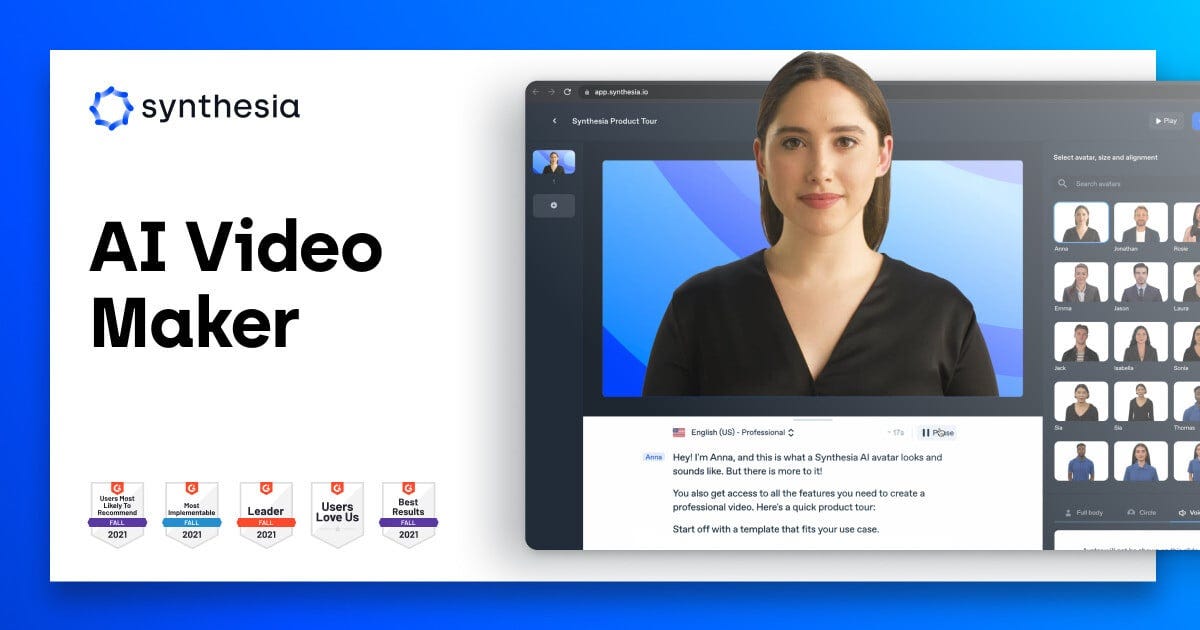
Video content drives engagement like no other medium. However, traditional video production requires significant time, equipment, and expertise. Synthesia eliminates these barriers completely.
Synthesia simplifies video production by utilizing AI-generated avatars and voice synthesis, eliminating the need for expensive filming equipment or production teams. It enables you to convert text into high-quality video presentations featuring realistic AI avatars that deliver content in a natural way. This makes it particularly useful for startups to create high quality marketing materials, training documents, product explainers, and interactive videos without the overhead of traditional video production.
Key Benefits for Startups:
Creates professional videos in multiple languages
Eliminates need for cameras, studios, or actors
Scales video production across different use cases
Maintains consistent brand messaging
Best Use Cases: Product demonstrations, training materials, marketing videos, customer onboarding, investor presentations
8. Lumen5 - Automated Social Media Video Generation

Social media demands constant content creation. Lumen5 transforms written content into engaging videos automatically.
Video marketing is crucial for brand engagement, and Lumen5 stands out as a tool that automates video creation. It’s an ideal solution for startups looking to create impactful video content without the heavy lifting traditionally associated with video production. By leveraging AI, Lumen5 automates much of the video creation process. Users simply provide a script or a link to a blog post, and the platform can generate a video draft in minutes. This automation significantly accelerates the video production process.
Key Benefits for Startups:
Transforms blog posts into engaging videos
Automates social media content creation
Maintains consistent visual branding
Reduces video production costs by 90%
Best Use Cases: Social media marketing, blog promotion, educational content, brand awareness, customer testimonials
9. Scale AI - Enterprise-Grade Data Processing

Data drives modern business decisions. Scale AI provides sophisticated data analysis capabilities typically reserved for large enterprises.
Scale AI believes great AI models start with great data. Founded to accelerate AI development, Scale AI provides tools that simplify the process of collecting, annotating, and optimizing data so teams spend less time on data wrangling and more time creating powerful models. Its generative AI platform helps companies customize leading generative models, ensuring they’re effective, safe, and tailored exactly to business needs.
Key Benefits for Startups:
Processes complex datasets without data science expertise
Provides actionable insights from raw information
Scales data analysis capabilities as you grow
Integrates with existing business intelligence tools
Best Use Cases: Customer behavior analysis, market research, performance optimization, predictive analytics, business intelligence
10. ClickUp Brain - Intelligent Project Management
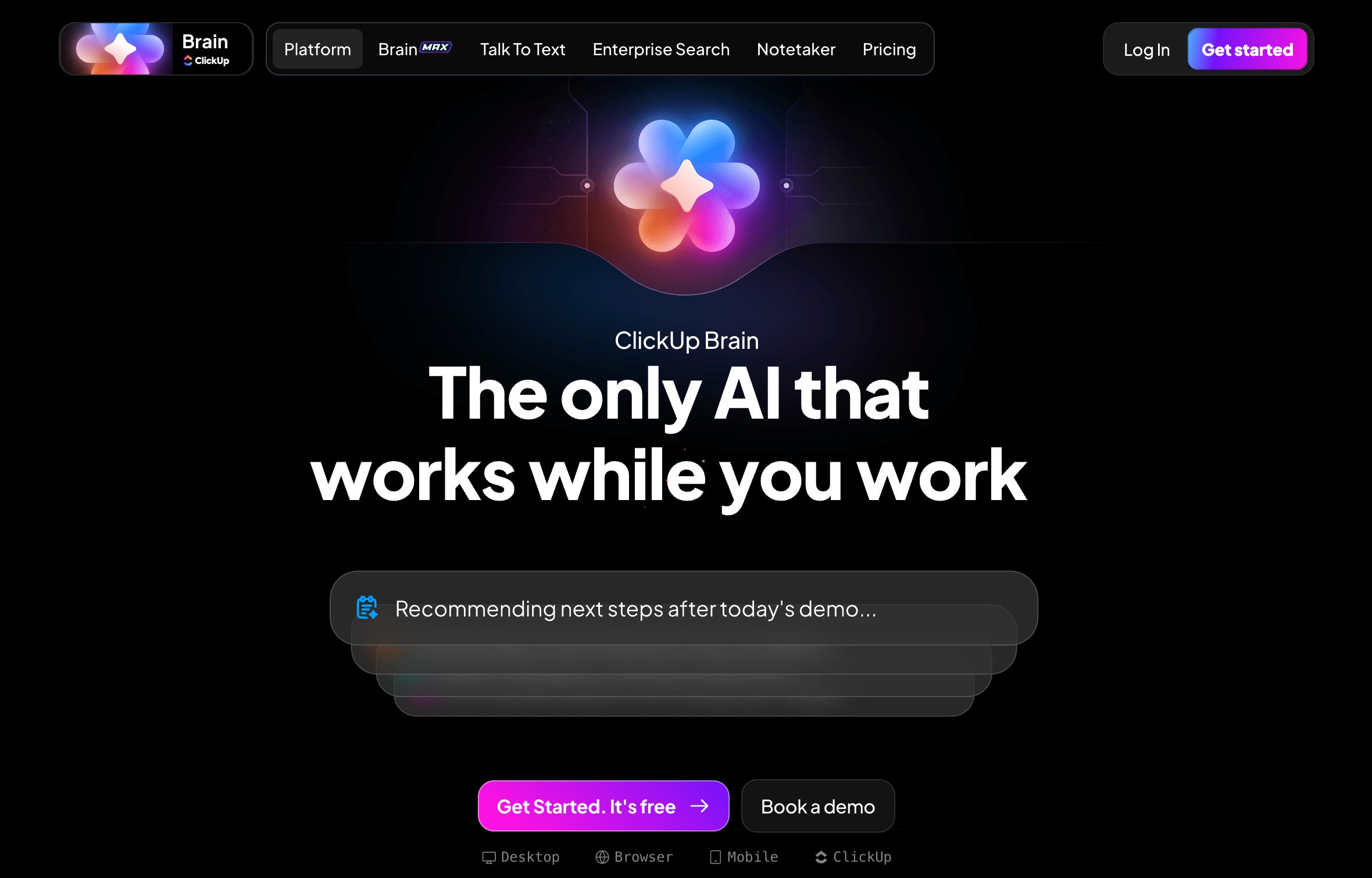
Project management complexity grows exponentially as startups scale. ClickUp Brain applies artificial intelligence to keep everything organized and moving forward.
As your startup grows, so do the workflow complexities. ClickUp Brain doesn’t just automate; it predicts bottlenecks, helping adjust schedules early and stay ahead of project timelines. When balancing multiple projects, ClickUp Brain can analyze workloads, predict timelines, and recommend the best way to distribute tasks. Teams get a clear picture of who’s available and what’s urgent, keeping projects on track.
Key Benefits for Startups:
Predicts project bottlenecks before they occur
Optimizes resource allocation automatically
Generates intelligent task prioritization
Scales project management as teams grow
Best Use Cases: Project planning, resource management, deadline tracking, team coordination, workflow optimization
Implementation Strategy: Getting Started with AI Automation Tools for Startups
Implementing ten new tools simultaneously would overwhelm any startup. Instead, follow this strategic approach:
Phase 1 - Foundation (Month 1): Start with ChatGPT Plus and Notion AI. These provide immediate value across multiple business functions while requiring minimal learning curves.
Phase 2 - Automation (Month 2): Add Zapier to connect your existing tools. Focus on automating your most repetitive tasks first - typically email management, data entry, and social media posting.
Phase 3 - Specialization (Month 3-6): Implement domain-specific tools based on your startup’s primary needs. SaaS companies might prioritize Cursor, while content-focused businesses benefit more from Lumen5 and Synthesia.
Identify repetitive tasks that consume the most time and can be automated. Define goals - decide whether you want to improve marketing, sales, customer support, or internal operations. Test tools using free trials to evaluate which tool fits your workflow best. Check integration to ensure compatibility with existing software. Measure ROI by tracking productivity improvements, time saved, and cost reductions.
Measuring Success with Top AI Software 2026
Success metrics vary by implementation, but focus on these key indicators:
Time Savings: Track hours recovered weekly through automation. Track metrics like time saved, tasks automated, lead conversion improvements, and customer satisfaction scores. For example, if a tool saves 5 hours per week per employee and your average hourly cost is $30, that’s $150 in weekly savings.
Quality Improvements: Monitor error reduction, consistency enhancement, and output quality across automated processes.
Growth Acceleration: Measure how AI tools impact lead generation, conversion rates, and customer satisfaction scores.
Resource Optimization: Calculate cost savings from reduced manual labor and improved efficiency.
Future-Proofing Your Startup with Essential AI for Entrepreneurs
The AI landscape evolves rapidly. Today’s cutting-edge tool becomes tomorrow’s basic requirement. Stay ahead by following these principles:
Continuous Learning: Dedicate time monthly to exploring new AI capabilities and updates to existing tools.
Community Engagement: Join AI and startup communities where entrepreneurs share experiences and recommendations.
Experimentation Budget: Allocate 5-10% of your tool budget for testing emerging AI solutions.
Integration Focus: Prioritize tools that play well with your existing stack over standalone solutions.
Several AI startups secured huge funding rounds and record-breaking valuations during early to mid-November 2025. These companies represent the cutting edge of coding automation, generative AI, enterprise intelligence and AI infrastructure. The AI startup space in November 2025 showed a powerful mix of hyper-growth, deeptech breakthroughs, and global expansion. From billion-dollar raises in Silicon Valley to India’s fast-rising AI-first companies, the sector is moving at unprecedented speed.
This rapid evolution means opportunities emerge constantly. Startups that establish strong AI foundations today position themselves to capitalize on tomorrow’s innovations.
Common Pitfalls to Avoid When Implementing AI for Small Business Growth
Even the best AI tools can backfire without proper implementation. Avoid these common mistakes:
Tool Overload: Implementing too many solutions simultaneously creates confusion and reduces adoption. Start small and scale gradually.
Integration Neglect: Choosing tools that don’t integrate with your existing workflow creates data silos and inefficiencies.
Training Shortfall: Assuming AI tools work perfectly without human guidance leads to poor results and team frustration.
Security Oversight: Failing to evaluate data privacy and security implications before implementing new AI solutions.
ROI Blindness: Focusing on features instead of measurable business outcomes leads to expensive tool collections that don’t drive results.
Building Your AI-Powered Startup Culture
Technology alone doesn’t guarantee success. Creating a culture that embraces and optimizes AI usage requires intentional effort:
Champion Development: Identify team members who demonstrate natural aptitude with AI tools and empower them to train others.
Experimentation Encouragement: Create safe spaces for trying new AI approaches without fear of failure.
Process Documentation: Document successful AI implementations to ensure consistent usage across your growing team.
Regular Reviews: Schedule monthly evaluations of AI tool performance and optimization opportunities.
Success Celebration: Recognize and share wins achieved through AI implementation to build momentum and buy-in.
The Competitive Advantage of Early AI Adoption
Early adoption of AI gives startups an edge over competitors. While larger companies navigate bureaucratic approval processes and legacy system constraints, nimble startups can implement powerful AI solutions immediately.
This advantage compounds over time. Teams that master AI tools today build capabilities that become increasingly difficult for competitors to replicate. The data generated, processes optimized, and insights gained create sustainable competitive moats.
Moreover, customers increasingly expect AI-powered experiences. Startups delivering superior service through AI automation position themselves as innovative leaders rather than scrappy upstarts.
Investment and Resource Allocation for AI Tools
Budget allocation requires strategic thinking. Most startups should follow the 70-20-10 rule:
70% on proven, high-impact tools (ChatGPT Plus, Notion AI, Zapier)
20% on domain-specific solutions aligned with core business needs
10% on experimental tools and emerging technologies
This approach ensures stable productivity gains while maintaining flexibility for innovation.
Remember that AI tools often provide exponential returns. A $50/month investment that saves 20 hours of work weekly generates massive ROI at typical startup wage rates.
Building for Scale: AI Tools That Grow With Your Startup
Choose tools that scale gracefully as your startup grows. The best AI tools for startups offer tiered pricing, advanced features for larger teams, and enterprise-grade security options.
Startups eyeing growth find AI an invaluable resource. By managing scalability challenges—from automating customer service to deriving strategic scaling insights—AI ensures startups can grow sustainably. This helps maintain quality and customer satisfaction and positions startups for long-term success in the competitive business landscape.
Focus on tools that provide APIs, extensive integrations, and customization options. These features become crucial as your needs evolve and your team expands.
Conclusion: Your AI-Powered Future Starts Today
The best AI tools for startups aren’t just productivity enhancers - they’re business transformation engines. From automating mundane tasks to generating sophisticated insights, these ten essential tools provide the foundation for sustainable competitive advantage.
Success requires more than tool selection. Implementation strategy, team training, and continuous optimization determine whether AI becomes a game-changer or an expensive distraction.
The startups thriving in 2026 will be those that embrace AI for small business growth today. While competitors struggle with manual processes and resource constraints, AI-powered startups operate with the efficiency and capability of much larger organizations.
Your journey begins with a single step. Choose one tool from this list, implement it thoroughly, and measure the results. Then build momentum by adding complementary solutions systematically.
The future belongs to startups that harness artificial intelligence effectively. The tools exist. The opportunity is clear. The only question remaining is: will you lead or follow?
Start today. Your AI-powered startup transformation awaits.
Frequently Asked Questions (FAQs)
Q1: What are the most cost-effective AI tools for early-stage startups?
A: ChatGPT Plus, Notion AI, and Zapier offer the best value for early-stage startups. These tools provide broad functionality across multiple business areas, with ChatGPT Plus starting at $20/month, Notion AI at $8/month, and Zapier offering a generous free tier. The combined impact of these three tools typically saves 15-20 hours per week for small teams.
Q2: How much should startups budget for AI tools in 2026?
A: Most successful startups allocate $200-500 monthly for AI tools, following the 70-20-10 budget rule: 70% on proven tools like ChatGPT and Notion AI, 20% on domain-specific solutions, and 10% for experimental technologies. This investment typically generates 300-500% ROI through time savings and productivity gains.
Q3: Can non-technical founders effectively implement these AI automation tools?
A: Absolutely. Modern AI tools prioritize user-friendly interfaces designed for non-technical users. Tools like Zapier, Notion AI, and HubSpot require no coding knowledge. Most founders can implement basic automation within hours using templates and guided setups. Focus on starting small and gradually expanding complexity.
Q4: Which AI tools provide the fastest ROI for startups?
A: Zapier and ChatGPT Plus typically deliver the fastest ROI by automating repetitive tasks immediately. Zapier can eliminate hours of manual data entry within days of setup, while ChatGPT Plus transforms content creation speed instantly. Most startups see measurable time savings within the first week of implementation.
Q5: How do I choose between competing AI tools in the same category?
A: Evaluate based on integration capabilities, ease of use, pricing structure, and specific feature alignment with your workflow. Use free trials to test 2-3 options for at least one week. Focus on tools that integrate seamlessly with your existing stack rather than standalone solutions that create data silos.
Q6: What security considerations should startups have when using AI tools?
A: Prioritize tools with SOC 2 compliance, data encryption, and clear data retention policies. Avoid uploading sensitive customer data or proprietary information to AI tools without understanding their privacy policies. Consider tools that offer on-premise or private cloud options for sensitive applications.
Q7: How can startups stay updated with the latest AI tools and features?
A: Join AI-focused communities on LinkedIn and Twitter, subscribe to newsletters from tools you use, and allocate 2-3 hours monthly for exploring new AI solutions. Follow startup accelerators like Y Combinator for insights on emerging AI tools, and participate in startup communities where founders share AI implementation experiences.