


Key Takeways:
• Quality is the constraint. Once AI moves from pilot to production, reliability depends on the quality of human feedback after training, not on model size alone.
• 2027 raises the bar. The EU AI Act’s high-risk obligations apply from 2 December 2027, and they treat annotation and labeling as governed data practices.
• The Philippines has the scale. The country’s IT-BPM industry is on course for an estimated $42.3 billion in revenue and 1.96 million full-time employees in 2026, making it the world’s second-largest delivery geography.
• Match the provider to the modality. Text, vision, and robotics work need different tooling, metrics, and reviewer skills.
• Buy on cost per usable output. A calibration pilot on hard-edge cases tells you more than any hourly rate or sales deck.
• Know when to say no. Offshore delivery is the wrong choice for data that cannot leave its jurisdiction and for judgments reserved for licensed onshore professionals.
AI training outsourcing to the Philippines is fast becoming part of how enterprise engineering teams in the United States and the United Kingdom move artificial intelligence from controlled pilots into live production, because model reliability depends heavily on post-training data quality rather than model size alone. When systems handle multi-step instructions, nuanced tone, or regulated workflows, vague evaluation rubrics and inconsistent human feedback quickly show up as hallucinations, policy slips, and costly rework.
I have spent more than 25 years building and advising outsourcing operations on the ground in the Philippines, and I have watched every new service line go through the same learning curve: buyers who choose on headline price pay for it later in rework. AI data work is no different, except that the cost of getting it wrong now lands inside the model itself.
For US and UK technology leaders, it has become a practical way to scale calibrated human judgment—including LLM training outsourcing to the Philippines for reinforcement learning from human feedback (RLHF), preference ranking, red teaming, and domain evaluation. Through PITON-Global, enterprises access free outsourcing advisory and supplier sourcing services for AI, robotics, and autonomous vehicle (AV) clients, connecting technical buyers with vetted delivery partners. Over the last two years, we have advised and assisted more than a dozen AI, robotics, and AV companies with their supplier sourcing. This article sets out what I would want any US or UK team to know before 2027.
Why Are US and UK Teams Turning to the Philippines for AI Training Outsourcing?
US and UK teams turn to AI training outsourcing to the Philippines because it combines strong English fluency, familiarity with Western business and regulatory norms, and decades of BPO quality management at lower cost than onshore hiring.
The scale behind that claim is measurable. The industry estimates that it will close 2026 with $42.3 billion in revenue and 1.96 million full-time employees, up from $40.3 billion a year earlier, and projects $45.3 billion and 1.99 million for 2027. The Philippines holds 17% of global IT-BPM services headcount and is the world’s second-largest delivery geography after India. On English, the country scores 565 on the 2026 EF English Proficiency Index, 80 points above the global average of 485 and inside the index’s high-proficiency band.

Reviewers of modern AI systems must judge whether an output follows multi-part constraints, stays grounded in source material, avoids fabricated claims, and matches appropriate tone and terminology for US and UK audiences.
• English Fluency and Cultural Nuance: High English proficiency and long-standing operational ties with US and UK enterprises help reviewers spot subtle shifts in tone, idiom, and intent without translating rubrics from scratch.
• Established Process and QA Discipline: Decades of enterprise BPO delivery in the Philippines have normalized written standard operating procedures, calibration exercises, and multi-layer review.
• Cost Efficiency Without Headcount Drag: Dedicated offshore teams can scale capacity flexibly while keeping internal research and engineering headcount focused on core model development.
From where I sit, the second point is the one buyers underrate. English gets a team through the door; the habit of working to a written standard, being audited against it, and escalating what does not fit is what makes AI evaluation work. It took the Philippine industry decades to build, and it transfers directly.
“Scaling AI data operations breaks down when teams treat complex evaluation like simple bulk tagging,” said John Maczynski, CEO of PITON-Global. “Reliable model performance requires clear rubrics, calibrated reviewers, and accountability around edge cases from day one.”
What Changes for AI Training Outsourcing in 2027?
Three things change for AI training outsourcing in 2027: regulation starts to reach the data work itself, governance becomes the deciding factor in whether AI delivers value, and the Philippine industry is repositioning around AI-enabled work. Teams that set up their outsourcing model in 2026 are choosing the operating conditions they will be audited under in 2027.
Regulation reaches annotation. The EU’s Digital Omnibus on AI, in force since July 2026, moved the application date for standalone high-risk AI systems under Annex III of the EU AI Act to 2 December 2027, with high-risk AI embedded in regulated products following on 2 August 2028. For any US or UK company placing such systems on the EU market, Article 10 of the Act requires training, validation, and testing data to be subject to data governance practices, and it names annotation and labeling among the data-preparation operations those practices must cover. Outsourced labeling is therefore part of the compliance record, not a back-office detail.

Governance decides value. Gartner predicted in September 2026 that by 2027, 60% of organizations that fail to address the cultural challenges of data and analytics governance will fail to govern AI successfully. Its earlier research predicted that through 2026, organizations will abandon 60% of AI projects unsupported by AI-ready data. Human feedback data is AI-ready only when the people producing it are calibrated, supervised, and auditable.

The industry is repositioning. In July 2026, the industry revised its industry roadmap, citing rapid AI adoption and intensifying global competition, and began framing its workforce targets around AI-enabled workers. In my view this is good news for AI buyers: providers now have a strategic reason to invest in the specialist skills, tooling, and security that AI data work demands, rather than treating it as a side line to voice support.
How Does LLM Training Outsourcing to the Philippines Differ From Legacy Labeling?
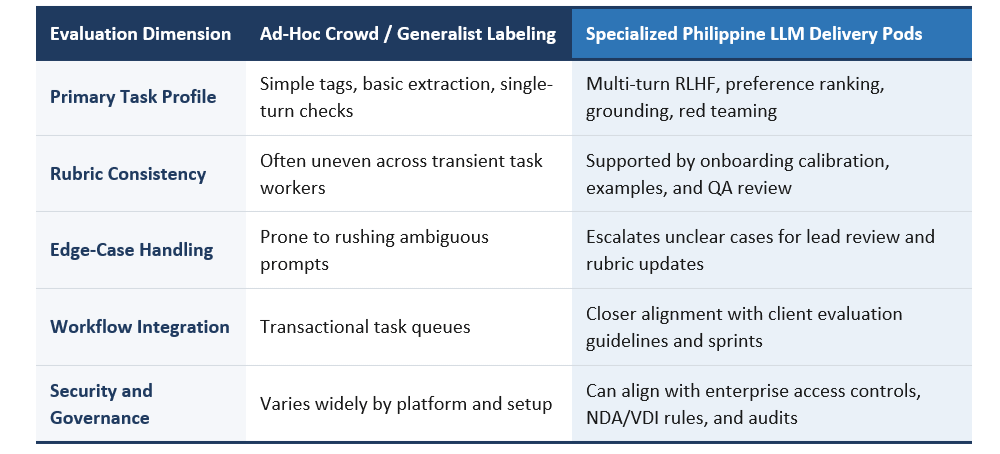
LLM training outsourcing to the Philippines differs from legacy AI training outsourcing by prioritizing rubric calibration, multi-turn reasoning checks, and specialist adjudication over high-volume, single-turn labeling. Legacy crowd workflows were built for simple classification tasks; large language model alignment requires consistent judgment across nuanced edge cases.
Table 1. Ad-hoc crowd labeling versus specialized Philippine LLM delivery pods
Which LLM and AI Workflows Benefit Most From Dedicated Human Review?
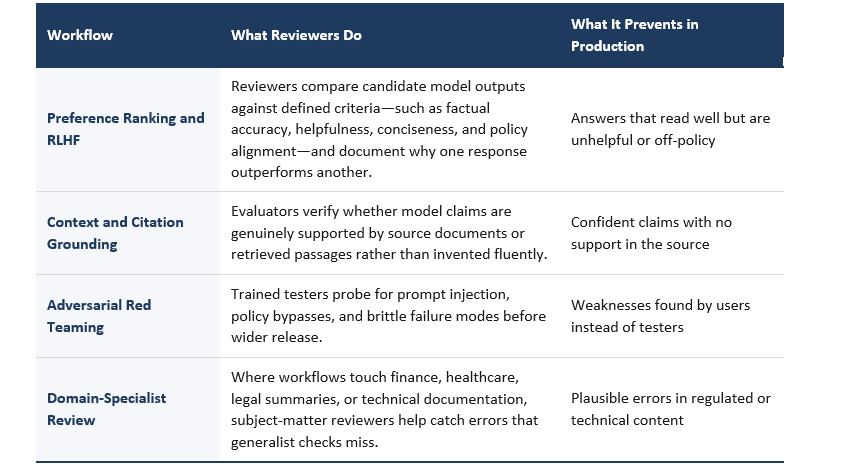
LLM and AI workflows that benefit most from dedicated human review are preference ranking, factual grounding verification, adversarial red teaming, and domain-specific rubric grading. These stages shape how a model behaves when users ask ambiguous, incomplete, or high-stakes questions in production.

Table 2. What reviewers do in each workflow, and what it prevents in production
How Do Modality Needs Shape AI Training Outsourcing Across NLP, Vision, and Robotics?
Modality needs shape AI training outsourcing to the Philippines because evaluating text preferences and safety boundaries requires different workflows and tooling than labeling 2D imagery, 3D sensor data, or physical robotics trajectories. Matching the provider’s proven modality to your actual data type prevents quality bottlenecks and rework.
Table 3. How text, vision, and robotics work differ, and what to test in a pilot
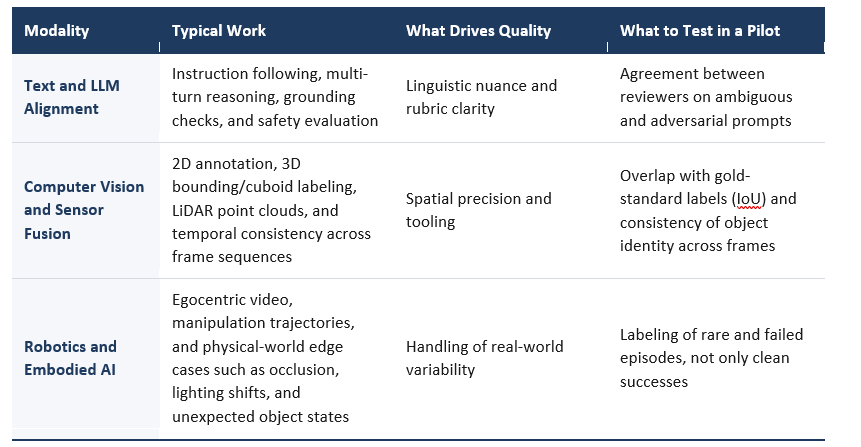
This is where I see the most avoidable mistakes. A provider with an excellent LLM evaluation practice is not automatically equipped for LiDAR, and a strong autonomous-vehicle annotation team may have no reviewers who can adjudicate a legal summary. Capability lists rarely make the distinction clear; a pilot on your own data does, which is why PITON-Global matches providers to the modality before anything else.
“The strongest outsourcing decisions happen when technical leaders define quality thresholds and security requirements before comparing price,” noted John Maczynski, CEO of PITON-Global. “Matching the right operational model to the workload saves months of rework later.”
What Should US and UK Buyers Check on Data Protection and Working Hours?
US and UK buyers should check two practical matters before any data leaves their environment: which legal mechanism covers the transfer, and which shift pattern gives them live overlap with the delivery team. The answers differ between the two countries, and both are easier to settle in the contract than after launch.
Table 4. Practical differences for US and UK buyers
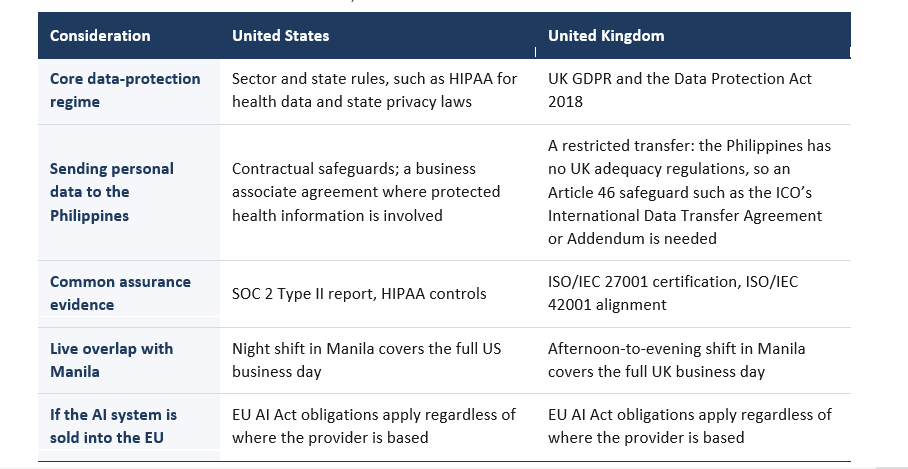
On the Philippine side, providers operate under the Data Privacy Act of 2012, enforced by the National Privacy Commission. On working hours, the Philippine industry was built on serving US time zones overnight, so round-the-clock shifts are normal practice rather than a special request.

How Should US and UK Leaders Vet Partners and Govern Security?
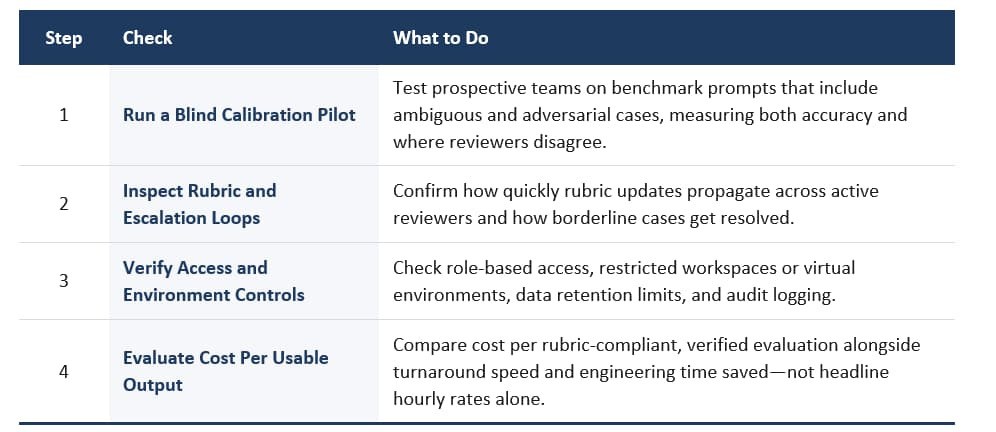
US and UK leaders should vet partners through a structured test on hard-edge cases, an audit of QA and escalation workflows, and verification of data security controls. Whatever the standard—SOC 2 Type II, ISO/IEC 42001, HIPAA, or UK/EU data-protection rules—access controls must be verified before sensitive prompts or proprietary data leave the internal environment.
Before committing to a multi-month engagement, engineering and security leads can use a practical four-point check:

Table 5. The four-point partner check
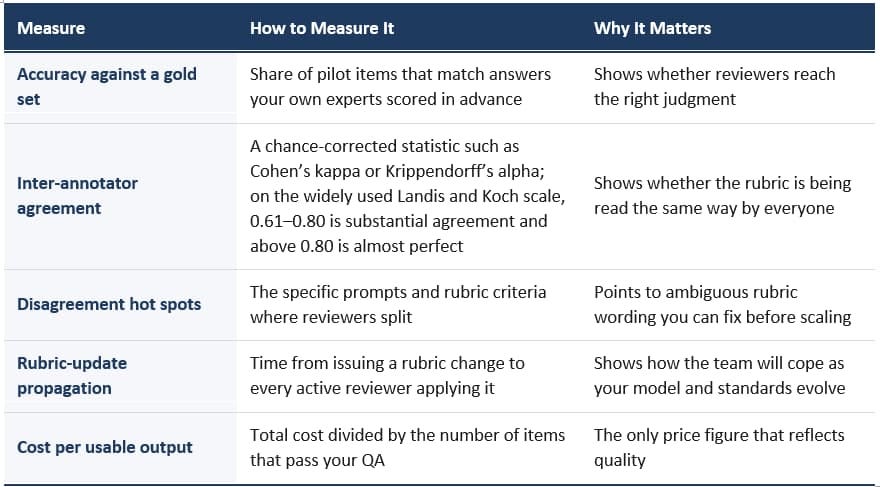
A pilot is only as useful as what it measures. This is the scorecard I recommend agreeing with every shortlisted provider before the first batch is sent:
Table 6. A calibration pilot scorecard
The last measure deserves a worked example, because it is where the lowest quote most often turns out not to be the cheapest. The figures below are illustrative, not market rates:
Table 7. Illustrative example: the lower quote costs more per usable output

When Is AI Training Outsourcing to the Philippines the Wrong Choice?
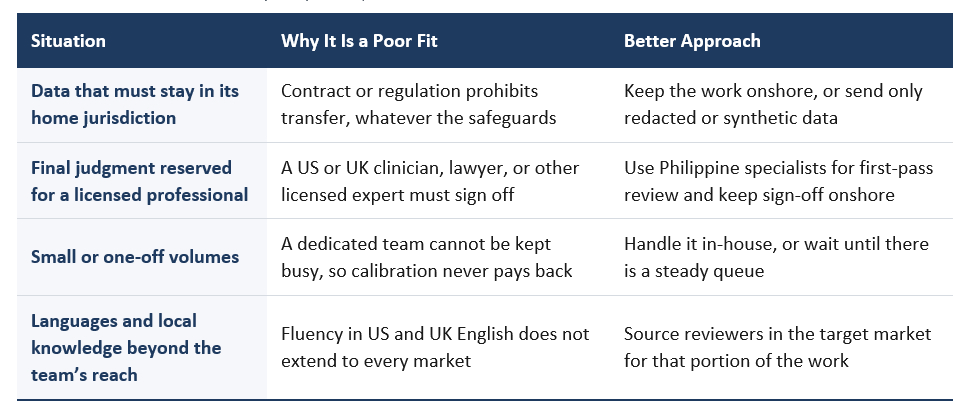
AI training outsourcing to the Philippines is the wrong choice when data cannot leave its home jurisdiction, when a licensed onshore professional must make the final call, when volumes are too small to keep a dedicated team calibrated, or when the work depends on languages and local knowledge outside the team’s reach.
I turn buyers away from offshore delivery more often than people expect. An advisor who never says no is selling, not advising. These are the situations where I recommend a different route:
Table 8. Where offshore delivery is a poor fit, and what to do instead
What Should the First 90 Days Look Like?
The first 90 days should move through four stages: define the standard, shortlist providers, run a scored pilot, then contract and ramp. I recommend giving the pilot the most time, because every later decision rests on what it shows.

Two details matter most in practice. Build the gold set with your own experts before you speak to any provider, so the standard is yours rather than the vendor’s. And settle the transfer mechanism and access controls during the pilot, not after it, so that production data never moves ahead of the paperwork.
How Does PITON-Global Support AI, Robotics, and AV Teams Outsourcing to the Philippines?
PITON-Global supports AI, robotics, and AV teams by providing free outsourcing advisory and supplier sourcing: we help technical buyers define the workload, shortlist vetted Philippine providers matched to their modality, and verify security before budget is committed. The buyer pays nothing for the service and makes the final selection.

The value we add comes from knowing the market at ground level. PITON-Global works with the top 18 AI training companies in the Philippines, which means I can tell a buyer which teams have run LiDAR programs at scale, which have credentialed reviewers for regulated domains, and which are still learning on the client’s time. Over the last two years, that knowledge has helped more than a dozen AI, robotics, and AV companies reach the right shortlist without months of their own discovery work.
Frequently Asked Questions
What is AI training outsourcing to the Philippines?
It is the use of dedicated Philippine teams to perform the human work that AI systems depend on, including data annotation, model evaluation, preference ranking, red teaming, and domain review, under the client’s rubrics and security controls.
How is LLM training outsourcing to the Philippines different from data labeling?
Data labeling applies simple rules to single items at high volume. LLM training work requires reviewers to judge multi-turn reasoning, grounding, and policy compliance against a detailed rubric.
Can UK companies send personal data to providers in the Philippines?
Yes, with a safeguard in place. The Philippines is not covered by UK adequacy regulations, so UK organizations typically rely on the ICO’s International Data Transfer Agreement or the Addendum to the EU standard contractual clauses.
How long does it take to start?
Plan for about 90 days from defining requirements to steady production: two weeks to define the standard, two to shortlist, four for a scored pilot, and four to contract and ramp.
What does PITON-Global charge AI, robotics, and AV companies?
Nothing. PITON-Global’s outsourcing advisory and supplier sourcing services are free for AI, robotics, and AV clients.
The Bottom Line for 2027
Effective sourcing means finding a delivery team that sustains accuracy as models and standards evolve, not chasing the lowest quote. For US and UK AI labs scaling reliable systems in 2027, AI training, including specialized LLM training outsourcing—works best when treated as an extension of evaluation engineering, anchored by clear rubrics and verifiable security controls.
About the Author

Ralf Ellspermann is Chief Strategy Officer at PITON-Global, a business process outsourcing (BPO) advisory firm focused on the Philippines. He has more than 25 years of first-hand, on-the-ground outsourcing experience in the country.
Over the last two years, Ralf and his team have advised and assisted more than a dozen AI, robotics, and autonomous vehicle (AV) companies with their supplier sourcing, working with the top 18 AI training companies in the Philippines. His work focuses on human-in-the-loop quality calibration, outsourcing governance, and helping enterprise technology teams build reliable post-training and operational workflows.
PITON-Global provides its outsourcing advisory and supplier sourcing services free of charge to AI, robotics, and AV clients.