


Solo-founded U.S. startups surged from 23.7% of all new companies in 2019 to 36.3% by mid-2025. The sharpest acceleration coincided precisely with the mainstream adoption of AI coding assistants and agentic tools. That is not a coincidence. It is causation.
The old insistence that you need a co-founder, a seed round, and a dev team just to reach market has collapsed. Today, one determined founder armed with the right AI tools can handle product development, marketing, customer support, and operations — not by grinding harder, but by automating smarter.
This guide breaks down the verified data behind the solo founder surge, profiles the specific tools driving it, and lays out the strategic framework for building a business with AI that actually scales.
The Solo Founder Surge: What the Data Actually Shows
Carta’s newly released Founder Ownership Report 2026 puts the trend in sharp relief: about 36% of startups founded on Carta in full-year 2025 were led by solo founders, up from 31% in 2024. Over the past ten years, the proportion has doubled.
“The share of start-ups with solo founders has steadily climbed from 22.2% in 2015 to a whopping 38% in 2024.” — Carta Solo Founders Report 2025
While solo-led companies represented 30% of startups founded in 2024, they received only 14.7% of cash raised in priced equity rounds that year. That funding gap is quietly closing — because AI tools are making outside capital less necessary in the first place.
The economic footprint of the solopreneur class is significant. U.S. Census Bureau data puts 29.8 million non-employer companies at roughly $1.7 trillion in revenue — about 6.8% of total GDP. In 2024 alone, entrepreneurs filed 5.2 million new business applications, according to Gusto’s 2025 New Business Formation research.
First-year profitability tells the clearest story:
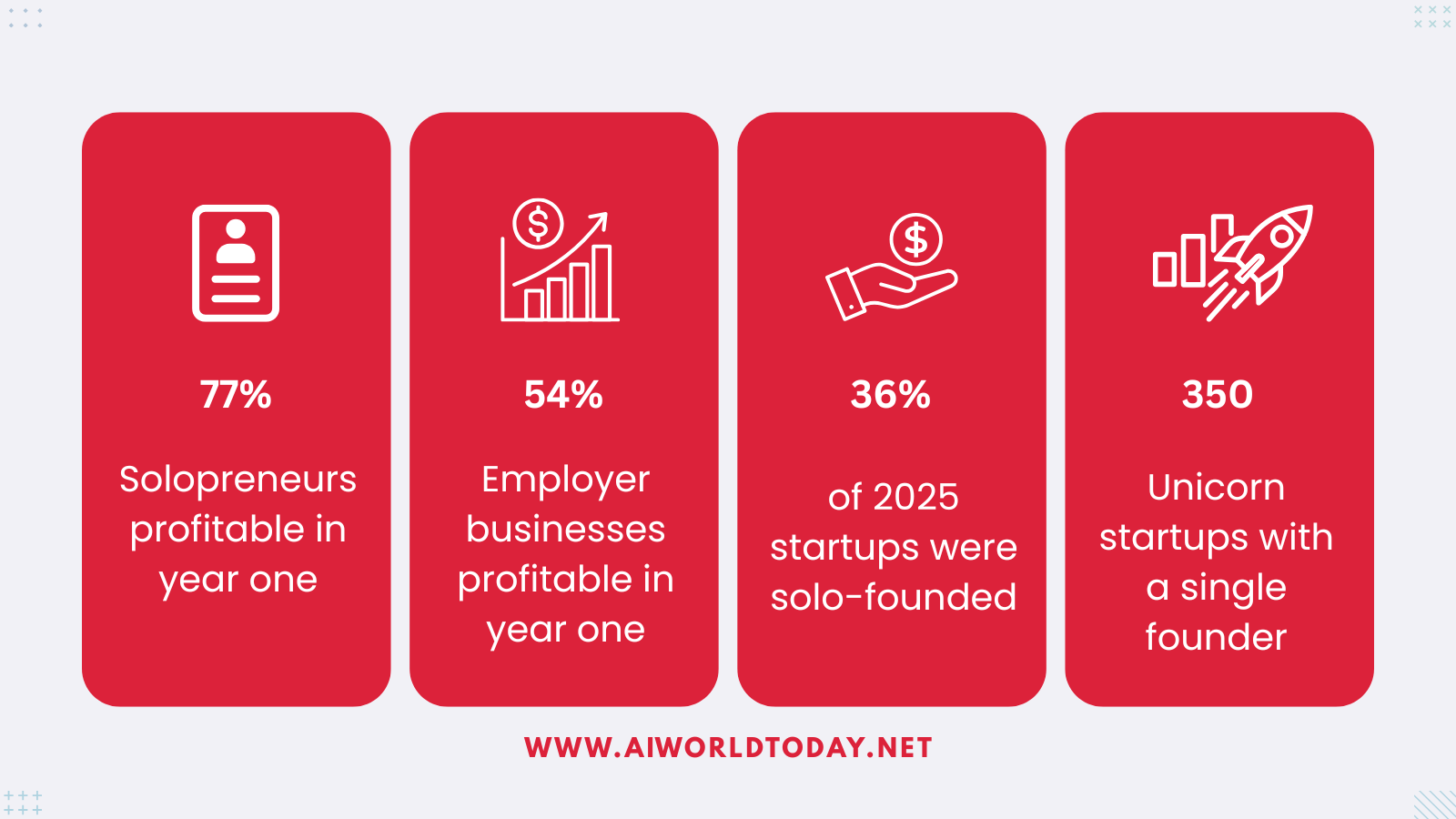
77% Solopreneurs profitable in year one , 54% Employer businesses profitable in year one, 36% Of 2025 startups were solo-founded, 350 Unicorn startups with a single founder
Solo founders also hold substantially more absolute ownership than lead founders in multi-founder companies. By Series B, solo founders hold roughly a 50% larger personal stake — because they split equity with no one. — Carta Founder Ownership Report 2026
AI Tools for Solo Founders: The Complete Stack Breakdown
A complete solopreneur AI tech stack in 2026 runs between $3,000 and $12,000 annually — a 95–98% cost reduction compared to hiring equivalent staff. When founders build this way, operating margins hit 60–80%, compared to 10–20% in traditionally staffed businesses.
Here are the tools that make those numbers real, organized by business function.
⚙️ Building & Development: Ship Code Without a Dev Team
Cursor — $2B ARR as of February 2026, doubling its revenue run rate in just three months . A University of Chicago study found companies merge 39% more pull requests after Cursor became default, with code quality remaining stable. Now used by over half the Fortune 500. Valued at $29.3 billion after a $2.3 billion Series D in November 2025.
Claude Code — Released in February 2025 and made generally available in May 2025 alongside Claude 4. Solo devs use it to scaffold apps, write APIs, generate UI code, and deploy to Vercel or Netlify — all within hours. Claude Code’s run-rate revenue has grown to over $2.5 billion, approaching Cursor’s figure and making it the fastest product ramp in enterprise software history. At QCon San Francisco 2025, Anthropic reported that about 90% of Claude Code’s production code is written by or with Claude Code.
GitHub Copilot — Now operates as an autonomous coding agent, not just a suggestion engine — handling features, bugs, and pull requests. Supports Claude 3 Sonnet and Gemini 2.5 Pro within a single interface. The dominant choice at large enterprises due to Microsoft’s procurement relationships.
Replit — Replit Ghostwriter and Replit Agent have redefined full-stack development for solo founders by integrating AI code assistance directly in the browser: real-time completion, contextual debugging, automated documentation, and entire app generation from a prompt.
Bolt.new, Lovable.dev, v0.dev — For rapid prototyping, these platforms convert natural language prompts or Figma designs directly into working full-stack apps. The go-to for non-technical founders who need a working MVP without writing a single line of code.
Stack Overflow’s 2025 Developer Survey: 84% of developers are using or planning to use AI tools in their workflows. 51% of professional developers use AI daily. The adoption curve is now vertical.
✍️ Content, Copywriting & Marketing: A Full Department on Subscription
ChatGPT — The most versatile daily-driver for email drafts, blog content, customer research, and product positioning. Continues to dominate consumer mindshare globally.
Claude — Anthropic reached $14 billion in annualized revenue by February 2026, up from $1 billion in December 2024 — one of the fastest business ramps in history, driven largely by Claude Code and enterprise deployment. Claude holds approximately 29% of the enterprise AI assistant market. For marketing, it excels at handling long documents, maintaining context across complex tasks, and producing cleaner first drafts that need less editing. Personalized emails written with Claude’s data-integration capabilities generate 139% higher click rates than non-personalized ones.
Jasper AI — Tailored for marketers, with 71 content templates, brand voice controls, and direct SEO platform integrations. Users report a 5x improvement in content creation efficiency and an average 30% increase in copy conversion rates.
Copy.ai — Used by over 500,000 users globally. Focused on creative and engaging copy with 90+ templates for various content types. Simple, powerful, and fast.
Writesonic & Rytr — Writesonic excels at long-form blog content with built-in article structure tools. Rytr is the budget option, supporting over 30 languages — ideal for solopreneurs watching cash flow.
Hoppy Copy — AI-powered email and marketing copywriting tool built specifically for entrepreneurs and marketers. Streamlines high-converting emails, newsletters, ads, and landing page copy.
Clearscope & Blaze — Clearscope analyzes your content against top-ranking pages and provides specific keyword and topic suggestions. Blaze is an AI-powered marketing platform built specifically for solopreneurs and small teams.
⚡ Automation & Workflow: The Connective Tissue
Zapier — The most connected AI orchestration platform, linking over 8,000 apps out-of-the-box. A new lead arrives, triggers a CRM update, fires a welcome email sequence, and sends a Slack alert — all automatically, with no code. AI-related tasks on Zapier have grown over 760% in the last two years.
Make (formerly Integromat) — A visual, more powerful alternative for complex multi-step automations. Drag-and-drop canvas with branching, routers, and error handling. Steeper to learn but significantly cheaper at high task volumes — the natural upgrade path as your stack matures.
n8n — Open-source and self-hostable, with 1,180+ pre-built integrations. Built-in AI nodes for OpenAI, Gemini, and Anthropic/Claude. Can orchestrate multi-step AI workflows using LangChain. Ideal for founders who want maximum control over their data.
Gumloop, Lindy, Pabbly Connect & Activepieces — Gumloop lets non-technical founders add AI layers using ChatGPT, Claude, Gemini, or Grok. Lindy creates custom AI agents for scheduling, emails, and CRM updates. Pabbly Connect offers simple automation with a one-time payment option. Activepieces is a no-code, open-source Zapier alternative.
🎨 Design & Visuals: Look Like You Have a Creative Director
Canva — Canva Magic Studio generated 20 social media posts in 15 minutes in documented tests. The AI suite bridges creativity and speed for founders with no formal design background.
Midjourney — Specialized in highly stylized, high-resolution visuals through text prompts. The go-to for branding, concept art, moodboards, and visual storytelling without a photographer on retainer.
Adobe Firefly — Integrates seamlessly with Creative Cloud and is trained on licensed content — critical for businesses worried about copyright exposure.
Leonardo AI — 150 free tokens daily (roughly 30–50 images), making it the most generous free tier that still produces quality results. Particularly strong for 3D and game design.
Stable Diffusion, DALL-E 3 & Playground AI — Stable Diffusion offers ultimate customization through local installation. DALL-E 3 leads for photorealism. Playground combines AI image generation with a canvas editor closer to Canva than to a pure image generator.
📋 Productivity & Project Management: Stay Organized Under Pressure
Notion AI — All-in-one workspace with a built-in AI assistant that summarizes notes, rewrites content, and helps brainstorm ideas directly inside your workspace. With Notion Calendar, it functions as a true planning hub.
Motion — Automatically re-arranges tasks on your calendar based on priority and schedule. Reschedules missed tasks to your next available timeslot without you touching anything. A genuine force multiplier for solo founders running every function simultaneously.
ClickUp, Asana & Monday.com — ClickUp for tasks, docs, time tracking, and complex workflows. Asana for structured cross-function progress tracking. Monday.com for flexible workflows that scale with clients.
AI Note-Takers: Fireflies, Otter.ai & Fathom — Inexpensive and invaluable. For a solo operator running client calls while managing a product simultaneously, automatic meeting capture and insight extraction is not a luxury. It’s infrastructure.
One Person AI Company in Action: The Case Studies
Theory is one thing. Documented outcomes are another.
Maor Shlomo — Base44 ($80M exit)
In December 2024, Shlomo opened his laptop and started building. No co-founder. No seed round. No team Slack channel. Six months later, Wix acquired his company, Base44, for $80 million in cash. The platform had 250,000 users and was generating $189,000 in monthly profit after covering LLM token costs. Shlomo was on track for an additional $90 million in earn-out payments through 2029.
Danny Postma — HeadshotPro ($300K/month)
Built an AI headshot generator to $300,000 per month in revenue working solo from Bali. His previous AI product, Headlime, sold for $1 million just eight months after launch. These aren’t viral accidents — they are the compounding result of one-person AI company mechanics applied with precision.
Pieter Levels — $3M/year, zero employees
Generates $3 million per year across his projects as a solo founder with no full-time staff — running multiple product businesses simultaneously from his laptop. The blueprint for what a fully optimized AI stack can sustain long-term.
David Holz — Midjourney ($200M ARR, fewer than 15 people)
Built with a skeleton crew of fewer than 15 people, Midjourney reached a reported $200 million in annual revenue and a multi-billion-dollar valuation. Extreme revenue efficiency is achievable even at scale when AI handles operational leverage.
OpenAI CEO Sam Altman has publicly stated his tech CEO group chat has “a betting pool for the first year that there is a one-person billion-dollar company.” Multiple analysts now forecast that milestone arriving between 2026 and 2028. There are already 350 unicorn startups that were founded by a single founder.
Building a Business With AI: The Mindset Behind the Tools
Building a business with AI is not purely a tool selection exercise. It’s a fundamental rewiring of how you allocate your most limited resource — attention.
Traditional startups asked: “What can my team execute?”
The solo founder asks: “What can my stack run while I’m focused on the highest-leverage decision of the week?”
Traditional co-founder roles included technical implementation (now AI-assisted coding), early customer support (now AI chatbots), and operational tasks (now AI automation). The minimum viable team has shrunk to one.
According to QuickBooks’ solopreneurship research, 50% of solopreneurs agree that digital technology — including AI and e-commerce tools — made it possible for them to launch their business. That’s not an adoption metric. That’s a viability statement.
AI for small business automation now covers every function that once required a dedicated hire: support bots handle tier-one queries 24/7, content pipelines publish on scheduled cadences, analytics dashboards refresh automatically, and email sequences trigger on user behavior signals without human input.
The Honest Challenges of Scaling Solo With AI
Scaling solo business with AI is powerful, but it demands honest acknowledgment of the real friction points.
Investor skepticism. While solo-led companies represented 30% of startups founded in 2024, they received only 14.7% of cash raised in priced equity rounds. VCs still fund co-founder pairs at roughly double the rate of solos. Solo founders pursuing outside capital face legitimate scrutiny around execution risk and key-person dependency — scrutiny that AI efficiency alone will not automatically resolve.
Platform risk. When your entire operation runs on third-party AI infrastructure, a single pricing change or service outage can disrupt your business overnight. Data portability, backup processes, and owning your core customer data are non-negotiable disciplines.
Burnout. Even a perfectly optimized AI stack can’t replace the strategic clarity that comes from having a peer to pressure-test your decisions with. Deliberate rest is not a lifestyle preference — it’s a business continuity measure.
Despite those realities, the adoption numbers leave no room for complacency:
68% of U.S. small businesses now use AI regularly — up from 48% in mid-2024 (QuickBooks 2026 survey)
58% of small firms are using generative AI, up from 40% in 2024 (U.S. Chamber of Commerce 2025)
91% of SMBs using AI report revenue increases (Salesforce SMB Trends Report)
83% of growing SMBs have adopted AI vs. 55% of declining businesses (AdAI Research, February 2026)
The small-to-large business AI adoption gap shrank from 1.8x to 1.2x between 2024 and 2025, according to the SBA Office of Advocacy. Small businesses are closing the gap in months — not years. The cost of non-adoption is growing every quarter.
The Near Future Belongs to the Lean Operator
Gartner predicts 40% of enterprise applications will be integrated with task-specific AI agents by the end of 2026, up from less than 5% today. Their best-case projection: agentic AI could drive approximately 30% of enterprise application software revenue by 2035, surpassing $450 billion.
Solo founders building AI-native workflows now will have those systems running, refined, and compounding in value before the majority of the market catches up.
From 2019 to H1 2025, the share of new startups with a solo founder rose from 23.7% to 36.3%. Carta’s 2026 Founder Ownership Report confirms the trend hasn’t slowed — about 36% of all 2025 startups were solo-led, jumping from 31% in 2024.
Scaling solo business with AI is no longer the road less traveled. It’s rapidly becoming the default path.
The founders who treat their AI stack as mission-critical infrastructure today — not a nice-to-have add-on — will hold compounding advantages in speed, cost, and iteration velocity that latecomers will genuinely struggle to close.
The one-person startup is real. The playbook exists in the results of those who went first. Start building.
Frequently Asked Questions
What are the best AI tools for solo founders just getting started?
The highest-ROI starting point combines a strong AI writing assistant (ChatGPT or Jasper), an automation layer (Zapier), and a project management system with AI capabilities (Notion AI or Motion). These three cover content, operations, and productivity — the top time drains for any solo operator. Add Cursor or Claude Code if you’re building software, and Canva’s AI suite for design needs. Start with 2–3 tools that directly impact how you make money or save time every week, then expand from there.
Can a solo founder realistically compete with a funded startup team?
Yes — especially in the early stages. An impressive 52.3% of successful startup exits were achieved by solo founders. Gusto’s research found 77% of solopreneurs were profitable in their first year, compared to 54% of employer businesses. Speed of execution and near-zero overhead are structural advantages that cash-heavy teams often cannot match during early product-market fit discovery.
How much does a full solopreneur AI tech stack actually cost?
Between $3,000 and $12,000 annually — roughly $250–$1,000 per month. That represents a 95–98% cost reduction compared to hiring equivalent staff. When founders build this way, operating margins hit 60–80%, compared to 10–20% in traditionally staffed businesses. Often less than the cost of a single part-time contractor.
What business types are best suited for the one-person AI company model?
Digital products, SaaS, content platforms, and AI-powered services are the strongest fits — high scalability, low marginal cost, and low regulatory friction. Industries requiring physical logistics, heavy regulatory oversight, or mandatory in-person service are considerably harder to run lean at scale.
Is building a business with AI sustainable long-term?
The edge compounds. Gartner predicts 40% of enterprise applications will integrate task-specific AI agents by 2026. Founders who embed AI-native workflows now will hold structural advantages — in data, operational habits, and system velocity — that latecomers cannot replicate quickly. The tools keep improving, costs keep falling, and the operators who started early hold compounding leads.
What are the biggest risks of running a one-person AI company?
Burnout from wearing every hat, platform dependency on AI infrastructure you don’t control, defensibility challenges when competitors can replicate your product easily, and isolation from having no co-founder. Addressing these requires peer communities, data portability across tools, and deliberate recovery built into your operating rhythm — not as a lifestyle choice, but as a business continuity measure.
How does an AI stack specifically enable scaling over time?
It replaces the functions that used to require departments. Content marketing, customer support, financial modeling, design, and software development can now be handled by a single person running the right stack. What once demanded a team of 5–10 people now requires one founder and $500–$1,000 per month in software subscriptions. The stack doesn’t just save time — it structurally compresses overhead while scaling output.
AI tools are genuinely leveling the playing field for solo builders. Great share.