


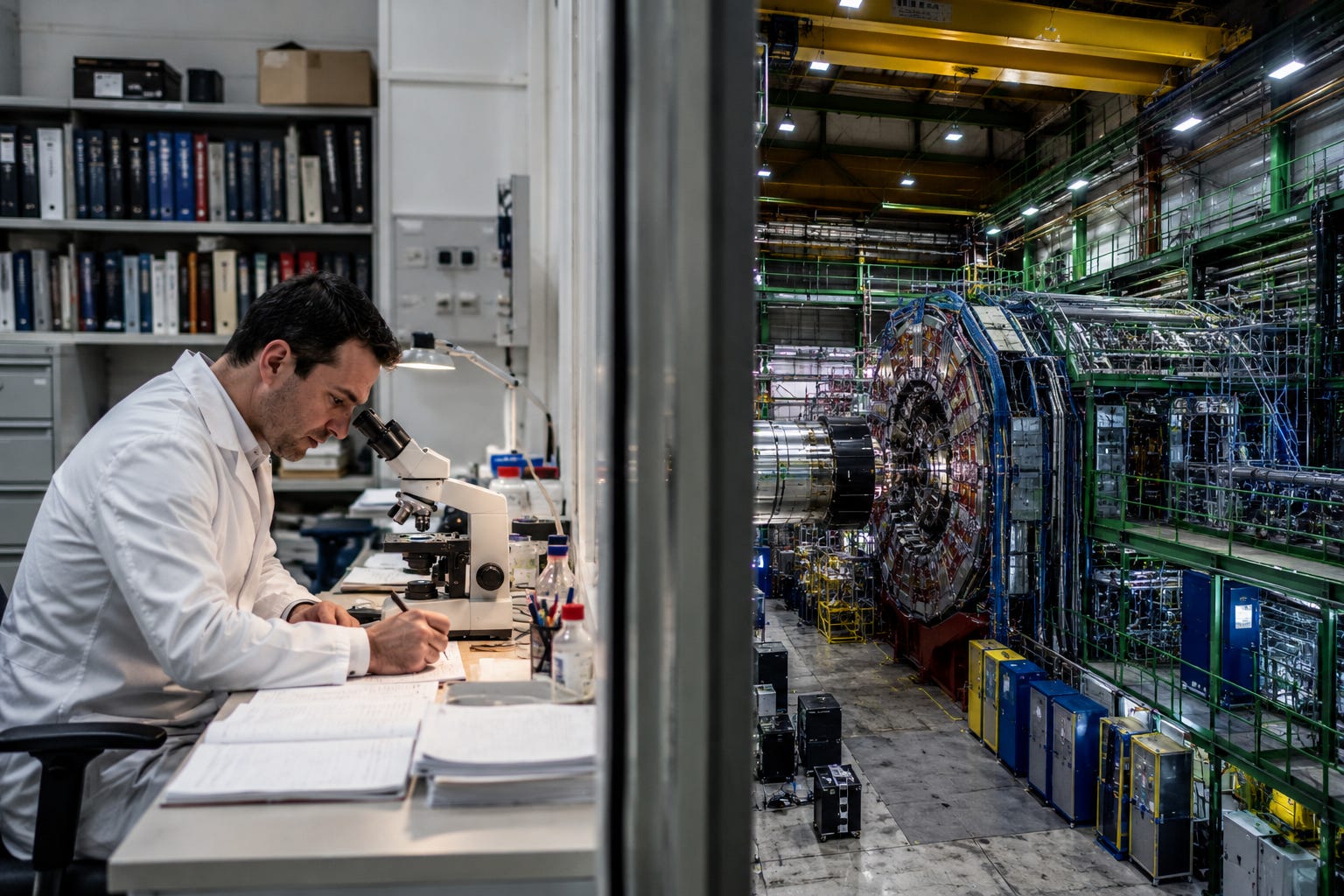
A single US government program aims to double scientific output within ten years by replacing human researchers with AI agents. That ambition has one leading scientist calling it the industrialization of research — and drawing a direct parallel to the factory revolution that transformed manufacturing two centuries ago.
Seventeen national laboratories, billions of dollars in funding, and partnerships with Nvidia and OpenAI: those are the bare bones of the Genesis Mission, a sweeping American scientific initiative launched by executive order in late 2025. The program’s goal is stark and specific — double scientific productivity within a decade by placing artificial intelligence at the center of the entire research process. Not as a calculator or a search tool, but as an autonomous agent that formulates hypotheses, designs experiments, analyzes data, and proposes what to do next. Emmanuel Jeannot, a researcher at France’s national computing institute Inria, has spent considerable time thinking about what that actually means. His conclusion, published in a new essay on arXiv, is both urgent and unsettling.
What the Genesis Mission and programs like it propose is not simply better science done faster. It is, Jeannot argues, the same structural shift that turned skilled craftsmen into factory floor supervisors two hundred years ago — except this time, the thing being automated is not physical labor. It is scientific thought itself. The researcher who once owned every step of an investigation — choosing the question, running the experiment, wrestling with the data, presenting findings to colleagues — becomes instead a supervisor of automated systems whose inner workings exceed any single person’s grasp. Jeannot calls this the industrialization of research, and he means it precisely, not as a metaphor.
His essay does not argue that AI-powered science is a bad idea. The achievements already on the books are too impressive to dismiss. AlphaFold, the AI system developed by Google DeepMind, solved the protein-folding problem that had stymied biology for fifty years — and did it in months rather than decades. Machine learning tools have identified new antibiotics, predicted material properties, and spotted patterns in astronomy datasets that would have kept human researchers occupied for generations. In February 2026, computer science pioneer Donald Knuth publicly described how an AI model solved a combinatorics problem in a few hours that he had been working on for several weeks. A month later, an OpenAI model disproved an eighty-year-old geometry conjecture using mathematical tools that no human researcher had thought to apply to the problem.
These are not publicity stunts. They are documented results, and they matter. But Jeannot argues that celebrating them while ignoring the structural changes that mass AI deployment will bring is exactly the mistake the world made when it rushed into industrialization without counting the costs. The factory produced real and substantial benefits. It also produced environmental destruction, concentrated wealth, erased craftsmanship, and created asymmetries that persist to this day. The industrialization of research, he warns, is following the same script — and the window for making deliberate choices about how it unfolds is closing fast.
The AI Science Revolution: From Tool to Autonomous Agent
There is an important distinction buried inside the phrase “AI for science,” and Jeannot is careful to make it early. Using AI as a specialized instrument — the way AlphaFold predicts protein structures or the way particle detectors at CERN use machine learning to reconstruct collisions — is not what he is writing about. In those cases, human researchers define the problem, set the boundaries, and interpret the results. The AI executes a well-defined task with extraordinary efficiency, but the scientific judgment stays with the human.
The second kind of AI for science is something different altogether. Here, a general-purpose AI system receives an open problem and works through it autonomously — reformulating the question, trying approaches, backtracking, trying again — with minimal human guidance. The Knuth example is instructive. He did not ask the AI to run a specific calculation. He described a problem he was stuck on, and the system explored approximately thirty iterative pathways over a few hours before arriving at a solution. That is not a sophisticated calculator. That is closer to a research collaborator.
The Genesis Mission wants to deploy that second kind of AI across every major domain of American science simultaneously. Energy. Materials. Biotechnology. Nuclear security. Quantum computing. The AI agents in Genesis are designed to run closed-loop automated workflows — meaning the system generates a hypothesis, designs an experiment to test it, collects and analyzes the data, and then uses those results to shape the next hypothesis, all without pausing for human review at each stage. Human scientists supervise and steer, but they do not drive.
Rick Stevens, one of the mission’s principal architects at Argonne National Laboratory, has compared the program’s ambition to the Apollo space program and its urgency to the Manhattan Project. That framing tells you something important about the priorities involved. Apollo and the Manhattan Project were not primarily scientific decisions. They were geopolitical ones. Genesis, Jeannot observes, was designed explicitly to maintain American technological dominance in competition with China — and Japan has since signed on as a partner. The time horizons and priorities of the program are therefore not those of scientists curious about the world. They are those of national security strategists and industrial partners.
That observation sets up the first of seven serious concerns Jeannot raises.
What Happens to the Scientists Who Trained for Decades?
The training of a scientist is a slow, expensive, deeply human process. An undergraduate degree, a graduate program, a doctoral thesis, years of postdoctoral work — by the time a researcher is truly capable of independent science, the institution that trained them has invested enormously in that person. The return on that investment is not just the papers they publish in the near term. It is the living, breathing expertise they carry for thirty or forty years — the intuitions built through hard experience, the sense of which questions are worth asking, the ability to recognize when something doesn’t smell right about a result.
That knowledge is not written down anywhere. A PhD supervisor does not transfer a database of information to a student. The transmission happens through years of shared work — through a kind of apprenticeship that leaves the student equipped not just with facts but with judgment. Jeannot calls this tacit knowledge, and he argues it is precisely the kind of thing that AI systems do not transmit and cannot replace.
If scientific work is increasingly delegated to AI systems, the investment logic changes completely. The primary capital is no longer human — it is machines, infrastructure, and the numerical weights inside trained AI models. Hardware becomes obsolete in three to five years. Models must be retrained as knowledge advances. The pressure to get a return on that investment quickly pushes toward intensive deployment rather than patient cultivation of junior researchers. And when a system is obsolete, it gets discarded. It does not mentor the next generation. It does not sustain an intellectual community. It does not transmit the tacit dimensions of the craft.
The short-term math looks attractive: an AI system can apparently do in hours what a PhD student does in three years. The rational institutional response might therefore be to hire fewer PhD students and deploy more computing power. In the near term, output goes up. In the medium term, the pipeline of trained scientists shrinks. In the long term, the expertise needed to understand, evaluate, and correct the AI systems themselves — which requires deep domain knowledge — starts to erode. The very capacity to check whether the AI is doing good science begins to atrophy, precisely as the systems producing science become more powerful.
AI-Driven Science and the Problem of Theories Nobody Understands
Science does not just produce correct predictions. At its best, it produces understanding — models of the world that human minds can actually grasp, reason about, and argue over. The difference between a prediction and an explanation matters enormously, and Jeannot spends significant time on it.
He uses chess as an analogy. The strongest chess engines in the world — Stockfish, AlphaZero — play at a level no human can approach. But even grandmasters cannot always explain why an engine chooses one move over another in complex positions. The engine’s “reasoning,” if you can call it that, is distributed across millions of numerical parameters in ways that do not map onto the vocabulary of human chess thinking. You trust the move because the engine wins, not because you understand it.
Now apply that to physics, or medicine, or materials science. An AI-generated scientific theory might predict experimental outcomes with extraordinary accuracy while remaining completely opaque to the humans who notionally produced it. We would have science in the practical sense — a powerful tool for solving problems — but we might lose science in the deeper sense: a human-intelligible account of why the world works the way it does.
This matters for reasons beyond philosophy. Human-interpretable theories allow scientists to spot errors, generate new ideas by analogy, explain results to non-specialists, and connect findings across different fields. When theories become opaque, all of those capacities weaken. Worse, we might find ourselves needing AI not just to generate theories but to interpret them — a form of intellectual dependency with no clear exit.
Jeannot acknowledges the standard objection: theories have always been technically complex, and explaining them to a general audience has always required simplification. True enough. But the risk he is describing is different. The worry is not that AI models are hard to interpret (they are, and everyone knows it). The worry is that the theories and conceptual structures those models generate might themselves become inaccessible — correct in the narrow empirical sense, but not grounded in the kind of reasoning that allows scientists to argue about them, extend them, or know when they break down.
Can AI Actually Make Breakthrough Discoveries?
One of the most thought-provoking sections of Jeannot’s essay concerns what he calls the difference between incremental progress and genuine scientific breakthroughs. This is where the case for AI-driven science gets genuinely complicated.
The history of science is punctuated by moments when everything changed: Newton’s laws, Darwin’s theory of natural selection, Maxwell’s equations, Einstein’s relativity, the double helix, plate tectonics. What these discoveries share is that they were not the inevitable output of accumulating more data. They required a conceptual leap — a moment when someone reorganized existing observations under a completely unexpected framework. The data was often already available; what was missing was the insight that transformed it.
Jeannot poses a sharp thought experiment. Give an AI all the scientific data available in 1905 and ask whether it can discover special relativity. Not predict the outcome of a specific experiment. Not find a correlation in a dataset. Actually discover that space and time are not what everyone thought they were — and do so by starting from a dissatisfaction with the internal consistency of existing theory so deep that it requires throwing away deeply held intuitions about the nature of reality.
His assessment is cautious but pointed. Large language models are, at their core, extraordinarily sophisticated pattern-recognition and recombination machines. They can find correlations, generate plausible hypotheses within established frameworks, and optimize known solutions with remarkable skill. What is far less clear is whether they can do what Einstein did: start from a sense that something is fundamentally wrong with the current picture, and arrive at a framework so different that it requires abandoning assumptions the entire field treats as obvious.
Special relativity required abandoning, not recombining, the conceptual framework available at the time. Whether current AI systems can do that remains, as Jeannot puts it, genuinely open — and the evidence so far does not offer strong grounds for confidence.
The practical consequence is significant. AI-driven science will almost certainly produce enormous value through incremental acceleration — exploring design spaces faster, automating tedious data processing, finding patterns human teams would eventually have noticed anyway. But if the systems driving research are optimized to work within existing frameworks rather than challenge them, we might end up with a flood of incremental results precisely at the moment when what science most needs is someone willing to say that the whole framework is wrong.
Who Decides What Gets Researched?
Perhaps the sharpest section of Jeannot’s essay concerns a question that might seem obvious but rarely gets asked directly: who decides what questions AI-driven science pursues?
Science has historically benefited from a quality that is easy to overlook because it has always been there — its research agenda is distributed and messy. Funding agencies and governments exert real pressure, but underneath those forces, thousands of researchers across hundreds of institutions follow their own curiosity, chasing angles no committee has endorsed. The result is a global cognitive ecosystem that is inefficient by many measures but capable of producing surprises no planned system could have anticipated.
Penicillin was not in a roadmap. Neither was the cosmic microwave background radiation, the discovery of prions, or the link between the bacterium H. pylori and stomach ulcers. These findings came from researchers who were, in one sense or another, working on the wrong question at the wrong time.
Genesis challenges that model directly. An infrastructure built around seventeen national laboratories, partnerships with Nvidia and OpenAI, and an explicit geopolitical objective does not emerge from the distributed preferences of the scientific community. It emerges from political and industrial decisions made by a small number of actors with specific interests and specific blind spots.
Jeannot documents one consequence that he calls already visible. Genesis is oriented toward energy, materials, biology, and defense-related physics. Climate science is not among its priorities — and not by accident. The mission was designed under a federal administration that systematically downgraded climate research and reoriented the Department of Energy away from climate-related work. The most powerful scientific infrastructure ever assembled is therefore being deployed with a deliberate gap on one of the most urgent questions facing the planet.
The deeper risk, though, is not this single omission. It is the gravitational logic it represents. Once large-scale AI science infrastructure becomes the dominant mode of producing research, the questions it does not ask become progressively harder to ask — not through prohibition but through economics. Research outside the agenda of a billion-dollar AI pipeline will be slower, less visible, and harder to fund. Priorities shift with administrations, but the physical infrastructure those administrations build persists and constrains what comes after.
AI-Driven Science Is Splitting the Research World in Two
Most discussions of unequal access to AI tools frame the problem as a speed gap: some institutions will move faster, others slower, but everyone heads in the same direction. Jeannot argues this framing misses what is actually happening.
What large-scale AI science initiatives are likely to produce is not a speed differential but a structural split — two forms of scientific practice that become progressively less able to communicate with each other, losing the shared language that makes critical evaluation possible between them.
The asymmetry cuts in both directions, and one of those directions has received almost no attention. Researchers outside advanced AI infrastructure will continue to publish papers. Those papers will be immediately ingested by the systems they cannot access. Large-scale AI science platforms are designed to absorb the entire corpus of published research. Scientists at under-resourced institutions will therefore contribute automatically to the productivity of systems that offer nothing in return.
Their work gets absorbed. Their datasets get used. Their findings train the next generation of AI models — while the scientists themselves remain unable to access, replicate, or even fully read the science those models produce in response. Jeannot calls this epistemic extraction and argues it has no real precedent. Previous resource asymmetries gave wealthier institutions better equipment. They did not involve the systematic harvesting of intellectual output from less-resourced institutions to power the engines of the better-resourced ones.
The downstream effects compound everything else in the essay. Peer review loses its foundation when authors and reviewers no longer work in the same epistemic environment. The logic of a scientific career — build expertise, publish, contribute to a cumulative conversation — breaks down when one side of that conversation operates at a speed and scale the other cannot follow. The danger is not that human-scale science disappears. It is that it loses the ability to critically engage with, challenge, or correct the AI-driven tier — and with that loss, science loses the distributed skepticism that is its only reliable defense against its own errors.
The Peer Review System Is Already Breaking Down
The scientific community has always regulated the quality of its output through peer review — the process by which expert colleagues read, evaluate, and challenge new work before it gets published. The system is slow, prone to bias, and has never fully solved the problem of reproducibility. But it rests on one basic assumption: that there are enough qualified human experts to evaluate the work being produced.
AI-driven science at scale breaks that assumption completely. No community of human reviewers can evaluate ten times the current volume of publications. The obvious response — use AI to review AI-generated papers — simply moves the problem one step back. Who evaluates the AI reviewers? The logical endpoint is a system in which papers are generated by AI, reviewed by AI, accepted or rejected by AI, and cited by AI — a closed loop that looks productive on paper but is increasingly disconnected from any real community of human scientific judgment.
The problem extends to individual researchers as well. Academic careers depend on both quantitative signals — publication counts, citation metrics — and qualitative judgment, which means actually reading someone’s work and asking them to explain and defend it. AI-driven science destabilizes both. Fifty AI-assisted papers a year tells you nothing about scientific quality. And “walk me through how you arrived at this result” becomes genuinely harder to answer when the result was produced by an automated agent the researcher supervised rather than derived themselves.
Hiring committees face a related puzzle, and it cuts in both directions. A scientist who excels at directing large-scale AI workflows may be lost without that infrastructure, or with a different version of it five years from now. A traditionally trained scientist may have skills that simply do not transfer to the new environment. The decisions being made in hiring committees today will shape the scientific workforce for the next thirty years, Jeannot notes — and no one has clear answers to these questions yet.
The Danger of Errors That Feed on Themselves
The final major concern Jeannot raises is perhaps the most technically precise, and in some ways the most alarming. He calls it the compounding error problem.
The scientific method works as a self-correcting system because the agents producing results and the agents checking them are largely independent. Different labs, different equipment, different training, different institutional incentives. Errors in any one pipeline are largely random with respect to errors in others, and when results contradict each other, that tension raises a flag.
A closed-loop AI pipeline breaks that independence at every stage simultaneously. Hypothesis generation, experimental design, data collection, analysis, and validation are all handled by systems sharing the same underlying models, the same training data, the same systematic blind spots. A bias that enters at stage one does not encounter a genuinely independent check at stage three. It encounters a system that already shares its assumptions. The errors do not cancel each other out. They compound silently across the full research cycle.
This is structurally similar to the replication crisis that has troubled psychology and medicine for years — but worse. In those fields, shared methodological assumptions eventually collided with independent replication and with the resistance of reality itself. In a large-scale AI science pipeline, both corrective mechanisms weaken simultaneously. The sheer volume of output makes independent human replication impossible for more than a tiny fraction of results. AI-to-AI replication, if the systems share the same architecture, produces the form of verification without its substance — an echo mistaken for an independent check.
There is a further danger Jeannot calls reingestion. AI systems get retrained as new results accumulate in the scientific literature. A flawed result absorbed into a future model’s training data does not remain an isolated error. It becomes a starting assumption, shaping subsequent hypotheses and experimental designs. The error gets institutionalized rather than corrected. The entire pipeline drifts away from empirical reality with no single step appearing to cause it.
The deepest version of this problem is the most basic: who actually reads the raw output of physical reality? In all science, the ultimate check is not peer review. It is contact with nature — the spectrum that does not match the prediction, the microscope image that contradicts the model, the patient outcome that refuses to cooperate with the theory. The more automated the pipeline becomes, the more mediated that contact gets. In a system optimized above all for speed, the question of who verifies the verifiers is not a technical footnote. It is the central challenge of the whole enterprise, and it has not yet received a satisfactory answer.
What Should Happen Next
Jeannot is careful throughout to avoid the position that AI-driven science should be stopped. The demonstrated achievements are real. The potential is genuine. His argument is that the conditions under which that potential can be responsibly realized have not been thought through carefully enough — and that the window for making those choices deliberately is closing.
He frames several urgent questions that he argues the scientific community and its funders need to answer before the infrastructure is fully built, not after:
How do we preserve the intergenerational transmission of scientific expertise when the economic incentive to train junior researchers is declining? What institutional structures can sustain the mentorship cycle?
How do we evaluate the quality of science — and of scientists — when the volume of AI-assisted output makes quantitative measures meaningless and when the boundary between human and machine contribution is blurred?
How do we ensure that the questions AI-driven science asks remain genuinely distributed, rather than concentrated in the priorities of the handful of institutions wealthy enough to build the infrastructure?
How do we maintain the independence between production and verification that the self-correcting character of science depends on — when both increasingly run on the same systems?
How do we prevent the structural split between AI-powered and human-scale research from becoming permanent, with the less-resourced tier contributing to a productivity it will never benefit from?
The parallel with industrial history offers both a warning and a partial reassurance. The industrial revolution was not stopped, and stopping it would not have been the right response. But its consequences were shaped by the choices made during its deployment — the regulations written, the rights established, the institutions built to manage its disruptions. Those choices took decades and enormous conflict to achieve. The industrialization of research is moving faster than that, and the choices available now may not be available later.
A science that produces more results more quickly but cannot train the next generation of scientists, cannot explain its own findings, cannot evaluate its own quality, and structurally excludes most of the world’s researchers from its benefits is not obviously an improvement on what we have. Getting this right requires not just engineering ambition. It requires an ongoing, serious conversation about what science is actually for — and what we would lose if we optimized it purely for speed and output without asking those questions first.
The research “The Industrialization of Research: On AI-Driven Science and Its Consequences” was authored by Emmanuel Jeannot of Inria